
Explore Religious Heritage Across Europe

Here you can search for a building to visit. You can use the map find destinations, or you can use the filters to search for a building based upon what different criteria.

Refine search

Dorpskerk

Ouderkerk aan den IJssel, NL

Single-nave late Gothic cruciform church with west tower and five-sided closed choir. The church is located inside the dike. Due to the dike raising, it has come to lie lower than the surroundings. In the second half of the 12th century, a tuff church was built here, consisting of a nave and a narrower choir. In the middle of the 14th century, the choir was replaced by a wider, five-sided closed choir with buttresses. After the building was destroyed between 1425 and 1428 during the Hoekse and Kabeljauwse wars, the choir was the first to be rebuilt. The 14th-century foundations were used for this. The nave was then rebuilt. The tuff stone that was still present was reused as wall cladding. At about the same time, construction of the current tower began. Around 1510, the church was enlarged to a cruciform church. The transept arms were built against the existing nave. At the end of the 18th century, the church and tower were extensively restored.
Dorpskerk

Nieuw- en Sint Joosland, NL

In 1991 the church was refurbished. The heating was replaced. The wooden floor was replaced by a stone one and the wooden benches by chairs. In addition, a kitchen was fitted out and the church was made suitable for multifunctional use. Financially, the job was made possible thanks to the willingness to sacrifice of the Nieuwlanders, including people who were not members of our congregation. 36 guilders were raised per inhabitant. In addition, many volunteers helped out, which kept the costs down. The clock faces and hands of the tower were overhauled in the period October/November 1991. In 1994 the civil authorities restored the church tower.

Dorpskerk

Hellendoorn, NL

The building consists of a Romanesque single-aisled nave (12th century) and a late Gothic choir with two side chapels and a sacristy. The nave walls are built of primeval stone up to three-quarters of their height; each has a round-arched gate closed with brick. The vaults, which collapsed in 1747, were re-installed in the choir during the restoration in 1961; the nave has retained a wooden pointed barrel vault. Oak pulpit (18th century).

Dorpskerk

Beetsterzwaag, NL

In the church under the organ gallery hangs the certificate of the union of the Reformed Church and the Reformed Church, September 17, 1997, when the Samen op Weg community Via Pacis - the way of peace - in Beetsterzwaag was called Olterterp. Now the Protestant community Via Pacis. This church is still regularly used for evening services and special services. The community holds the morning services in De Ontmoetingskerk (the former Reformed Church).

Dorpskerk

Nunspeet, NL

Extension in 2001, rear extension.

Dorpskerk

De Bilt, NL

Dutch Reformed Church, 1657. Simple hall building. Tower with wooden crowning, 1839. Organ with main work and upper work, made in 1845 by the brothers HB and GW Lohman. Restored in 1980 by Flentrop Orgelbouw and extended with a free Pedal. Bell frame with clock by C. and J. Seest, 1783, diam. 70.5 cm. A wooden south pointer is placed on the south wall of the church.

Dorpskerk

Peize, NL

Dutch Reformed Church. Originally a 13th century single-nave church, but significantly modified. Inventory: 18th century pulpit, wrought iron baptismal font holder. Originally a single-manual organ made in 1631 by A. Verbeeck for the Pepergasthuiskerk in Groningen. In 1697 it was rebuilt by Arp Schnitger and fitted with a free pedal. The Rugwerk was added in 1757 by AA Hinsz. In 1862 the organ was placed in Peize by P. van Oeckelen. Organ case 1785, instrument AA Hinsz.

Dorpskerk

Poortugaal, NL

Dutch Reformed Church. Late Gothic building, substructure tower (14th century), raised 15th B; choir mid 15th; transept and chapels against the tower 15th B; nave replacing an older one, 16th. Restored ca. 1920-1934. Rectangular choir, three-aisled nave, of which the side aisles have gables with hipped roofs on each bay. Simple brick columns, barrel vaults with tie beams. Inventory: partly late Gothic choir screen, pulpit 1774, lords' pews and text boards (17th), many tombstones. In the southern transept fresco, depicting the Last Judgement, ca. 1500. Organ with main work, upper work and free pedal, made in 1860 by WH Kam (Dordrecht) for the Poor Church (Bethlehemskerk) in The Hague. Purchased in 1977, restored by Fama & Raadgever and placed in Poortugaal. In the church a bell of an anonymous founder, 1525, diam. 116.5 cm.

Dorpskerk

Dorpskerk

Almen, NL

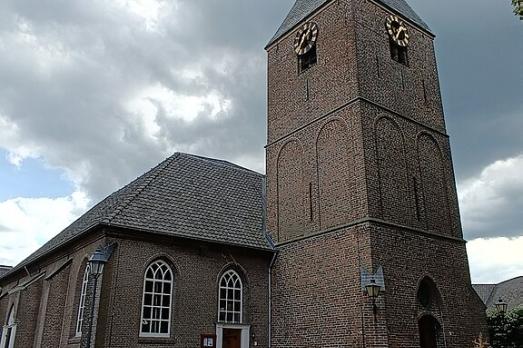
Brick church from the 14th century. The tower was originally separate from the church and is somewhat older. The church has a Romanesque Bentheimer stone baptismal font. Under the choir lie several mummies. Enlarged in 1849, choir built in 1915.

Dorpskerk

Eelde, NL

The village church in Eelde is originally a Roman Catholic church, which was dedicated to St. Gangulphus. In 1598, stadtholder Willem Lodewijk ordered the conversion to the "reformed" religion by means of a "plakkaet". The name Reformed was not officially introduced until 1815 and the church continued to be called the Dutch Reformed Church until 2005. Since October 2005, the village church has been the church building where the Protestant community of Eelde-Paterswolde holds its weekly services. The Protestant community of Eelde-Paterwolde was created in 2005 from the merger between the Reformed community of Eelde and the Reformed Church of Paterswolde. In the single-nave church from the 14th century, tuff stones from an older church have been incorporated, particularly around the entrance. This earlier church stood on the same site and was already built in the 11th century. The church is built east-west and has a rectangular nave of 8.5 x 28 meters. A narrower, three-sided closed choir has been added to the east side. The stone choir vault was replaced by a wooden ceiling at the beginning of the 18th century. The wooden ceiling was painted with an allegorical representation of life and death, joy and mourning. (see photo below) The painting was probably made by Hermannus Collenius (1650-1723) The pulpit in the church dates from 1621. The wooden pews were replaced by chairs during the restoration of 1973. There are still four gentlemen's pews in the church. In the choir is the gentlemen's pew of the Oosterbroek manor house; against the north wall are two gentlemen's pews of the Lemferdinge manor house. It could not be determined to which manor house the fourth pew belonged. Furthermore, there is a wrought iron holder with a copper baptismal font in the church. During the restoration in 2000, the plasterwork in the church was completely removed and a consecration cross was revealed under one of the old layers of plaster. This cross dates from the pre-Reformation period and was restored and conditioned as far as possible. The cross is located on the wall next to the lord's pew opposite the pulpit. Until 1989, the church was equipped with a mechanical tower clock by H. Detgen in Groningen. Made in 1870. The clock was loaned to the Bell Foundry Museum in Heiligerlee in 1989.

Be inspired

Stupkalnis.lt

10 Buddhist stupas to discover in Europe

Stupas are symbols of enlightenment and peace that commemorate different stages of Buddha's life. Since the mid-20th century, thousands of stupas have begun to populate Europe. We have compiled some of the most impressive ones in this list.