Soldiers’ Beit Midrash in Telšiai

The beit midrash on the plot belonging to Moshe Levin near Plungė (today Respublikos) Street, was designed in 1866. The design shows a Neo-Classicist building with a broad eastern prayer hall. The two-storey western façade had a central entrance doorway flanked by two narrow windows. However, the actual building differed from the design: the prayer hall became larger, its eastern wall was pierced by six (rather than four as originally planned) windows. It is hard to establish whether the gable pierced by a central oculus was ever built, or the "beit midrash" was covered with a hipped roof, like the one it has today.

About this building

For more information visit on this building visit http://historicsynagogueseurope.org/browser.php?mode=set&id=9268
Other nearby buildings

Center for Jewish Art

Yeshiva in Telšiai

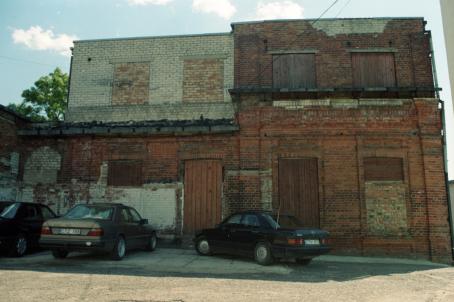
The Telšiai yeshiva is an Ashkenazi synagogue built in 1908 by the architect Yakok I. Ushakov. Its original form is captured on a photograph from the 1920s and also in a postwar picture. Its street façade was pierced with large segment-headed windows on the ground floor, and with smaller round and segment-headed ones in the gable. The façade was decorated with brickwork pilasters, panels, frieze, stringcourses, and finials. According to a memoir by Shmuel Natanovich, the yeshiva occupied a large single-storey building, of about 800 sq m. The building was surrounded by a high fence, and the house of the rabbi was situated within the fenced yard. At the entrance to the building, there was a room for the lessons and a room for the library. In the yeshiva hall, there were three blocks of benches with lecterns, a Torah ark in the eastern wall and a bimah in the center. The brick annex on the northern part was added in the 1930s, as well as probably the upper floor in the western part. The eastern gable and the frieze were destroyed in a fire in 1960; probably, new parts were added afterward. The building was renovated in 1978. In 2004 only some decorations above the windows are still preserved. The windows are blocked with wooden planks. The building belongs to the Jewish Community of Lithuania.

“Synagogues in Lithuania: A Catalogue” Archives

Mechina of the Yeshiva in Telšiai

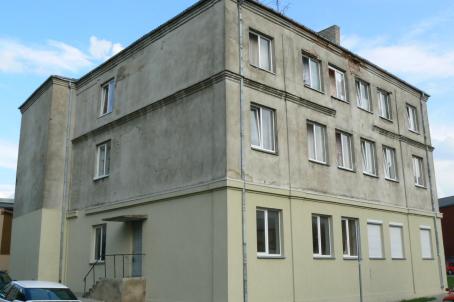
The Mechina building was constructed in 1933-34; two storeys were added in 1937 according to a design by Stanislovas Stulginskis. It was designed as a modernist building, featuring vast plastered, undecorated surfaces. However, its facades were articulated with plain stringcourses and slender pilasters, while a steep roof and a large dormer over the attic space echoed traditional Lithuanian town building. Its main entrance, located on the northwestern façade, was surrounded by modernist multi-faceted windows; the staircase was lit by a vertical strip window. A plaster Star of David was set above the main entrance. The Mechina was a three storey building, which combined a prayer hall on the ground floor, four classrooms on the first floor, and offices on the upper one. The flat ceiling of the prayer hall was supported by four rectangular piers, and the bimah stood in between them. The classrooms were probably used for the teaching of the general subjects, while Torah study took place in the prayer hall. The Torah ark stood at the southeastern wall of the hall. Currently it is a three-storey plastered building, which retains the designed division of the facades with pilasters and stringcourses. Its attic has been converted into a regular additional floor. While fenestration of the southwestern façade has largely survived, that of the northeastern façade has been changed, and its modernist elements as well as the Jewish sign have vanished. All frames of the openings were replaced with modern plastic ones.

Wikimedia Commons

Beržoras Wooden Church

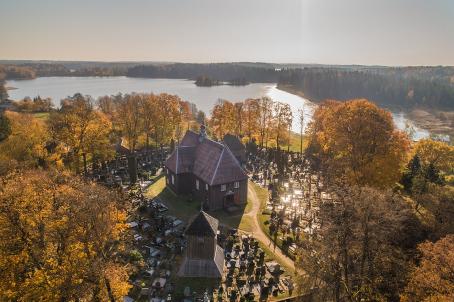
The wooden church of Beržoras (Church of St Stanislas), built in 1746, is one of the oldest wooden buildings of sacral architecture in Lithuania, and the cemetery in which it is located is also one of the oldest in Lithuania. The surrounding wooden chapels of the church, also built in the 18th century, were destroyed in the 20th century but rebuilt recently.