Church of Saint-Nicolas

The church of Saint Nicolas de Cavillon in the Somme is a country stone building with a low bell tower, a sixteenth century Romanesque nave and a chevet dating from 1781. The interior is covered with a vaulted ceiling, wood capped with sanders carved plant and geometric motifs and blochets adorned with human heads. You can find beautiful polychrome wooden statues from the sixteenth century, next to others made of polychrome plaster in the nineteenth century.

About this building

The church of Saint Nicolas is found in the small flowery village of Cavillon, surrounded by fields and woods the Somme. The site of Cavillon has existed since the Gallo-Roman era, as evidenced by the many remains that can still be found in the place called the brickyard.

Dependent on the diocese of Amiens, the church, built in local stone with a low steeple covered with slates, is dedicated to Saint Nicolas.

It has a sixteenth-century Romanesque nave with basket-handle windows and a three-sided chevet with the date 1781. The interior is covered with a ceiling of vaulted wood with sand-tress carved with vegetation and geometric motifs and blochets adorned with human heads.

Decorating the interior are beautiful polychrome wooden statues from the sixteenth century, including a naïve Christ and a statuette of Saint Anthony, as well as others made from polychrome plaster in the nineteenth century. These include a statue of a Bishop (perhaps Saint Nicolas). Above a small side door, a very sober sundial is engraved. International catering sites are organized for young people during the holidays.

Key Features

  • Architecture
  • Monuments

Other nearby buildings

Sauvegarde de l'Art Français

Church of Saint-Arnould

The Saint Arnould church of Bougainville is located in the center of a small town in the Somme. Built from stone in the 16th and 17th centuries, the church is made up of a nave of three spans, flanked by a bell tower on which hangs a turret of stairs, a choir and a sacristy. Partially destroyed during the revolution of 1789, the nave was rebuilt in the 19th century while a chevet was rebuilt in the 20th century. You can admire a wooden virgin and a holy water font.

Wikimedia Commons/Ybroc

Église Saint-Jacques

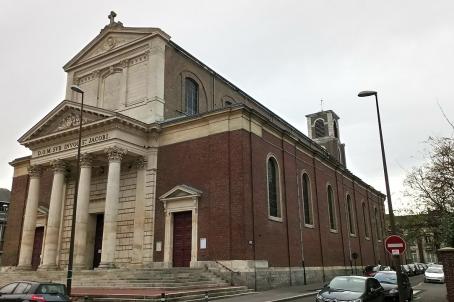
The church of St. James was built from 1837 to 1857 on top of a former medieval church from the mid 15th century which was demolished in 1833. The architect of the new church was François-Auguste Cheussey. During the First World War, the German bombing in 1918 damaged the church and its furnishings, but the church was further devastated during the Second World War and had to be restored afterwards. This task was entrusted to the architect Arduin.

Wikimedia Commons/Raimond Spekking

Église Saint-Germain-l'Écossais

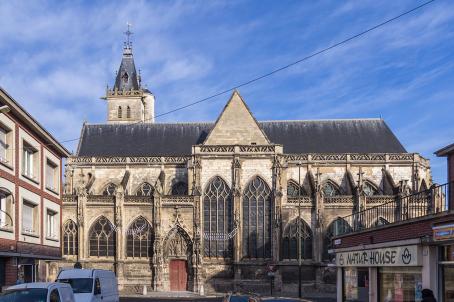
The church of Saint-Germain-l'Écossais is first mentioned in 1131, but the present church was mainly built between 1455 and 1490. From 1855 to 1877, the town's architect, Louis Henry Antoine, carried out a complete restoration of the church. The church was damaged in 1918, at the end of the First World War, by German bombing. It was more seriously damaged during the Second World War, when the German bombardment of 19 May 1940 destroyed the south gable and much of the furniture. The restoration of the building took a long time, from 1957 to 1992.