Gereformeerde Gemeente in Nederland
Rhenen, NL
Hall church from 1953 without a tower. It was designed by AA van Ommen.

Here you can search for a building to visit. You can use the map find destinations, or you can use the filters to search for a building based upon what different criteria.
Rhenen, NL
Hall church from 1953 without a tower. It was designed by AA van Ommen.
Groot-Ammers, NL
Church hall without tower. Saturday, November 4, 1961, the new church building can be taken into use by the Reformed Church in the Netherlands (Groot-Ammers) . This building is located approximately 100 meters from the old church building. The church building is built in bungalow style and contains around 180 seats. It is a happy day for the congregation on April 17, 2007 when the completely renovated and expanded church building can be taken into use. The church building was expanded with 80 seats, bringing the total to 225.
Dordrecht, NL
Modern church building without tower. In 1953, part of the church council of Dordrecht, with a number of members, left the Synodal association of the Reformed Churches. Initially, they attended church in the building 'Truth and Peace' on the Museumstraat. In 1969, they decided to build their own church. The new church building on the Sterrenburg was put into use in 1971, Reformed Church in the Netherlands (Dordrecht) . Until 1971, the Reformed Church in the Netherlands in Dordrecht used the Walloon Church . In August 1971, they took their own church building into use.
Katwijk aan Zee, NL
On January 8, 1966, the foundation stone was laid by elder PA Jongeneel for the new church building on the Louwestraat. The church building was officially put into use on April 28, 1966 during a church service in which Dr. C. Steenblok from Gouda presided as a consultant of the congregation. Dr. Steenblok came to preach once a month. He received f 30 for this, this included travel expenses. The tram stopped right in front of the church building, while the train in Gouda stopped near the rectory, so there was a good connection.
Elst, NL
Modern church with tower. Replaced an earlier church building of the Reformed Church in the Netherlands. Expansion 2005.
Alblasserdam, NL
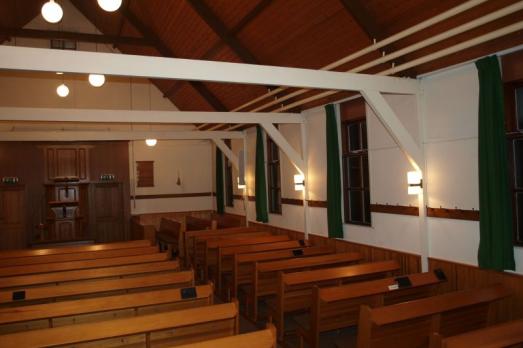
The Gereformeerde Gemeente in Nederland (Reformed Church in the Netherlands) was first built in 1928. However, this building was destroyed during the Second World War. It was rebuilt in 1948 and expanded for the last time in 2003.
Hedel, NL
After the church council decided at the end of 1990 to buy an existing building of the Dutch Reformed Church in Hedel with 125 seats, on May 30, 1991, Rev. W. Verhoeks already presides in the Rehoboth building on Prins Bernhardstraat. In this service he administers the sacrament of Holy Baptism and takes Public Confession. In De Wachter Sions of October 31, 1991, it is reported that the congregation has moved to Prins Bernhardstraat 14
Arnemuiden, NL
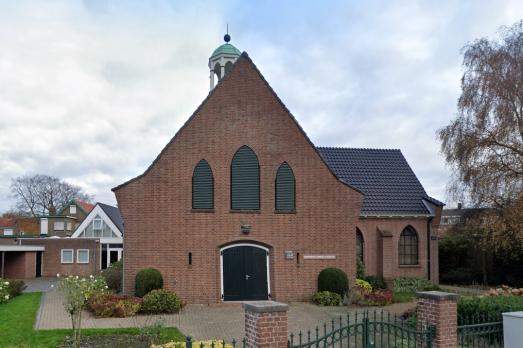
Large, interesting, beautiful reconstruction church in neo-Gothic forms. Until 1953 church of the Reformed Church, then church of the Reformed Church in the Netherlands. Traditionalistic hall church with a domed turret on the roof and pointed arched windows, built in 1950 according to a design by G.J. van Beekum and expanded in 2002 with a two-aisled transverse arm. Internally pointed wooden barrel vaults.
s-Gravendeel, NL
Characteristic hall church without tower. Built as a Reformed Church. The construction of this church cost ƒ 4,830.54. In 1979, the Reformed Church community took the newly built Ontmoetingskerk into use. In the last service of the Reformed Church in this building, the emeritus minister, ds. Visser, presided. After the amen, he said, while closing the pulpit Bible: "We are leaving the old church, but we are taking God's Word with us." He then walked down the pulpit with the pulpit Bible under his arm. The building on Rijkestraat was transferred to the Reformed Church in the Netherlands in 1979. Before that, they had worshipped in the building on Rijkestraat 54 , but that had become too small.
Rhenen, NL
Large modern church with a roof turret.

new
For a long time, Europe was ruled by powerful monarchies. Monarchy and religion have been connected since time immemorial. Here are 7 sites across Europe where royalty historically bent the knee to a higher power and received their crown.

Stupas are symbols of enlightenment and peace that commemorate different stages of Buddha's life. Since the mid-20th century, thousands of stupas have begun to populate Europe. We have compiled some of the most impressive ones in this list.

Walter Maria Förderer (1928–2006) was a Swiss architect and sculptor renowned for his neo-expressionist church designs in the 1960s. In this list we have compiled 6 of his church designs that seamlessly integrate religious and secular elements.

How is Religiana helping to conserve and promote Religious Heritage in Europe and why should you get involved?
Find out about Religiana
Are you a tourism organisation or religious heritage sites manager? Discover the advantages of becoming a partner.
See current partners
We can keep you up to date with the latest news from Religiana and religious heritage conservation across Europe.
Sign up to the FRH newsletter