Great Temple in Târgu Mureş

The Great Temple in Târgu Mureş was built between 1899 and 1900 by Jakob Gartner for a Status quo ante community (Hungarian Jewish that did not join the Neologist organisation or the Orthodox communities). The synagogue underwent many restorations (1910, 1929, 1975, 1983, 2003). The brick synagogue was built in the Neo-Romanesque and Neo-Moorish style.

About this building

For more information visit on this building visit http://historicsynagogueseurope.org/browser.php?mode=set&id=20569
Other nearby buildings

Țetcu Mircea Rareș/Wikimedia Commons

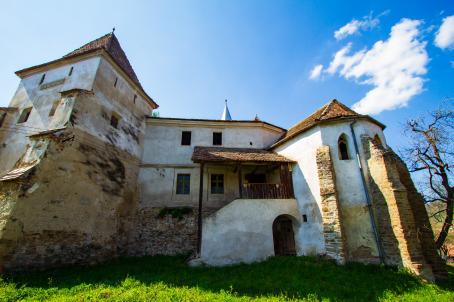
Filitelnic Fortified Church

In the 15th century a Gothic hall church with a bell tower and pointed windows was built. Over the centuries the building went through various repairs and modifications, among which is worthy to mention the renewal of the bell tower’s roof in 1787 and full restoration of the church, of the surrounding wall, the bastion and the portal between 1580 and 1655.
The last repair took place in 1972, when the church and the bell tower were renovated and the fortification wall, the gate tower and the north tower were consolidated. Major damages to the church were already being reported in 1980 and since 1989 on the Sunday service is held in the parish house.
Every year the church showed more and more degradation. The roof of the chancel and then partially the roof of the nave became a ruin. But in 2010 a descendant of former inhabitants (Georg Fritsch jr.) together with the Arcus Association in Târgu Mureş adopted the church and started to successfully repair it. Since 2012 the church has a new roof.

Tudor Seulean/Flickr

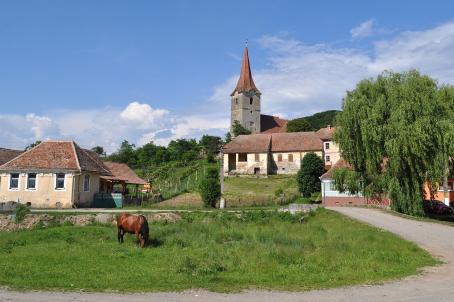
Cund Fortified Church

On the western side of the 15th century hall church a bell tower was erected in 1804. The pilasters of the tower show late Baroque features. From the original fortification wall almost nothing survived to this day, but the fence surrounding the yard of the church marks the initial perimeter. The chancel still preserves its original late Gothic ribbed vault, while the paneled ceiling of the hall was replaced early 20th century by a flat plastered ceiling. The most valuable piece of the interior furniture is the pre-reformation winged altar depicting the Passion of Christ. Today this altar is displayed in Sighişoara inside the Hill Church. In the chancel one can admire the late Gothic pews from 1532.

Raoul Pop/Flickr

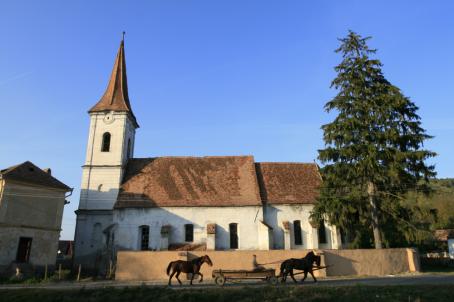
Curciu Fortified Church

The church in Curciu has remained almost unchanged since its construction in the beginning of the 15th century. The remarkable value of the three-aisle basilica with polygonal chancel lies in its outstanding stone masonry. In the chancel the well preserved mullioned windows with tracery can be admired as well as the typical Gothic windows in the tower. The sculptures ornamenting the portals, tower, windows, buttresses, as well as the capitals, keystones, sedilia and the door of the sacristy date back to around 1427. At the beginning of the 19th century the side aisles were heightened, thus obtaining a cross section of a hall church. At the same time both the main nave and the side aisles were covered with a flat, stuccoed ceiling. The tower’s defence level was demolished and replaced in 1913 by the present, with zinc sheet covered spire. Today the ring wall with the gate tower initially used as entrance, as well as a Gothic chapel integrated in this wall still stands as part of the fortified ensemble.