
Huizum Church

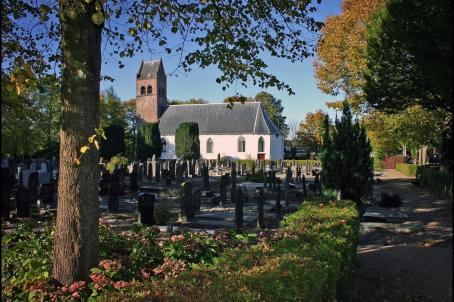
In the south of the capital of Friesland is a real village church: the John the Baptist Church of Huizum. The church has been owned by the Alde Fryske Tsjerken Foundation since 2014. The local commission organizes a range of activities. Due to its special appearance and size (180 seats), the church is also a popular location for commemorations (funerals) and for wedding ceremonies.

About this building

Huizum used to be a separate village. Now the Dorpskerk is exactly in the geographical heart of contemporary Leeuwarden. The church is included in the network of cycle nodes (route 67) and from 2016 via the sloops route over the Wirdumervaart it is also accessible by boat. Free parking is possible on the large car park opposite Intratuin (south side of Tijnjedijk) by following the sign "Huizumer cemetery" on the ring road. Four pointed arch windows can be seen in the south wall of the nave and another two in the five-sided choir closure. Two large pointed arches and two round windows have been installed in the north wall of the nave. On the west side of the north wall is the entrance, which is framed in empire style. The tower dates largely from the thirteenth century. In the sixteenth century, a piece was built on top. In this new section, paired bilge holes are provided. The gables on both sides of the gable roof have climbing pointed arches. There are two bells in the tower, one from 1529 and one from 1582. The Village Church of Huizum was taken over by the Stichting Alde Fryske Tsjerken on November 29, 2013 and managed by the Local Commission. He organizes concerts, lectures and poetry evenings and leases the church for mourning and wedding services and other special gatherings (jubilee family / organizations).
Key Features

  • Architecture
  • Interior features
  • Churchyard

Visitors information

  • Level access throughout
  • Parking within 250m
  • Non-accessible toilets in the building

Other nearby buildings

Placeholder image

Huizum Church

The Dorpskerk Huizum (12th cent.) is the oldest monument of the city of Leeuwarden, has a very valuable interior and is now used for concerts, exhibitions, lectures etc. The great building with old graveyard, bier house etc, was never visited so often as nowadays. Location: Huizum Dorp 67, a 15 minutes walk from the Central Station through a nice 'green blew' area along the beautiful river Potmarge. The old village of Huizum is now surrounded by the town but is still a lovely oasis in the city. See www.dorpskerkhuizum.nl.

Bethel-kerk

The Christian Reformed Church of Leeuwarden was founded at the end of June 1893. On 15 July 1893 a church council was elected, which was confirmed the following day. The first own minister, J. Bos, came in 1895. Until then he had served the congregation in Leeuwarden as an elder/leader. In 1895 the first parsonage was purchased, located at Zuidvliet no. 28, after which the first church was built on a site behind it. This was located at Molenpad no. 15 and was nicknamed "Schipperskerkje", due to the relatively large number of skippers among the congregation members. The total number of members in Leeuwarden was approximately 35, large and small, men and women, baptized members and professing members. At that time there were two other Christian Reformed Churches in Friesland besides the Christian Reformed Church of Leeuwarden, namely in Suawoude and Harlingen. Leeuwarden had a close bond for a long time, especially with the church of Suawoude, which later fell apart in a schism. In 1898, the A-churches (Afscheiding) and the B-churches (Doleantie) united in Leeuwarden. This had resulted in an exodus to the Christian Reformed Church of about 50 people, which meant more than a doubling. The church then grew rapidly, in 1901 there were already 200 members and when Bos left in 1908 there were about 340. On 15 March 1911, a new, more spacious church was put into use, which stood on the Wijbrand de Geeststraat, built by contractor S. Luinstra. This church, called the Bethelkerk, which was equipped with a gallery, received the first pipe organ of the municipality in 1912. Previously, they sang a capella under the direction of the sexton-cantor and then at a harmonium, which was played by two female organists. This is remarkable, since they normally preferred/give preference to male organists.

Opstandingskerk

High, flat-roofed hall church, partly with indirect light. Service rooms added on to one side. Built in 1960 to a design by the architectural firm Nielsen, Spruit and Van der Kuilen. On the gallery an organ with two manuals and free pedal, built in 1966 by Bakker & Timmenga (Leeuwarden).