
Lambertuskerk

The church was founded in 1367 as a chapel and in 1395 as a parish church named after Saint Lambertus. In that year, the Utrecht bishop Frederik van Blankenheim gave permission to the believers in Buren to form an independent parish in the Lambertus church.[1][2] In the 15th century, the church was expanded with side aisles and a new main choir and was given its current appearance. The church has a tower with a superstructure in Renaissance style, which was built by Alessandro Pasqualini and Pieter Post. The church was restored in the period 1973 to 1980. The church tower was restored in 1990. The Bätz organ dates from 1852.[3]
About this building

.

Other nearby buildings

Bic (Wikimedia Commons) [Attribution or CC BY-SA 4.0], via Wikimedia Commons

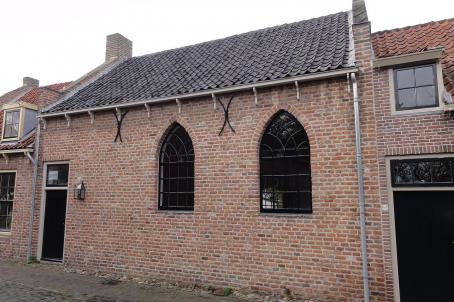
Synagogue in Buren

The synagogue was situated inside an existing private residence in the year 1804. The façade of the modest and rather inconspicuous building features large pointed arched windows which were added during a renovation in 1864. The synagogue continued to be used until 1890 and was subsequently sold in 1901. The Jewish community of Buren merged with Tiel in circa 1906. The building was renovated in 1968 and currently functions as a meeting and exhibition space.

Heilige Gregorius

The Roman Catholic Church of St. Gregory, Rectory and Entrance Gate were built in 1886 to a design by G. te Riele Wzn (1833-1911) in the Neo-Gothic style. G. te Riele worked between 1870 and 1897 mainly in Overijssel and Gelderland, where he built about twenty Neo-Gothic churches. He was the father of Cuypers pupil Wolter te Riele.

Joriskerk

The Dutch Reformed Church consists of a single-aisled nave that was built around 1500. The nave is six bays long and had a single-aisled choir with a three-sided choir closure. The nave has a flat wooden ceiling consisting of mortise and tenon beams. The 15th-century choir was later demolished, except for one bay, and replaced by a consistory room. This was expanded during a restoration of the church between 1979 and 1981. At that time, the consistory was given its current appearance in a historicizing style.