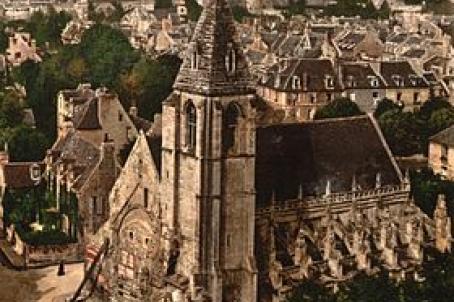
Church of Saint-Samson

The small parish church of Saint-Samson Plumetot in Normandy was built between the twelfth and eighteenth century. In 1944 it suffered damage from the war. It has an enlarged nave on the aisle to the north, extended by a choir with a flat chevet. To the west, a square bell tower, leans against the church. The church has a beautiful stone altarpiece from the end of the reign of Louis XIV.
About this building
The small parish church of Saint-Samson, listed as a Historic Monument, is located in Plumetot, Normandy. The first mention of this parish dates back to 1224, in a room of the chartrier of Abbey Barbery. The church, built between the twelfth and eighteenth century, suffered damage throughout World War 2, especially during the Allied invasion of Normandy. The base of the bell tower, on the covers and the high parts of the nave were heavily damaged, but the church was restored in the 1960s.
The church is composed of a rather low nave, of rectangular plan, widened by an aisle to the north from which it is separated by two arcades resting on a quadrangular pillar. The choir and the adjoining chapel to the North appear to be from the twelfth or fourteenth century. The arches are decorated with escutcheons, indicating the late fifteenth or early sixteenth century. The choir is decorated with a keystone representing an angel wearing the coat of arms of the LEBAS and whose half-deployed wings meet in a circle. To the west, a square bell tower leans against the church. It is covered with a roof of batière in flat tiles. The walls of the church are covered with rubble and flat tile covers.
The church has a beautiful stone altarpiece from the end of the reign of Louis XIV. The twisted columns are loaded with pampers; an urn from which falls of flowers and fruits are hung on the circular cornice. A canvas represents the Burial of Christ, in the style of Jouvenet.