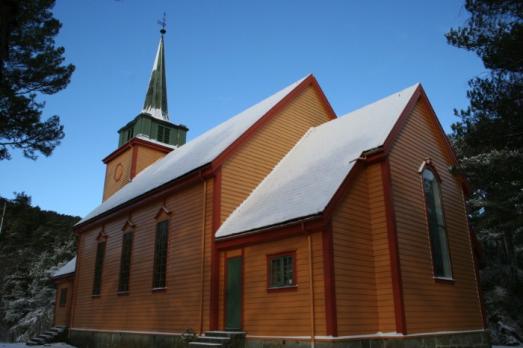
Reksteren Church
Reksteren, NO
Reksteren church is a long church completed in 1937 in Tysnes. The architect of the church is T. Alvsaker.

Here you can search for a building to visit. You can use the map find destinations, or you can use the filters to search for a building based upon what different criteria.
Reksteren, NO
Reksteren church is a long church completed in 1937 in Tysnes. The architect of the church is T. Alvsaker.
Plounéour-Ménez, FR
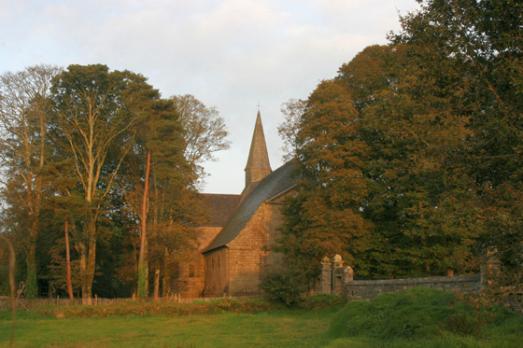
The Cistercian abbey of Le Relec has been for more than 8 centuries an atypical place that you sometimes have to look for and that always gives the visitor who arrives there the feeling of arriving in an oasis, a little apart from the world. Far from the urban centres, sheltered from any human agitation, the Abbaye du Relec has been present on the territory of the Monts d'Arrée since the 12th century. The second Cistercian abbey established in Brittany, it is representative of the Cistercian ideals of that time. Today, the abbey-church of Romanesque origin but modified several times, the remains of the cloister, the ponds, the pavement lined with tall trees, the 18th century fountain and the old gardens surrounded by a deep moat, give the place a dual heritage identity: cultural and natural.
Soest, NL
The home of the liberal religious community is the Rembrandt Chapel, located at Rembrandtlaan 20 in Soest. Four years after the religious community was founded, on 24 September 1925, the chapel was put into use. The chapel was designed by one of the then members, the Soester architect Jan Jacob Meurs. In order to use the building multifunctionally, a stage was built in and it was given the name building for "Religion and Art". In 1950, the chapel was provided with a bell tower. In 1952, the building was expanded and renovated. In order to make the building more widely usable, it was renovated again in 1994 and adapted to the requirements of the time. In addition to the activities of the liberal religious community, the building also accommodates other activities. The building has beautiful acoustics especially suited for chamber music ensembles. The Soesterkring makes frequent use of the chapel for its lectures during the winter months. It is also a grateful rehearsal space for several Soester choirs. The chapel is surrounded by a beautiful garden, which is maintained by its own members. Organ
Steenderen, NL
Reformed Church (St. Remigius). Late Gothic pseudo-basilica with three-aisled nave and western tower. The first two tower sections 14th (?), nave 15th B or 16th A, choir 1440. In 1783 the stone vaults were demolished and the nave and aisles were covered by a roof. The wooden frames in the windows date from 1836. Spire 1783. Clock, cast in 1635 by Henrick ter Horst. Organ with main work and positif, built around 1780, probably by JJ Mitterreither. Purchased in 1971 from the Amsterdam Reformed Church. Restored that year and extended with a free pedal by KB Blank & Zoon. Mechanical tower clock Hms Braakman, Brummen, with inscription: HMS BRAAKMAN BRUMME FECIT 1851 NR. 3.
Hengelo (Gld), NL
Reformed CHURCH (St. Remigius). Late Gothic pseudo-basilica with three-sided closed choir, nave and aisles under one roof and built-in, very monumental tower with string courses and traceried niches. The church is completely covered with cross-ribbed vaults and has pillars between the aisles and the nave. North of the choir the sacristy. Choir ca. 1400, nave and tower XV. Restorations in 1839 and 1955-1960. In the choir frescoes: apostle figures (XV A) and against the eastern wall of the northern aisle: Epiphany and two saints (XVb?). Conserved 1930. Inventory: pulpit (XVII), 21 copper wall chandeliers (XVII). Two-manual mechanical organ with originally an attached pedal, made by J. Proper (Kampen) in 1895. Restored in 1977 by the Hendriksen & Reitsma company. On that occasion extended with a free pedal that is not protected. Bell frame with the sound of two bells, one of which is from an anonymous founder, 1446, diam. 104 cm. and one of P. van Trier, 1612, diam. 138 cm. Mechanical tower clock, has been decommissioned.
Hoogeveen, NL
In the centre of Hoogeveen is the church building of the Remonstrant Congregation. This building is rented by the Dutch Reformed Church of Hoogeveen to hold its services and other activities. The building was put into use in 1894 and offered space for 350 churchgoers. 250 chairs were purchased, for the price of f 1.35 each. The pulpit cost f 78.50. In 1957, a youth building was built behind the church. The church building was restored in 1963. A legacy made it possible for a new heating system to be installed in the 1970s and for the old organ to be replaced by an electronic organ.
Haarlem, NL
Remonstrant church built in 1886-87 to a neo-Renaissance design by A. van der Steur jr., constructed in orange-coloured brick - alternating with 'bacon layers' made of artificial sandstone and other elements such as cordon bands, keystones and spring stones and closed off by a surrounding cornice with triglyphs and consoles - on a cross-shaped plan on the corner of Wilhelminastraat, Prins Hendrikstraat and Oranjekade under a composition of slate saddle and tent roofs in a mesh covering. On the NW corner a round staircase tower with a conical slate spire and on the corners of the transepts on the east and west sides each two arkel turrets changing from four- to eight-sided (together symbolising Jesus and the four Evangelists).
Dordrecht, NL
Built in 1900-1901 to a design by the Dordrecht architect HA Reus in an architectural style related to Rationalism, with influences of Art Nouveau in the special interior. The design for the hall church, made in the context of a closed competition, had as its motto 'Unity in the necessary, Freedom in the uncertain, Love in everything'. The church was built by the contractor J. Kooyman Lz. on a plot of land of the former clothes bleachery 'de Verloren Zoon'. The church is set back slightly, creating a triangular forecourt.
Hengelo, NL
Nice reconstruction church, built as a Remonstrant Church. There is cooperation with the Mennonites, who have not had their own church building since about 1985.
Alkmaar, NL
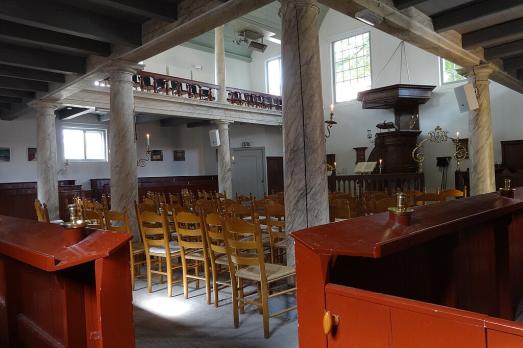
The Remonstrantse Kerk is a historical Remonstrant Church built in 1658.

new
For a long time, Europe was ruled by powerful monarchies. Monarchy and religion have been connected since time immemorial. Here are 7 sites across Europe where royalty historically bent the knee to a higher power and received their crown.

Stupas are symbols of enlightenment and peace that commemorate different stages of Buddha's life. Since the mid-20th century, thousands of stupas have begun to populate Europe. We have compiled some of the most impressive ones in this list.

Walter Maria Förderer (1928–2006) was a Swiss architect and sculptor renowned for his neo-expressionist church designs in the 1960s. In this list we have compiled 6 of his church designs that seamlessly integrate religious and secular elements.

How is Religiana helping to conserve and promote Religious Heritage in Europe and why should you get involved?
Find out about Religiana
Are you a tourism organisation or religious heritage sites manager? Discover the advantages of becoming a partner.
See current partners
We can keep you up to date with the latest news from Religiana and religious heritage conservation across Europe.
Sign up to the FRH newsletter