Heilige Hubertus
Blerick, NL
Current parish church from 1954. Three-aisled basilica without tower.

Here you can search for a building to visit. You can use the map find destinations, or you can use the filters to search for a building based upon what different criteria.
Blerick, NL
Current parish church from 1954. Three-aisled basilica without tower.
Ooij, NL
The Roman Catholic Church of St. Hubertus dates from 1906. The church replaced a water board church from 1835. The church is a three-aisled neo-Gothic pseudo-basilica designed by Caspar Franssen (1860-1932). During the Second World War, the church served as a shelter for residents of Nijmegen, who were left homeless by the bombing of 1944. Shortly afterwards, the church itself suffered damage from shelling. The church was restored after the war. The tower was not built until 1955. In the church is a memorial window from 1948, made by R. Smeets. This church is listed as a Municipal Monument of the Netherlands.
Alem, NL
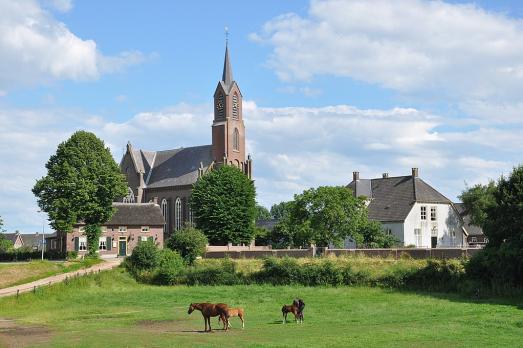
Heilige Hubertus is a Roman Catholic Church built between 1872 and 1875. The façade was rebuilt in 1963. In 2017, the church was closed and sold. However, since 2022 celebrations are held once a month.
Groot Genhout, NL
In 1933 the parish was founded and separated from the parish of Beek. That year the rectory was also built to the design of architect Stephan Dings from Beek. In the period 1936-1937 the church was built to the design of architect Alphons Boosten from Maastricht. The church was designed inspired by the façade of the Romanesque Basilica of Our Lady in Maastricht and was built in a romantic-modernist style. The church is considered one of the most important exponents of the so-called Limburg Reveil, a regional art movement from the Interbellum that often found its inspiration in a self-confident, personal and romantic approach to its own native region. Artists who contributed to the creation of the church building are Henri Jonas, Charles Eyck, Joep Nicolas, Charles Vos, Gisèle Waterschoot van der Gracht, Jacques Verheyen, Jef Scheffers, Yvonne Trypels and Eugène Quanjel.
Rotterdam, NL
The Eendrachtskapel is the oldest Roman Catholic Church in Rotterdam that is still used for Roman Catholic worship. It was built in 1871 and was used until the 1980s as the Chapel of the Most Holy Sacrament, where the Eucharistic Bread, the Body of Christ, was exposed in the monstrance day and night. This Perpetual Adoration was provided by the "Sisters of Perpetual Adoration". This sister congregation has its mother house in Brussels. The large rose windows also feature the symbol for the Host Miracle of Brussels. From this chapel, the adjacent monastery, novitiate and Episcopal Retreat House "Thabor", much charity work has been done within the city of Rotterdam. For example, the "Huize Antonius" on the Nieuwe Binnenweg in Rotterdam (formerly called the Antoniusgesticht) was founded from this chapel. The now internationally known and operating Memisa (Medical Mission Action) also started in this chapel. Its office was located in the old novitiate, which was later replaced by a new building. The novitiate and the monastery had their own chapel, as did the Retreat House. Next to it was the Sacrament Chapel. Of all these buildings and chapels, the former Sacrament Chapel, now called the Eendrachtskapel, is the only one left. When the Rotterdam Cathedral on the Westzeedijk was demolished in 1968, the chapel was elevated to parish church. It was given the patron saints of the cathedral and the Diocese: HH Laurentius and Ignatius (of Loyola). The statue "Maria van de Wijnhaven" also came from the cathedral to the Eendrachtskapel. Originally, the statue stood above the high altar of the Roman Catholic Church of the Wijnhaven, which was demolished in 1926. In order to preserve and honour the Eucharistic character of the Chapel, following the example of the Perpetual Adoration, which was discontinued with the departure of the sisters in the 1980s, the Blessed Sacrament of Christ's Body is displayed in the Monstrance. The Holy Eucharist, the Mass, is then celebrated. In this way, the Eendrachtskapel has retained its function as a chapel of silence to this day. An oasis of peace and prayer in the hectic and business centre of the world city of Rotterdam. The maintenance of the chapel requires constant attention. A selection of the work carried out in 2016-2017:
Heibloem, NL
The residents of Heibloem and the surrounding area traditionally attended services in the Broederskerk of the monastery in the village. When the monastery was requisitioned by the German occupiers in 1940, the Masses had to be celebrated in a beugelbaan. After the Second World War, the Brothers had plans to expand their boarding school, and a rectory was established to provide for the construction of their own church building and village school. Pierre Weegels was asked to be the architect. He designed a church that resembles the Sint-Isidoruskerk in Haler. However, only the nave was built. The church was consecrated in 1952.
Sint Isidorushoeve, NL
New parish and hamlet St. Isidorushoeve, founded in the 1920s. Village and church bear the name St. Isidorus, patron saint of the rural population. The church is an early work by Joh. Sluijmer from Enschede. It is a cruciform church on a strongly centralizing ground plan, built according to the concept of the people's church, in traditionalist forms with references to the Gothic. The front tower is crowned by a high, incurved spire.
Haler, NL
Church with a belltower.
Enschede, NL
The current St. Jacobus de Meerderekerk was built in 1932-'33 to replace the previous church from 1862 , which was demolished due to dilapidation. The church is designed as a central building with a dome, according to the guidelines of the so-called liturgical movement (improved visibility of the altar), on a so-called Christocentric floor plan (choir at the intersection of nave and transept). The church is considered a highlight in the oeuvre of Hendrik W. Valk (1886-1973) and is one of the most important Roman Catholic church buildings built in the first half of the twentieth century. Stylistically, there is a transition to a more traditionalist building style, in this case strongly influenced by oriental and Byzantine forms. The monumental inventory was created shortly after construction (including windows and Stations of the Cross by Ch. Eyck and J. ten Horn; altars from Brom and Nicolas studios). See the description below from the Cultural Heritage Agency of the Netherlands and images.
Bocholtz, NL
The church was built in the years 1869-1873 to a design by PJH Cuypers. In 1953 H. Koene expanded the church on the choir side with a very spacious, new choir and second transept. During this expansion a new parsonage was also built to the north of the church. There they found foundations of a single-nave building with a narrower, straight-closed choir and around it foundations of a larger building from the late Middle Ages.

new
For a long time, Europe was ruled by powerful monarchies. Monarchy and religion have been connected since time immemorial. Here are 7 sites across Europe where royalty historically bent the knee to a higher power and received their crown.

Stupas are symbols of enlightenment and peace that commemorate different stages of Buddha's life. Since the mid-20th century, thousands of stupas have begun to populate Europe. We have compiled some of the most impressive ones in this list.

Walter Maria Förderer (1928–2006) was a Swiss architect and sculptor renowned for his neo-expressionist church designs in the 1960s. In this list we have compiled 6 of his church designs that seamlessly integrate religious and secular elements.

How is Religiana helping to conserve and promote Religious Heritage in Europe and why should you get involved?
Find out about Religiana
Are you a tourism organisation or religious heritage sites manager? Discover the advantages of becoming a partner.
See current partners
We can keep you up to date with the latest news from Religiana and religious heritage conservation across Europe.
Sign up to the FRH newsletter