
Explore Religious Heritage Across Europe

Here you can search for a building to visit. You can use the map find destinations, or you can use the filters to search for a building based upon what different criteria.

Refine search

Hervormde Kerk

Dodewaard, NL

In a study conducted by the National Bureau for Archaeological Heritage Research, it was established that the church was built around 1050. In a deed from 1188, the parish of Dodewaard is mentioned for the first time among the goods of the Count of Dalen. In a letter from 1316, a parish church is mentioned, in which a valuable cross was said to have been located, which already enjoyed a certain fame at the time and was transferred to the collegiate church of St. Walburg in Arnhem because of the "unsafe" in Dodewaard. In this letter from 1316 by Reinald I of Gelre, Dodewaard, which had to give up its relic cross to Arnhem, is called an unsafe and unpopulated place. However, the tendency of this letter justifies doubt about the correctness of this mention. Reinald was looking for a reason to donate the cross to the newly established church in Arnhem, which he had endowed. The church of Dodewaard appears on a list of churches from 1395. In the confirmation of a donation on 16 October 1410, "the parishes of Dodewerde and Hyen" were mentioned. In 1613, the first minister, Hermannus van Broekhutzen, was confirmed "in the church service of Hien and Doyweert".
Hervormde Kerk

Haastrecht, NL

Reformed Church. Late Gothic wooden-arched CROSS CHURCH, of which only the short nave, the transept and the tower remain. The side aisle bays have gables. Tower hull XIII B in early Gothic forms, Renaissance superstructure restored after fire damage in 1896; tower again approx. 1960. Interior: two copper crowns (XVII). Organ with Hoofdwerk and Bovenwerk, made in 1847 by L. van Dam and Sons for the Reformed Church in Bovenkarspel. Transferred to Haastrecht in 1968.

Hervormde Kerk

Maasdam, NL

Charming, eclectic village church with tower. Built to replace its demolished predecessor .

Hervormde Kerk

Hichtum, NL

Reformed Church. With its west side on the Zeilvaart on a mound, an early 13th century church building with a tower from the 16th century. Inside, behind the pulpit, a large 17th century epitaph; carved gravestone 1626. Single-manual organ, with Louis XVI case by organ builder A. van Gruisen, 1795. Bell tower with the sound of two bells, one by H. Falck, 1617, diam. 106 cm. and a modern clock. Mechanical wrought iron tower clock, 17th century, later fitted with electric winding.

Hervormde Kerk

Hervormde Kerk

2e Exloërmond, NL

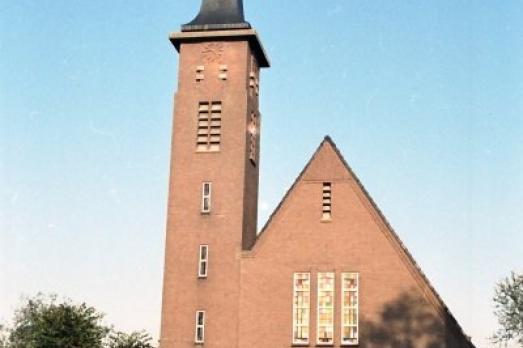
The Hervormde Kerk is a Protestant place of worship dating from 1939. Since 2002, after the Reformed Church was decommissioned in each location, it has been used as the central church of the Protestant Church in the Netherlands (PKN) in Exloërmond. The church organ was built in 1976 by the firm Gebr. Reil (Heerde).

Hervormde Kerk

Drimmelen, NL

Dutch Reformed Church. Founded in 1792 by Jonkvrouw van Doorn, Lady of Drimmelen (commemorated in a stone above the entrance, with coat of arms), to replace the church in Oud-Drimmelen. Hall church, closed on three sides at the short ends; arched windows; high slate roof with roof turret. Internal wooden wall pilasters and wooden barrel vault with two rosettes with mermaids. Adjoining parsonage from the time of construction. Iron entrance gate between two bluestone pillars also from the time of construction. 18th century copper lecterns and baptismal font holder. Restored in 1965.

Hervormde Kerk

s-Gravenmoer, NL

Dutch Reformed Church. Since changes after destruction by the French in 1672 consisting of a three-sided closed choir of two bays, from the 15th century, two low, 15th century, shortened in the 19th century, transepts, a 15th century nave of five bays, enlarged around 1500 with a north aisle and a built-in 14th century tower with buttresses on the west side, an arched frieze under the spire and a vault over the lower space. Internal columns with molding capitals and wooden barrel vaults. Restoration completed in 1963. Oak pulpit, baptismal fence and associated copper work from 1680, replaced. 17th and 18th century tombstones. Mechanical wrought iron tower clock by Juriaan van Zutphen, 1695, electric winding.

Hervormde Kerk

Puttershoek, NL

Dutch Reformed Church. Hall church (1839), of which the eastern facade has an entablature with triglyphs and metopes and a cornice. Hipped roof. Round arched windows. Plastered tower (15th?), provided with a wooden superstructure after a fire in 1889. Inventory: Pulpit and lord's pew (18th). Organ with main work and secondary work, made in 1858 by CGF Witte. During the restoration by Flentrop in 1989, a free pedal was added.

Hervormde Kerk

Eethen, NL

Dutch Reformed Church, consisting of a three-sided closed choir of brick with tuff stone bands and buttresses, from the second half of the 15th century; a lower Romanesque nave from the 12th century, made of tuff stone, with small windows in round arch fields separated by wall dams, enlarged to the west in the 13th century with a brick bay, and a simple flat tower from the end of the 14th century, raised with a section in the 15th century and crowned by a spire constricted from four to the back.

Hervormde Kerk

Sint Philipsland, NL

NH Church. A small hall church dating from 1668 on an elongated octagonal floor plan. Tie beams with pear bead key pieces, applied secondarily, origin unknown. Pulpit from the construction period. Canopy benches on either side of the pulpit. Externally, the wall surfaces are divided by simple pilasters; the slate and saddle roof is crowned by an open roof turret with clock and bell. Mechanical tower clock, Gebr. van Bergen, equipped with electric winding.

Be inspired

Stupkalnis.lt

10 Buddhist stupas to discover in Europe

Stupas are symbols of enlightenment and peace that commemorate different stages of Buddha's life. Since the mid-20th century, thousands of stupas have begun to populate Europe. We have compiled some of the most impressive ones in this list.