Kruiskerk
Diever, NL
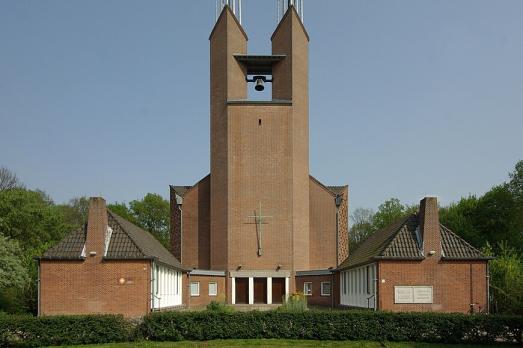
Modern church with an interesting roof turret, which comes from the earlier, demolished Reformed Church.

Here you can search for a building to visit. You can use the map find destinations, or you can use the filters to search for a building based upon what different criteria.
Diever, NL
Modern church with an interesting roof turret, which comes from the earlier, demolished Reformed Church.
Daarlerveen, NL
Built as a Reformed Church. Characteristic church building with crossing tower. In 1945 Reformed Church Liberated. Renovated in 1985. Restored and refurbished and put back into use on Saturday 30 September 2006. (57-07) After merger in 2023 NGK
Dordrecht, NL
Built as a church of the Free Evangelical Church in 1936. As such it fell out of use in 1976 and was taken over by the Baptist Church.
Huizen, NL
Built as the Reformed Church of Huizen. Well-maintained modern church with tower. Now one of the three churches of the Protestant Community of Huizen. The other two churches of this community are the Goede Herderkerk and the Oosterlichtkerk.
Meppel, NL
Architecturally interesting reconstruction church, because of the centralizing floor plan in the form of an irregular octagon. Remarkably late work in the oeuvre of BW Plooij. Built as the second Reformed Church of Meppel, after the older Reformed Church on the Groenmarkstraat, which was then called the "Oude Kerk". In 1994 it fell out of use as a Reformed Church ("Synodal") and was sold to the Reformed Church Liberated. This church gave the building the name Kruiskerk. This church is listed as a Municipal Monument of the Netherlands.
Berlikum, NL
In the sixties, the current church was built to a design by architect G. Steen from 1960. The new construction took place on the grounds of the old school. The work was carried out by construction company H. Westra from Franeker. The building was finally completed in 1966 under the architecture of the architectural firm Steen en Tuinhof. An illuminated cross was placed on the tower. On 31 January 1969, the renovated organ was put into use. In 1969-70, a new rectory was also built. In 1972, the building of the nursery school next to the church and the associated grounds were purchased. A parking lot was constructed on the grounds, while the building itself was rented to a music association. This situation still exists today. In 1986, major maintenance was carried out on both the church and the rectory. The remarkable elevator in the building, which connects the meeting rooms and canteen downstairs with the church hall upstairs, was installed at the end of the eighties.
Amstelveen, NL
The Kruiskerk in Amstelveen , located at Van der Veerelaan 30a, was designed by architect Ir. Marius Duintjer . The church was built in 1949 - 1950 by order of the Reformed Church and put into use on 11 May 1951.
Eerbeek, NL
Late neo-Gothic church with tower. This church replaced a neo-church from 1859 that had become too small, the "Oude Kerk" (Old Church) that was demolished in 1930. The original name of this interbellum church with tower was "Dorpskerk". Later, probably in the context of "Samen op Weg", the church name was changed to "Kruiskerk".
Marum, NL
The Kruiskerk is a church of the Protestant Community of Marum built in 1926.
Heerde, NL
Interesting interbellum church, designed by the famous architect FB Jantzen. Renovated and expanded in 1985.

new
For a long time, Europe was ruled by powerful monarchies. Monarchy and religion have been connected since time immemorial. Here are 7 sites across Europe where royalty historically bent the knee to a higher power and received their crown.

Stupas are symbols of enlightenment and peace that commemorate different stages of Buddha's life. Since the mid-20th century, thousands of stupas have begun to populate Europe. We have compiled some of the most impressive ones in this list.

Walter Maria Förderer (1928–2006) was a Swiss architect and sculptor renowned for his neo-expressionist church designs in the 1960s. In this list we have compiled 6 of his church designs that seamlessly integrate religious and secular elements.

How is Religiana helping to conserve and promote Religious Heritage in Europe and why should you get involved?
Find out about Religiana
Are you a tourism organisation or religious heritage sites manager? Discover the advantages of becoming a partner.
See current partners
We can keep you up to date with the latest news from Religiana and religious heritage conservation across Europe.
Sign up to the FRH newsletter