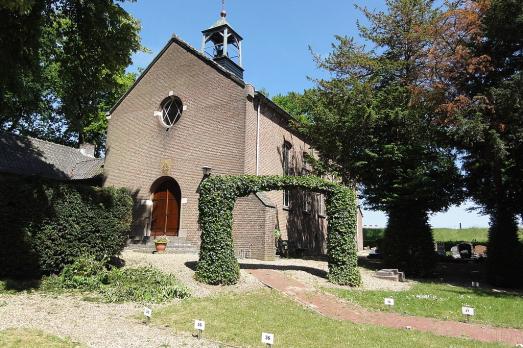
Protestantse Kerk
Angeren, NL
Small reconstruction church, built to replace a church destroyed during the war.

Here you can search for a building to visit. You can use the map find destinations, or you can use the filters to search for a building based upon what different criteria.
Angeren, NL
Small reconstruction church, built to replace a church destroyed during the war.
Noardburgum, NL
When the Protestant Church of Noardburgum was formed, it was decided to continue using the Dutch Reformed Church as a Protestant church and to sell off the Protestant Church. This church is listed as a National Monument of the Netherlands.
Schildwolde, NL
In 1686 probably built on older foundations five-sided closed church building. In the church pulpit with twisted columns along the tub; coat rack board, stairs and sounding board, all from 1666. A covered and a non-canopied lord's pew with carved friezes and attachments, both around 1666. All pews with knobs, on the pulpit side remains of baptismal fence with spindle frieze. Many gravestones 17th-19th century. Freestanding 13th century tower with brick spire rising above gables with climbing arch friezes. Mechanical tower clock, "Concordia", WJ Koek, Midwolda. Mechanical wrought iron tower clock 1598, in 1702 by R. Symons provided with a pendulum mechanism. Restored in 1908. Decommissioned. Organ made in 1868 by R. Meijer.
Oisterwijk, NL
The original parish church (Petrus' Banden) of Oisterwijk is returned to the Roman Catholics during the reign of King Lodewijk Napoleon. For an amount of ƒ 7,000, a new church for the Reformed (later Protestant) will be built. Mr. Hubert is given and accepts the assignment to design the drawings of the new church and to draw up the associated specifications, cost estimates, etc. This church is listed as a National Monument of the Netherlands.
Schraard, NL
Single-nave, predominantly yellow brick (various sizes), slate-roofed CHURCH BUILDING with semi-circular closed choir and unarticulated saddle roof tower. The 12th-century Romanesque tower was raised in the 13th century during the construction of the Romanesque church. The top of the tower was renewed, possibly in the 18th century. Deep-set round-arched and pointed-arched windows with glazing bars. Access on the south side under a pointed arch. The nave is covered by a wooden barrel vault, possibly from after a fire in 1524. The inventory includes a pulpit from 1633, a baptismal fence and several pews with balls on the corners and cheeks with heads in early Renaissance style (ca. 1560). Furthermore, some tombstones and a funeral board. In the tower a belfry with a bell by W. Wegewaert, 1603, diameter 81 cm.
Maarsbergen, NL
Reformed church in Maarsbergen, built in 1883-1884 by order of Geertruida Adriana du Bois, widow of CJ Blok. The church is said to have been built in response to the wishes of her brother, Aalt du Bois. The Du Bois family lived in Maarsbergen Castle and had the church built on their own land. The hall church, built in eclectic style, was designed by architects FW van Gendt and AR Freem. The Renaissance features that can also be seen in the Amsterdam Zuider- and Westerkerk can be seen, particularly in the tower and the buttresses. In 1934, the tower was built on the initiative of the Commission for the commemoration of the 50th anniversary, based on plans by architect J. Pothoven. This tower with an open imperial crown replaced a small facade crowning. This original crowning is indicated on the design drawings of the Maarsbergen church. The front and rear facades originally had a simple articulated crowning. On the front facade a bell was placed under a canopy, on the back facade a spherical crowning. The interior has been preserved intact. The organ is protected by the state. A meeting room was built against the back facade of the church, which is not protected. The north facade of this building dates from the 19th century. Originally the building served as a school building.
Kolham, NL
Reformed Church on churchyard. Small church built in 1640, closed on three sides on the east side and provided with a roof turret above the west facade that was renovated in 1808. A bell from 1808 once hung in the roof turret. This was stolen during the Second World War by order of the occupier.
Moerdijk, NL
Dutch Reformed Church. Simple hall building from 1815. Bell tower with clock by Bakker and Pootman, diam. 45 cm. The first Reformed Church, on the Zwaluwsedijk, was destroyed during the war in 1944. A new Reformed Church was built on the Grintweg in 1953, based on a design by C. van der Bom. After the formation of the PKN community, the last service was held in that church on 21 August 2005. This church is listed as a National Monument of the Netherlands.
Lent, NL
Tower of the Reformed Church because of a bell frame with a bell by M. Fremy, 1683, diam. 73 cm.
Nijega, NL
The Dutch Reformed Church of Nijega is originally a medieval hall church, dedicated to St. Agatha. After a major renovation in 1893 by municipal architect DD Duursma, the church was given its current appearance. The bell tower was also built in that year. The two bells in it came from the belfry, which stood in the churchyard. The year 1381 is mentioned on the oldest preserved bell. A bell from 1793 was removed by the Germans during WWII and replaced in 1957. The entrance gates decorated with cast iron death symbols also date from 1893.

new
For a long time, Europe was ruled by powerful monarchies. Monarchy and religion have been connected since time immemorial. Here are 7 sites across Europe where royalty historically bent the knee to a higher power and received their crown.

Stupas are symbols of enlightenment and peace that commemorate different stages of Buddha's life. Since the mid-20th century, thousands of stupas have begun to populate Europe. We have compiled some of the most impressive ones in this list.

Walter Maria Förderer (1928–2006) was a Swiss architect and sculptor renowned for his neo-expressionist church designs in the 1960s. In this list we have compiled 6 of his church designs that seamlessly integrate religious and secular elements.

How is Religiana helping to conserve and promote Religious Heritage in Europe and why should you get involved?
Find out about Religiana
Are you a tourism organisation or religious heritage sites manager? Discover the advantages of becoming a partner.
See current partners
We can keep you up to date with the latest news from Religiana and religious heritage conservation across Europe.
Sign up to the FRH newsletter