
Explore Religious Heritage Across Europe

Here you can search for a building to visit. You can use the map find destinations, or you can use the filters to search for a building based upon what different criteria.

Refine search

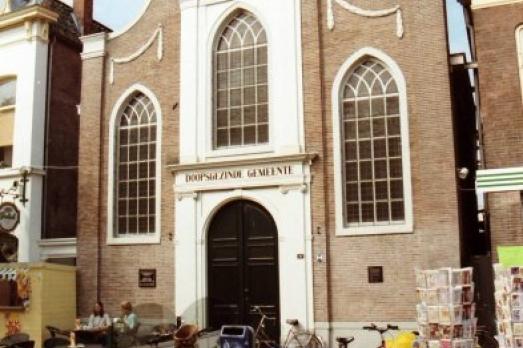
Doopsgezinde Kerk

Doopsgezinde Kerk

Almelo, NL

The Doopsgezinde Kerk (Mennonite Church) in Almelo was built in 1684. In 1732, the church was expanded and the current facade was added. The building was restored in 1978. It is listed as a National Monument of the Netherlands.

Doopsgezinde Kerk

Damwâld, NL

The foundation stone for the Mennonite meeting house was laid on 29 April 1767 by two-year-old Wyger Martens. Renovations took place in 1858 and 1910. In 1974-1975, another renovation took place, during which the pews were replaced by chairs and the pulpit was replaced by a smaller and heavier one. The interior was renovated in 2008. The colour blue now predominates. There is a wooden floor and the organ has been painted completely white. The re-opening took place on 20 September 2008. (61-09)

Doopsgezinde Kerk

Purmerend, NL

Built as the Chapel of the Roman Catholic Hospital St. Liduina Foundation, which was abandoned in 1988. Sober reconstruction chapel in Bossche School style.

Doopsgezinde Kerk

Goes, NL

Built as a Mennonite Church. Small hall church without a tower.

Doopsgezinde Kerk

Feanwâlden, NL

In 1895 Bakker & Timmenga built a new organ for the Mennonite Church in Veenwouden. The same firm restored the work in 1981. In June 1981 the organ could be put back into use.

Doopsgezinde Kerk

Edam, NL

In the 17th and 18th centuries, the Mennonites were not allowed to build their churches on public roads. They often held their church services in an ordinary house or a clandestine church. That is why this inconspicuous building is half hidden behind the sexton's house. It was the meeting place of the Frisian community that united with the Waterland movement in Edam in 1742. The Vermaning was built in 1702 after a previous church building on the same site was seriously damaged by fire in 1699. The interior has an oak interior from the 18th century.

Doopsgezinde Kerk

Monnickendam, NL

Mennonite Meeting House. Timber frame construction, 17th century, with brick side walls and a brick gable with interlacing at the rear with round arched windows, 17th century. Neoclassical facade with pediment, 19th century. Pulpit, benches, wooden lectern and copper candlestick. 17th century. Organ 19th century. Copper lectern, 18th century. This church is listed as a National Monument of the Netherlands.

Doopsgezinde Kerk

De Westereen, NL

In Kollumerzwaag a Mennonite community was founded between 1600 and 1620. At the beginning of the 19th century this community declined and was threatened with dissolution. Around 1816 the Vermaning was demolished and rebuilt in 1816 in Zwaagwesteinde. There was not a single church there at the time. After the death of Rev. Bosma the community ceased to exist in 1844. The Vermaning was sold and converted into a smithy. Later it became two workers' houses and in 1934 family doctor Noordhof bought the old Vermaning, had it demolished and built his doctor's house on the foundation.

Doopsgezinde Kerk

Drachten, NL

The Mennonite Meeting House dating from 1790 and its associated side rooms were restored and renovated in 2007. The old entrance with the large doors is now the main entrance again. Inside, everything is so flexibly arranged that the building can have a multifunctional purpose. (60-08/61-09)

Be inspired

Stupkalnis.lt

10 Buddhist stupas to discover in Europe

Stupas are symbols of enlightenment and peace that commemorate different stages of Buddha's life. Since the mid-20th century, thousands of stupas have begun to populate Europe. We have compiled some of the most impressive ones in this list.