Maranathakerk
Barendrecht, NL
Former company building. In 1989 converted into Dutch Reformed Maranatha Church. A metal bell tower was added at that time, containing one bell.

Here you can search for a building to visit. You can use the map find destinations, or you can use the filters to search for a building based upon what different criteria.
Barendrecht, NL
Former company building. In 1989 converted into Dutch Reformed Maranatha Church. A metal bell tower was added at that time, containing one bell.
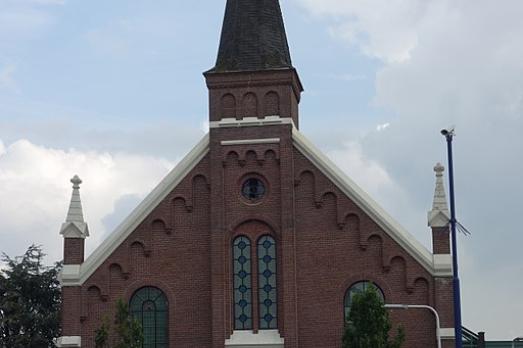
Alphen aan den Rijn, NL
Built as a Reformed church. Formerly called Zuiderkerk. Nice neo-church with tower. Severely damaged by fire (or fire-setting) in 1998, restored in 1999. Before the fire, the interior of this church had already been extensively modernized.
Drogeham, NL
Modern church without tower.
Deventer, NL
The Maranatha Church (1991-1992) was built to replace an older church building for the Moluccan community in Deventer, based on a design by Aldo van Eyck and his wife Hannie van Eyck between 1983 and 1985. With this church, Van Eyck attempted to develop a building with a minimal distinction between inside and outside, but which does not isolate itself from its surroundings, because this would fit in well with the religious experience of the users. For Moluccan Christians, the church service is a ceremony that begins in the living room at home and continues within the walls of the church. The distinction between inside and outside is eliminated in various ways. Van Eyck: 'The church as a continuation of the terrain, the terrain as an accompaniment to the walk to the church - that is actually the idea - not placed on the terrain, but situated in it.' For example, white roses climb up the walls 'to soften the walls'. The boundary between inside and outside is optically blurred. The closed outer walls are covered with climbing roses so that the church blends into the garden. The church space has a square plan, the four corners of which are defined by various semicircular fanlight elements. The church consists of two parts, the actual church space and a part with meeting room and consistories, which are connected by an inner street. Furthermore, the church has a flat roof that is supported by concrete columns. The unambiguous axiality of the traditional church has been replaced by a multi-axial system of local symmetries. The curved fanlight elements are clad on the outside with untreated iroko wood. A flat roof on a system of round concrete columns defines the original square. The inner walls are painted in blue stripes that go from dark to light and provided with wavy lines by artist Iene Ambar with shells found on the Moluccan islands. Due to the blue colour of the curved walls and the fact that they are in daylight, it seems as if one has come together under a flat roof in the open air. The imagination of the churchgoers is stimulated by the multiple sightlines created by the Van Eycks - this in contrast to most churches where there is only one direction of view. The church is not axially arranged, as is common in many churches, but polycentric, with multiple centers of attention and liturgical focal points. In this respect, the Maranatha Church is in line with Aldo van Eyck's earlier church designs, Wheels of Heaven (1963) and the Pastoor van Ars Church (1964-1969).
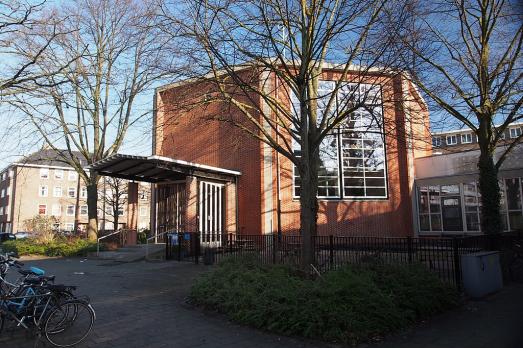
Amsterdam, NL
Construction started in 1953, but the actual construction did not start until 1954 on a vacant lot where the Hunzestraat, Kuinderstraat and Uiterwaardenstraat meet in the Rivierenbuurt.
s-Gravenhage, NL
The Maranathakerk occupies a unique place in the reconstruction architecture of The Hague. The building is a prototype of a famous series of German "emergency churches" after the Second World War. The spiritual father of the emergency churches was the German master builder Otto Bartning. The Dutch architect Frits Eschauzier integrated a donated roof structure into his own design. The church has been a municipal monument since 2018.
Goes, NL
On the site of the now demolished predecessor . Modern church with tower.
Almelo, NL
The Maranathakerk
s-Gravenzande, NL
On July 3, 1919, the foundation stone of this church building was laid by Rev. D. Driessen. The day of commissioning was set for December 18, 1919. Hall church without tower in neo-Gothic forms.
Ermelo, NL
Modern rectangular church with detached tower. Built as a Reformed church.

new
For a long time, Europe was ruled by powerful monarchies. Monarchy and religion have been connected since time immemorial. Here are 7 sites across Europe where royalty historically bent the knee to a higher power and received their crown.

Stupas are symbols of enlightenment and peace that commemorate different stages of Buddha's life. Since the mid-20th century, thousands of stupas have begun to populate Europe. We have compiled some of the most impressive ones in this list.

Walter Maria Förderer (1928–2006) was a Swiss architect and sculptor renowned for his neo-expressionist church designs in the 1960s. In this list we have compiled 6 of his church designs that seamlessly integrate religious and secular elements.

How is Religiana helping to conserve and promote Religious Heritage in Europe and why should you get involved?
Find out about Religiana
Are you a tourism organisation or religious heritage sites manager? Discover the advantages of becoming a partner.
See current partners
We can keep you up to date with the latest news from Religiana and religious heritage conservation across Europe.
Sign up to the FRH newsletter