Grote of Sint Joriskerk

The history of the church goes back to the year 1248, when a primitive court chapel, named after the patron saint Saint George, was replaced by a parish church.

About this building

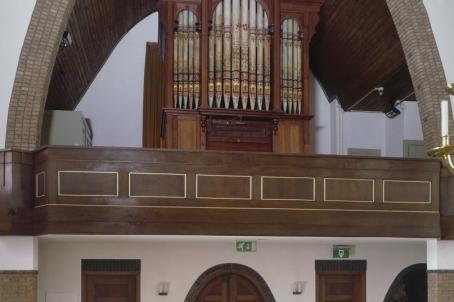
Little is known about the possibly late Romanesque parish church other than that the lower part of the current tower of the church was part of it. About a century later the church had the appearance of a cruciform church in early Gothic style. As far as can be determined, conversion into a hall church began in the early 15th century, during which the church was expanded on the north and south sides and a new and larger choir was also built. Later still, the north and south aisles were enlarged towards the west, with the tower being placed entirely within the church and the north and south portals being added. This last renovation and expansion was completed in 1534, so that the St. George's Church only had the now familiar appearance of a three-aisled hall church since that date.
Other nearby buildings

Willy Lindwer

Synagogue in Amersfoort

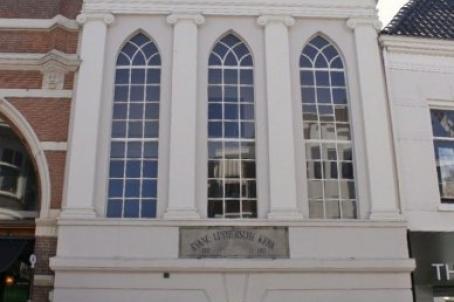
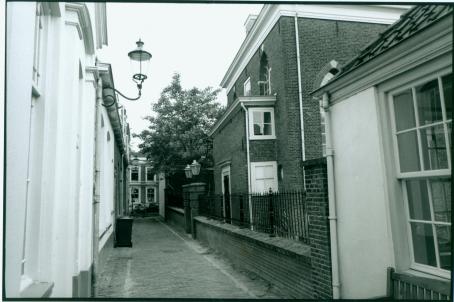
The synagogue of Amersfoort which was dedicated in 1727 was a rectangular shaped building located behind a private home. The original synagogue was used by both the Ashkenazi and Sephardic communities. The plans for the current synagogue were developed by the architect B. Ruitenberg. The design was inspired by the German neoclassical synagogue in Kleef which dates back to 1821. Unlike the rounded arch windows found in the example of Kleef, the synagogue of Amersfoort received pointed lancet windows and a round apse located at the eastern end. The neoclassical Torah ark dates back to 1843 and contains the Hebrew dates (5)487 and (5)611, corresponding to the year 1727 and 1843. The women's gallery is located at the opposite side of the Torah Ark. The synagogue was renovated in 1926/27 by the architect H. Elte Phzn. during which the art deco stained glass windows were installed. After a subsequent renovation by the architect A. Oznowicz the building became once again used as a synagogue in 1949. Oznowicz was also responsible for the design of the furniture including the bimah and railings of the Torah Ark. The architect P. Wassink tried to restore the original color palette during a renovation in 1993/94. After an excavation in 1993 of a nearby house located behind the synagogue, the original mikveh was discovered.

Rijksdienst voor het Cultureel Erfgoed

Heilige Georgius

Hall church in Amsterdam School style, with parabolic entrance, expressive brickwork and detailing of the clock. Based on a design (1927) by the Amersfoort architect Willem van Gent. Beautiful interior with oak communion bench (1693) and paintings by Hendrick Bloemaert. These works of art came from the predecessor of this church, a clandestine church from 1692.