Cathedral of the Immaculate Conception

The Cathedral of the Immaculate Conception of the Holy Virgin Mary is a neo-Gothic Catholic Church at Moscow's center, that serves as the cathedral of the Catholic Archdiocese of Moscow. Located in the Central Administrative Okrug, it is one of three Catholic churches in Moscow and the largest in Russia. The construction of the cathedral was approved in 1894 by the Ministry of Internal Affairs under Tsarist Russia. Groundbreaking was in 1899; construction work began in 1901 and was completed ten years later. Three-aisled and built from red brick, the cathedral is based on a design by architect Tomasz Bohdanowicz-Dworzecki. The style was influenced by Westminster Abbey and Milan Cathedral. In 2002 it was elevated to the status of cathedral. Following an extensive and costly program of reconstruction and refurbishment, the cathedral was reconsecrated in 2005. In the 21st century, the cathedral is once again the setting for regular liturgical celebrations in multiple languages—Russian, Polish, Korean, English, French, Spanish, Armenian and Latin—as well as benefit concerts featuring organ and church music. The cathedral is listed as a heritage building in the Russian Federation, and is a protected monument.

About this building

N/A
Key Features

  • Architecture
  • Monuments

Visitors information

  • Bus stop within 100m

Other nearby buildings

Wikimedia Commons/Petar Milošević

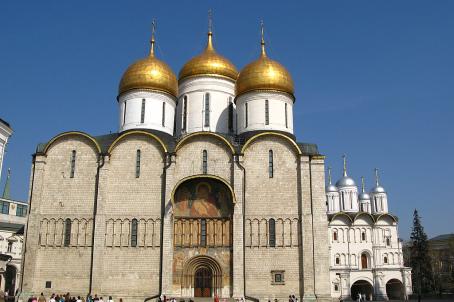
Dormition Cathedral, Moscow

The Dormition Cathedral (Uspensky Sobor) in the Moscow Kremlin is the main Russian Orthodox church, serving as the coronation site for Russian monarchs, the burial place for patriarchs, and a major historical and spiritual centre. It is known for its iconic Russian Orthodox architecture and religious significance as the "mother church" of Muscovite Russia, housing significant icons and art.

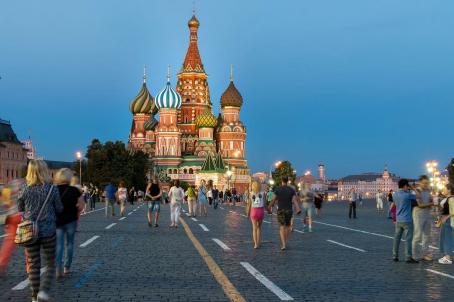
Saint Basil's Cathedral

The Cathedral of Vasily the Blessed, commonly known as Saint Basil's Cathedral, is a Christian church in Red Square in Moscow, Russia and is regarded as a symbol of the country. The building, now a museum, is officially known as the Cathedral of the Intercession of the Most Holy Theotokos on the Moat. It was built from 1555 to 1561 on orders from Ivan the Terrible and commemorates the capture of Kazan and Astrakhan. It was the city's tallest building until the completion of the Ivan the Great Bell Tower in 1600. The original building, known as Trinity Church and later Trinity Cathedral, contained eight churches arranged around a ninth, central church of Intercession; a tenth church was erected in 1588 over the grave of venerated local saint Vasily (Basil).
The building is shaped like the flame of a bonfire rising into the sky, a design that has no parallel in Russian architecture.

Wikimedia Commons

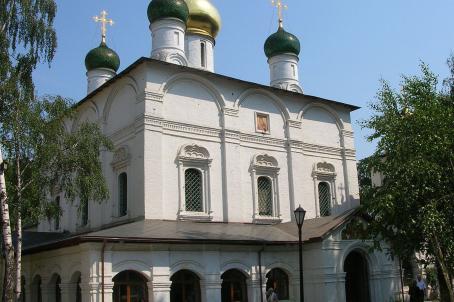
Sretensky Monastery

The Sretensky Monastery is an orthodox monastery built in the 14th century. The modern monastery complex includes the Sreteniye Cathedral of the Vladimir Mother of God Icon with two chapels, galleries, a belfry and a few service buildings. The monastery is the place where the Our Lady of Vladimir met Muscovites in the late 14th century. At the meeting place with the icon (that is, Sreteniya), a wooden church was built in honor of the Vladimir icon, rebuilt in stone in 1679. In 1918 the monastery was closed, and from 1928 to 1930, all the churches, except the Our Lady of Vladimir, and almost all the buildings were destroyed. Since 1958, the cathedral housed the restoration workshops of I. Grabar. The monastery was reopened in 1995. It houses the largest Orthodox publishing house, the famous male choir, and a seminary.