Jesuit Church, Valencia


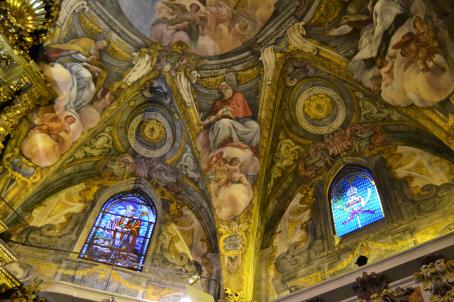
On the banks of the River Turia and next to the Botanical Gardens, Valencia has the Church of the Society of Jesus in the Arrupe Centre, formerly the San José School. Erected by the architect Joaquín María Belda in 1884, it is one of the few churches in the city in the neo-Byzantine style. The majestic interior space culminates in a barrel vault with a blue background and golden stars, enhanced by the play of light from the coloured stained glass windows.
About this building
The Jesuit Church is located in the heart of the city of Valencia. The building is a magnificent example of Neo-Byzantine style architecture, one of the most significant examples in the region. Built at the end of the 18th century by the architect Joaquín María Belda, its original use as the chapel of the Colegio de San José has meant that it has gone unnoticed by the general public, but the monument is now open to the public. The visitor will discover a solemn and beautiful space, in which all the decorative techniques of the period come together in a subtle way to enhance the refined architecture of the temple. On entering for the first time, one is struck by its imposing size, more typical of a parish church than a school chapel, as it is made up of a main nave 40 metres long and 10 metres wide, flanked by two side naves. The central space is covered by a barrel vault that culminates at 15 metres, whose pictorial decoration simulates a blue sky with golden stars, to which are added polychrome sash arches and imposing rose windows with metallic reflections. This majesty is sublimated by an impressive set of more than 165m² of polychrome stained glass windows, from the workshop of J. Muria, which brings a pleasant multicoloured light to the interior space. One of the most remarkable elements of the church is its set of vaults, groin vaults on the sides and barrel vaults in the main nave, the latter being one of the largest in Spain, with a span of 10 metres. But it contains many other masterfully executed works, such as the high altar, the mural paintings, the plaster mouldings, the coffered ceilings painted in imitation of wood, and the exceptionally well-made lighting fixtures. All of this gives this monument a coherence in the decorative programme that unites the arts with the trades, giving it an unquestionable patrimonial relevance. For Valencian society as a whole, the Jesuitas church constitutes a valuable cultural legacy, as unknown as it is important, which can now be discovered and enjoyed.