
Saint-Joseph de Calais, Church

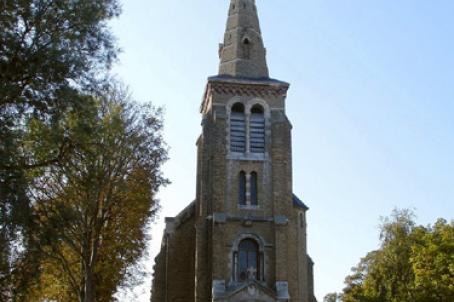
Father Georges Sauvage, appointed parish priest of Sainte-Madeleine on August 18, 1921, conceived the project of building a church that he planned to be quite large, as well as a presbytery and a workroom. Work was quickly undertaken. From September 1923 to December 1924, the work began under the direction of the architect Poyé. However, the ?nances were insufficient, and the work was interrupted. On December 24, 1924, Monseigneur Julien inaugurated the choir and a transept completed in the apse on the north side. From March 1924 to March 1925, a presbytery was created and on March 19, 1925, the church of Saint-Joseph was opened for worship.

About this building

The church is oriented and arranged according to a Latin cross plan. The entrance is located on the side part between the choir and the nave, and is composed of five bays.
Visitors information

  • Level access to the main areas
  • Parking within 250m

Other nearby buildings

Sainte-Marie-Madeleine au Petit Courgain Church, Calais

The work was quickly carried out and the building was completed well before St. Peter and the Sacred Heart, at a cost of 27,000 francs for the church and 8,000 francs for the presbytery. On March 8, 1868, the dean of Notre-Dame, Canon de Lencquesaing, delegated by Mgr. Lequette, Bishop of Arras, proceeded to the blessing and inauguration of the church, which was placed under the patronage of Saint Madeleine.

Notre-Dame de Calais Church

Its construction, begun in 1223, was only completed after several building campaigns up to the 17th century. Unique of its kind in France, Notre-Dame is probably the only church of Tudor influence in continental Europe. Its external appearance is similar to that of the cathedrals of Winchester, Rochester and Gloucester: it has neither buttresses nor buttresses, unlike most French cathedrals.

Église Notre-Dame de Calais

In 1214, Adrien de Wissant had a church built dedicated to Notre-Dame and erected as a parish in 1224. This church became the northern transept of the current building when the first expansion work was undertaken at the end of the 17th century.