Stupkalnis Lhabab Stupa

The first Buddhist stupa in Lithuania, Stupkalnis Lhabab Stupa, was inaugurated in 2022. It was built to commemorate the 25th anniversary of the Diamond Way School’s activities in Lithuania.

About this building

The stupa was built on a piece of Stupkalnis land purchased in 1997 by the Diamond Way Buddhist Community. Summer courses are held every year in Stupkalnis retreat centre. Apart from a meditation room with a capacity for 200 people, the complex includes three huts for Diamond Way Buddhist retreats.

Key Features

  • Monuments
  • Atmosphere / quiet space

Other nearby buildings

Center for Jewish Art

Wooden Synagogue in Laukuva

The beit midrash, built in 1928, stands north of Taikos Street, facing the town center with its southern entrance façade. It is a rectangular log structure on a fieldstone masonry foundation, covered with horizontal planks. Oriented with its short walls to east and west, it is 15.13 m long, 13.77 wide and 10.07 m high above the foundation. The building is topped with a gable roof, covered with asbestos sheets; original shingles are partially preserved under them. The prayer hall occupied the eastern part of the building, while the women's section was situated on the first floor of the western part. It may be assumed that the prayer hall was lit by the three windows on south and north; currently, there are only two rectangular windows on each side. The original fenestration on the east is unknown; a doorway in the southern part of the eastern façade is of post-WWII origins. There are no remains of Torah ark or bimah. Two small rectangular windows on the northern façade, and one similar window on each western and southern façades once gave light to the women's section. After WWII, the beit midrash was converted into a palace of culture. The prayer hall was changed into an auditorium, with the stage at the western end, over part of the original vestibule. A wooden entrance portico under a gable roof was added to the southern façade, and a plastered brick cinema projection unit to the eastern one. The building has been abandoned since the 1990s.

Wikimedia Commons

Taurage Evangelical Lutheran Church

From the 18th century to the beginning of the 20th, solid, square or cross churches were mainly built. The buildings without a tower now received a larger or smaller belfry. Some buildings are half-timbered or made entirely of wood. Even the village churches received decorative elements such as turrets, niches, pseudo windows, etc. The construction of the church was supervised by a special commission. She made sure that the houses of worship were built in the neo-Romanesque or neo-Gothic style, with a bell tower and made of red bricks.

Taurages Svc. Trejybes parapija

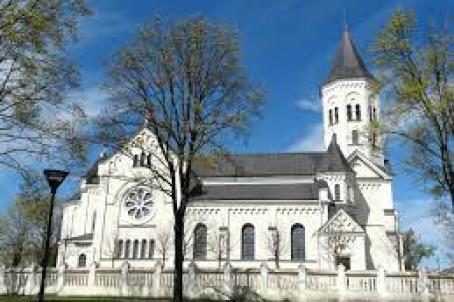
The church is historic, has neo-Romanesque and classicist style features, a Latin cross plan, with a five-walled apse and one octagonal tower. It has 6 altars. Cemetery fence with openwork masonry.