Koninkrijkszaal
Sober modern building.

Sober modern building.
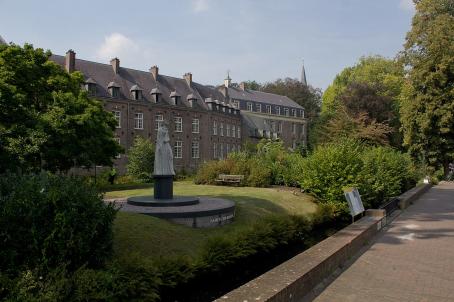
Gemert Monastery Castle, founded by the Teutonic Order, has a rich religious heritage dating back to the 12th century. Over time, it served various religious orders, including the Jesuits and the Spiritans, who resided there until the 20th century.
In 1904, the Waterstaat church was demolished to make way for a new neo-Gothic church that had been built just north of the Waterstaat church. This church was designed by Caspar Franssen. It is a neo-Gothic cruciform basilica with a crossing tower and a high entrance tower with four sections. Its colourful neo-Gothic interior has been particularly well preserved. The church contains a Pieta by the Den Bosch artist Van de Ven, who died suddenly when it was installed. When swine fever broke out in 1997, a special mass was celebrated in this church, after which various pig farmers maintained a devotion to St. Anthony Abbot.
The rectory Roman Catholic Church (H. Maria Hemelvaart, already mentioned in 1434, consists of a nave, the western part of which was renovated in 1747 and the eastern part of which (probably the original choir) was renovated in 1696-1708. Side aisles along the eastern part, choir with extensions and tower (1902 and later by Dr. Pierre Cuypers (1827 - 1921) and the architect Joseph Cuypers (1861 - 1949)), the latter replacing a tower (XV). The western nave bays have bears, the eastern flat pilasters; simple windows closed with a segmental arch. In the eastern nave bay on the south side a support 1708. Above the closed entrances in the second bay stones with the coats of arms of the German Order: on the south side two with the coats of arms - Belderbusch (or -de Loe), -von Schonborn (?) and German Order Cross and on the north side a stone with the coat of arms of Hendrik van Wassenaar tot Warmond (around 1709). Internally, the western nave section has a slightly lower (stucco) vault than the eastern section. The church has: Wooden side altar (18th century) with altarpiece: Holy Family. Organ with 18th and 19th century components by an unknown maker. The Rugpositief was added in 1950 and is not protected. A carved oak organ counter (18th century), on which the coat of arms of Belderbusch (or -de Loe), with order cross. Two painted confessionals (18th century), one of which with carving and coat of arms of Belderbusch (or -de Loe) with order cross. Bell tower with chime consisting of three bells, of which two bells by A. Jullien, 1689, respectively diam. 59.5 cm and 51.5 cm and a modern clock. Mechanical tower clock, has been decommissioned.

How is Religiana helping to conserve and promote Religious Heritage in Europe and why should you get involved?
Find out about Religiana
Are you a tourism organisation or religious heritage sites manager? Discover the advantages of becoming a partner.
See current partners
We can keep you up to date with the latest news from Religiana and religious heritage conservation across Europe.
Sign up to the FRH newsletter