Wooden Synagogue in Laukuva

The beit midrash, built in 1928, stands north of Taikos Street, facing the town center with its southern entrance façade. It is a rectangular log structure on a fieldstone masonry foundation, covered with horizontal planks. Oriented with its short walls to east and west, it is 15.13 m long, 13.77 wide and 10.07 m high above the foundation. The building is topped with a gable roof, covered with asbestos sheets; original shingles are partially preserved under them. The prayer hall occupied the eastern part of the building, while the women's section was situated on the first floor of the western part. It may be assumed that the prayer hall was lit by the three windows on south and north; currently, there are only two rectangular windows on each side. The original fenestration on the east is unknown; a doorway in the southern part of the eastern façade is of post-WWII origins. There are no remains of Torah ark or bimah. Two small rectangular windows on the northern façade, and one similar window on each western and southern façades once gave light to the women's section. After WWII, the beit midrash was converted into a palace of culture. The prayer hall was changed into an auditorium, with the stage at the western end, over part of the original vestibule. A wooden entrance portico under a gable roof was added to the southern façade, and a plastered brick cinema projection unit to the eastern one. The building has been abandoned since the 1990s.

About this building

For more information visit on this building visit http://historicsynagogueseurope.org/browser.php?mode=set&id=8906

Other nearby buildings

“Synagogues in Lithuania: A Catalogue” Archives

Soldiers’ Beit Midrash in Telšiai

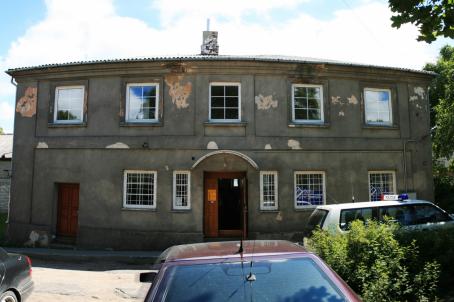
The beit midrash on the plot belonging to Moshe Levin near Plungė (today Respublikos) Street, was designed in 1866. The design shows a Neo-Classicist building with a broad eastern prayer hall. The two-storey western façade had a central entrance doorway flanked by two narrow windows. However, the actual building differed from the design: the prayer hall became larger, its eastern wall was pierced by six (rather than four as originally planned) windows. It is hard to establish whether the gable pierced by a central oculus was ever built, or the "beit midrash" was covered with a hipped roof, like the one it has today.

“Synagogues in Lithuania: A Catalogue” Archives

Mechina of the Yeshiva in Telšiai

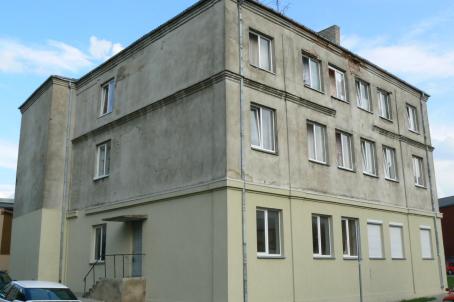
The Mechina building was constructed in 1933-34; two storeys were added in 1937 according to a design by Stanislovas Stulginskis. It was designed as a modernist building, featuring vast plastered, undecorated surfaces. However, its facades were articulated with plain stringcourses and slender pilasters, while a steep roof and a large dormer over the attic space echoed traditional Lithuanian town building. Its main entrance, located on the northwestern façade, was surrounded by modernist multi-faceted windows; the staircase was lit by a vertical strip window. A plaster Star of David was set above the main entrance. The Mechina was a three storey building, which combined a prayer hall on the ground floor, four classrooms on the first floor, and offices on the upper one. The flat ceiling of the prayer hall was supported by four rectangular piers, and the bimah stood in between them. The classrooms were probably used for the teaching of the general subjects, while Torah study took place in the prayer hall. The Torah ark stood at the southeastern wall of the hall. Currently it is a three-storey plastered building, which retains the designed division of the facades with pilasters and stringcourses. Its attic has been converted into a regular additional floor. While fenestration of the southwestern façade has largely survived, that of the northeastern façade has been changed, and its modernist elements as well as the Jewish sign have vanished. All frames of the openings were replaced with modern plastic ones.