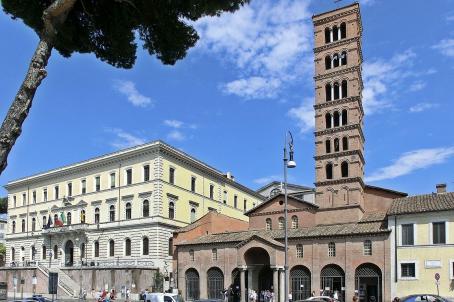
Basilica of Saints Bonifacio and Alessio

The Basilica of Saints Boniface and Alexis was built between the 4th and 5th centuries. In 1216, Pope Honorius III (1216-1227) ordered the reconstruction of the complex; the restoration of 1582 was followed by the reconstruction of Tommaso De Marchis in the 1750s and the reconstruction by Somaschi from 1852 to 1860. The modern church retains elements from all these periods. The bell tower is Romanesque, some columns from the church of Honorius are present in the eastern apse of the modern church, the portico is medieval; the 16th-century façade, reworked by De Marchis, highlights the medieval portico.
About this building

Key Features

  • Architecture
  • Monuments

Visitors information

  • Bus stop within 100m
  • Café within 500m

Other nearby buildings

Wikimedia Commons/Fczarnowski

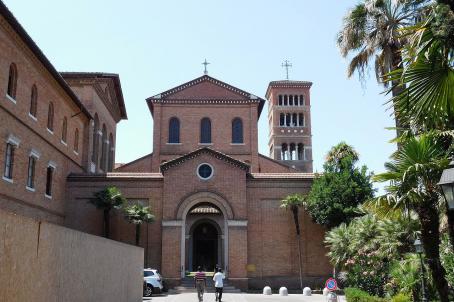
Chiesa di Sant'Anselmo all'Aventino

The church of Sant'Anselmo all'Aventino, despite its appearance, is a recent construction. It was built in a neo-Romanesque style by Francesco Vespignani between 1892 and 1896. The interior consists of a nave and two aisles divided by granite columns, a latticed ceiling and an apse decorated with mosaics; the crypt with five aisles is particularly large. The church is built on the remains of a Roman Domus of the 2nd-3rd century AD, which can be seen in the basement of the church.

Santa Cecilia in Trastevere

The church and convent of Santa Cecilia in Trastavere in Rome was built on the site of the home of St. Cecilia, a martyr of the 3rd century. Her mutilated body was found incorrupt in 1599; a statue under the altar depicts the way it was found. Excavations of Cecilia's Roman house can be explored underneath the church.

Wikimedia Commons/Felix König

Basilica of Santa Maria in Cosmedin

The Basilica of Santa Maria in Cosmedin is the result of the enlargement under Pope Hadrian I (772-790) of an ancient Christian place of worship attested since the 6th century. It also underwent a major renovation in 1123, making it one of the few examples of 12th-century sacred architecture in Rome. It is known to house the Bocca Della Verità. The 8th-century crypt has a rectangular plan, with a flat ceiling, and a tripartite hall with naves of four bays each with Corinthian columns. A peculiarity of this crypt is the transept, one of the rare cases of reintroduction of this element, typically Constantinian, into Carolingian architecture.