Heilige Antonius van Padua
Heusden, NL
Small neo-Gothic church with roof turret in the village of Heusden, Municipality of Asten.

Here you can search for a building to visit. You can use the map find destinations, or you can use the filters to search for a building based upon what different criteria.
Heusden, NL
Small neo-Gothic church with roof turret in the village of Heusden, Municipality of Asten.
Keldonk, NL
Neo-Romanesque church with tower. The Roman Catholic church of St. Anthony of Padua (1912, J. Margry) has been restored. An important part of that restoration were the statues of the eight saints who closely observe the Sunday churchgoers.
Nijmegen, NL
Interesting neo-Gothic church with ridge turret at the crossing and unfinished facade. Beautiful, colorful, post-war stained glass windows. New parish in southern city expansion Nijmegen. Foundation stone April 4, 1916; consecrated June 20, 1917. Three-aisled cruciform basilica, mainly in late neo-Gothic style, on a centralizing floor plan. Hexagonal crossing, flanked by a double transept (transept), and crowned by a dome with ridge turret. At the back of both transept arms are stair turrets. Pillars, arches and vault ribs are made of fair-faced brickwork; the walls and vault surfaces are largely plastered. This church is listed as a Municipal Monument of the Netherlands.
Best, NL
Built in the Wilhelminadorp district, in the south of Best. Architecturally important reconstruction church in traditionalist forms, derived from Romanesque. Three-aisled design with wide central nave, based on the concept of the people's church. Low, squat tower with tent roof above the choir. Many interesting details, including a series of stained glass windows. At the end of 2012, unrest and resistance arose within this parish against the plans to form a merger parish with Oirschot. After intensive consultation, this merger parish was realized and bears the name Sint-Odulphus van Brabant.
Ede, NL
Roman Catholic parish church of St. Anthony of Padua, located in the south of Ede.
Haarlem, NL
Roman Catholic Church St. Anthony of Padua, 1843 by TF Suys, high neoclassical pilaster facade. Two-manual electro-pneumatic organ made in 1913 by the Adema company, modified in 1952 and in 1989. In the last modification, the console was placed in the middle of the organ.
Hellevoetsluis, NL
Beautiful small neo-Gothic church with a smaller, than originally designed, tower. Built to replace an earlier Roman Catholic church from 1835, which was demolished in 1891. In terms of the village image on site, an extremely interesting, and unique, ensemble of this church (tower) with the nearby situated, higher, certainly also interesting and beautiful, water tower (ao. 1896; architect N. Biezeveld). In the center of Barendrecht there is a similar ensemble: Historic Village Church with tower near the higher water tower.
Nijverdal, NL
Three-aisled cruciform basilica with multi-faceted closed pseudotransept (transept) in late neo-Gothic style. Typical in the oeuvre of H. Kroes, in which an attempt was made to connect the neo-Gothic style with the renewed Roman Catholic liturgical wishes and spatial concepts of the early twentieth century. The main naves are covered by net vaults. Front tower with balustrade, corner turrets and spire. The inventory and glazing date largely from the construction period and shortly thereafter. This church is listed as a Municipal Monument of the Netherlands.
Heilig Landstichting, NL
Extremely important, unique, fantastic church with dome and double tower front. Church building, dedicated to St. Anthony of Padua, built in the 1910s in close connection with buildings and grounds of the Biblical Open Air Museum, now Museum Orientalis, on the Holy Land Foundation. The church is considered one of the main works from the oeuvre of architect Jan Stuyt (1868-1934).
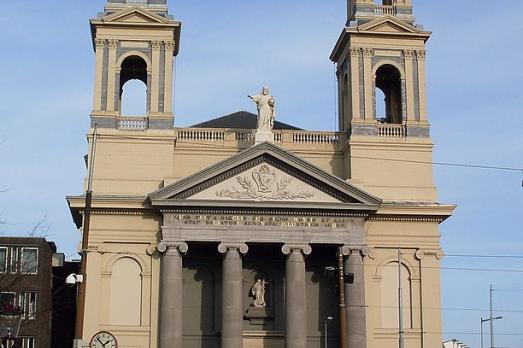
Amsterdam, NL
The church originated from a clandestine church . This was served by Franciscan fathers and was located from 1641 at the back of the current church in the house "Moyses" on the Jodenbreestraat , where a statue of Moses hung on the facade. In 1682, the adjacent house "Aäron" ( Aäron ) was also purchased by Dr. Johannes de Vroom, a physician from Breda.

new
For a long time, Europe was ruled by powerful monarchies. Monarchy and religion have been connected since time immemorial. Here are 7 sites across Europe where royalty historically bent the knee to a higher power and received their crown.

Stupas are symbols of enlightenment and peace that commemorate different stages of Buddha's life. Since the mid-20th century, thousands of stupas have begun to populate Europe. We have compiled some of the most impressive ones in this list.

Walter Maria Förderer (1928–2006) was a Swiss architect and sculptor renowned for his neo-expressionist church designs in the 1960s. In this list we have compiled 6 of his church designs that seamlessly integrate religious and secular elements.

How is Religiana helping to conserve and promote Religious Heritage in Europe and why should you get involved?
Find out about Religiana
Are you a tourism organisation or religious heritage sites manager? Discover the advantages of becoming a partner.
See current partners
We can keep you up to date with the latest news from Religiana and religious heritage conservation across Europe.
Sign up to the FRH newsletter