
Explore Religious Heritage Across Europe

Here you can search for a building to visit. You can use the map find destinations, or you can use the filters to search for a building based upon what different criteria.

Refine search

Heilige Willibrordus

Kloosterburen, NL

The Sint-Willibrorduskerk in Kloosterburen is a neo-Gothic church building, designed by PJH Cuypers. The church replaced an earlier Catholic church from 1842, which soon proved to be too small. The church was built by the parish itself.
Heilige Willibrordus

Coevorden, NL

The Roman Catholic St. Willibrordus Church was built in 1913-1914 to a design by Wolter te Riele (1867 - 1937) from Deventer and executed by contractor A. de Boer from Coevorden. The building is constructed in a simple neo-Gothic style. The interior paintings applied in 1925 by Fa. Cuypers from Roermond have disappeared. The interior is not protected.

Heilige Willibrordus

Heilige Willibrordus

Arnhem, NL

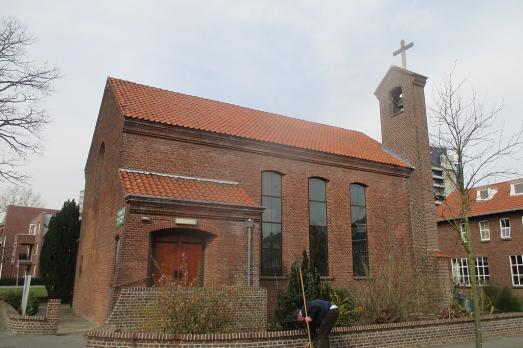
The church building dates from 1941, which was of course a strange time to build a church. On the other hand, it was not yet known at that time whether the German occupation would be permanent.

Heilige Willibrordus

Bodegraven, NL

The Sint-Willibrorduskerk in Bodegraven was designed around 1859 by Pierre Cuypers (1827 - 1921). It was consecrated in 1865. The building is a three-aisled cruciform basilica in brick, in a sober early Gothic style with pointed wooden barrel vaults. The nave is four bays deep and has a cross-shaped building that connects to the choir. The choir is one bay deep and is connected to rectangular radiating chapels. It is closed on five sides and is covered by brick vaults. The brickwork is made of grey-red brick and has braids and bands of yellow and black stone in the interior. The church was consecrated on 10 July 1865 by Mgr. Wilmer.

Heilige Willibrordus

Sappemeer, NL

St. Willibrordus, 1866-1873, Pierre Cuypers (1827 - 1921) . Three-aisled neo-Gothic hall church without transept. Pointed gables on the side aisle bays. Tower with two niches in each facade, frontals and four-sided spire. Articulated brick pillars with moulded capitals, cross-ribbed vaults. Polychrome interior with painted brick; furnishings and glazing from the construction period, from the Cuypers & Stolzenberg studio in Roermond. The windows in the nave partly come from the St. Martinus church in Foxham-Martenshoek, which closed in 1990. Early work from Cuypers' second period, influenced by the Westphalian hall church Gothic. Mechanical tower clock.

Heilige Willibrordus

Obbicht, NL

The church replaced the previous church from 1903, which had become too small.

Heilige Willibrordus

Diessen, NL

The church of Diessen is named after Saint Willibrord, an English Benedictine monk. Around 712, he donated a number of properties, including properties in Diessen, to the abbey of Echternach. At that time, Willibrord also built a well in the village for baptism. A 16th-century replica can still be seen next to the church, which has undergone several transformations over time. In 1161, the church consisted of a chapel made of wood and straw. In order to manage the properties donated by Willibrord, the abbot of Echternach had appointed a guardian or advocate in various places, who also exercised a form of worldly authority in the area assigned to him. The Benedictines of Echternach were also involved in pastoral care in Diessen.

Heilige Willibrordus

Liessel, NL

The Roman Catholic Church, built on the western side of the Hoofdstraat in the centre of Liessel and dedicated to St. Willibrordus, was built between 1899 and 1901 and was designed by C. Franssen. It is a non-oriented Neo-Gothic cross basilica with an eastern tower. The church was consecrated on 30 April 1901. In 1944 the church was severely damaged by war. Shortly after the war, as a result of this damage, part of the masonry, vaults and roof, as well as the spire, were renewed under the architecture of SJP van der Sluijs (Eindhoven). The repairs were generally carried out in a neo-Gothic style.

Heilige Willibrordus

Berghem, NL

Tower added in 1475. Church demolished in 1856, and replaced. The historic tower was then maintained.

Be inspired

Stupkalnis.lt

10 Buddhist stupas to discover in Europe

Stupas are symbols of enlightenment and peace that commemorate different stages of Buddha's life. Since the mid-20th century, thousands of stupas have begun to populate Europe. We have compiled some of the most impressive ones in this list.