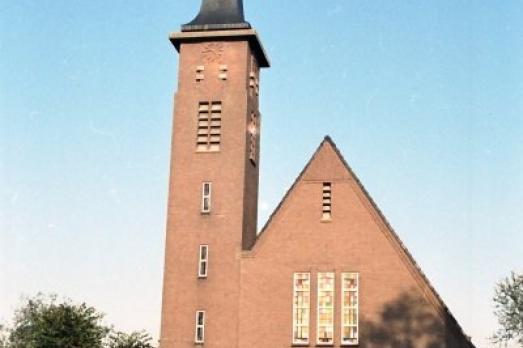
Hervormde Kerk
Nijkerkerveen, NL
Important neo-church with tower.

Here you can search for a building to visit. You can use the map find destinations, or you can use the filters to search for a building based upon what different criteria.
Nijkerkerveen, NL
Important neo-church with tower.
2e Exloërmond, NL
The Hervormde Kerk is a Protestant place of worship dating from 1939. Since 2002, after the Reformed Church was decommissioned in each location, it has been used as the central church of the Protestant Church in the Netherlands (PKN) in Exloërmond. The church organ was built in 1976 by the firm Gebr. Reil (Heerde).
Broek op Langedijk, NL
Dutch Reformed Church. Single-nave late Gothic building, consisting of a nave (16th century) and a narrower 15th century choir. In the west facade above the entrance a pointed arch niche with traceries; above this facade a wooden tower. Pulpit 1709; copper baptismal arch 17th century; Ten Commandments board 1642; three copper crowns; two silver communion cups 1655. Bell frame with bell by Geert van Wou, from 1504.
Drimmelen, NL
Dutch Reformed Church. Founded in 1792 by Jonkvrouw van Doorn, Lady of Drimmelen (commemorated in a stone above the entrance, with coat of arms), to replace the church in Oud-Drimmelen. Hall church, closed on three sides at the short ends; arched windows; high slate roof with roof turret. Internal wooden wall pilasters and wooden barrel vault with two rosettes with mermaids. Adjoining parsonage from the time of construction. Iron entrance gate between two bluestone pillars also from the time of construction. 18th century copper lecterns and baptismal font holder. Restored in 1965.
Kloosterhaar, NL
The church replaced a smaller church from 1892. Striking and quite rare example of reformed church building from the reconstruction period in traditionalist forms.
Eethen, NL
Dutch Reformed Church, consisting of a three-sided closed choir of brick with tuff stone bands and buttresses, from the second half of the 15th century; a lower Romanesque nave from the 12th century, made of tuff stone, with small windows in round arch fields separated by wall dams, enlarged to the west in the 13th century with a brick bay, and a simple flat tower from the end of the 14th century, raised with a section in the 15th century and crowned by a spire constricted from four to the back.
Friens, NL
On a high mound, simple, three-sided closed church from 1795, internally enriched with thirteen mourning boards (1637-1843) of the Sytzama family. Against the choir wall six large carved tombstones Sytzama (1607-1759). In the churchyard seven early 19th century tombstones of the Haerama family. In the roof turret bell of anonymous founder from the 13th century, diam. 79.7 cm. Mechanical tower clock.
Ottoland, NL
Dutch Reformed Church. Simple building on a rectangular plan with a high saddle roof between gables and a bell tower above the west facade. The church originally dates from the end of the 16th or beginning of the 17th century, but major restorations were carried out in 1734 and 1848. Last restoration around 1960. Interior: a pulpit 18b and commandment boards (18d). Bell tower with bell by N. Muller, 1732, diam. 64.5 cm. Mechanical wrought iron tower clock, probably 17th century. A wooden sundial hangs on a buttress on the south wall of the church. This church is listed as a National Monument of the Netherlands.
Simonshaven, NL
Neoclassical plastered hall church from 1852 with round arch windows connected by a cordon list and bell tower with square wooden superstructure, crowned by a concave spire. Internal pilasters and a stuccoed wooden cove ceiling; pulpit with baptismal fence and organ case from 1909. Mechanical tower clock, Firma Weule, the electrical system is original.
Groot-Ammers, NL
Tower of the Netherlands. Rev. Church. A slender tower of the medieval parish church, a brick structure from around 1500, decorated with bands of various types of natural stone, traced niches and brick phials against the perpendicular buttresses. The masonry is closed at the top by a frieze of pointed arches, above which rises a small, slender spire.

new
For a long time, Europe was ruled by powerful monarchies. Monarchy and religion have been connected since time immemorial. Here are 7 sites across Europe where royalty historically bent the knee to a higher power and received their crown.

Stupas are symbols of enlightenment and peace that commemorate different stages of Buddha's life. Since the mid-20th century, thousands of stupas have begun to populate Europe. We have compiled some of the most impressive ones in this list.

Walter Maria Förderer (1928–2006) was a Swiss architect and sculptor renowned for his neo-expressionist church designs in the 1960s. In this list we have compiled 6 of his church designs that seamlessly integrate religious and secular elements.

How is Religiana helping to conserve and promote Religious Heritage in Europe and why should you get involved?
Find out about Religiana
Are you a tourism organisation or religious heritage sites manager? Discover the advantages of becoming a partner.
See current partners
We can keep you up to date with the latest news from Religiana and religious heritage conservation across Europe.
Sign up to the FRH newsletter