Hervormde Kerk
Kamerik, NL
Neo-Gothic church with historic tower. Church built in 1833 on a T-shaped plan against a tower from the first quarter of the 16th century.

Here you can search for a building to visit. You can use the map find destinations, or you can use the filters to search for a building based upon what different criteria.
Kamerik, NL
Neo-Gothic church with historic tower. Church built in 1833 on a T-shaped plan against a tower from the first quarter of the 16th century.
2e Exloërmond, NL
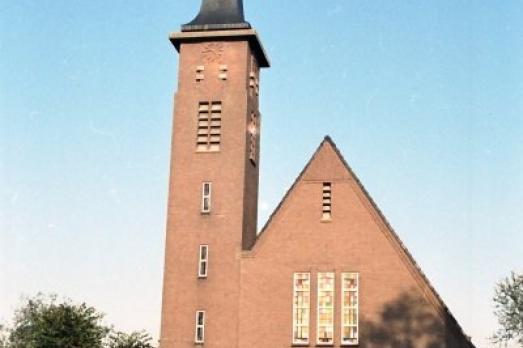
The Hervormde Kerk is a Protestant place of worship dating from 1939. Since 2002, after the Reformed Church was decommissioned in each location, it has been used as the central church of the Protestant Church in the Netherlands (PKN) in Exloërmond. The church organ was built in 1976 by the firm Gebr. Reil (Heerde).
Oudega, NL
Simple, mid-19th century single-nave church dating from 1850. It is situated on a mound and surrounded by a churchyard, built of yellow Frisian stone; the whole is closed on three sides, is covered by a saddle roof covered with blue tiles and crowned by a turret of a more recent date (19th century) with a constricted spire with tower cock that is equipped with coupled sound holes with dividing columns. This church is listed as a National Monument of the Netherlands.
Emmer-Compascuum, NL
Important interbellum church. The Herv. church of Emmer-Compascuum (De Runde ZZ 108) is a straight closed hall church with a side standing unarticulated tower with saddle roof. The church, built in 1925, shows business-expressionist details. (Source: DBL)
Opijnen, NL
Plastered church building from 1860. The church is a three-sided closure, internal cove ceiling. The inventory includes: a richly carved pulpit in transitional forms Louis XIV-Louis XV, dated on the sounding board; 1744. Lectern and baptismal font holder. Otherwise complete inventory from the construction period; reader's chair, lord's pew, wainscoting with copper wall arms, all circa 1860. Two-manual organ, made in 1859 by H. Knipscheer. The free Pedal made in 1947 is not protected. This church is listed as a National Monument of the Netherlands.
Otterlo, NL
Single-nave village church with early 14th century nave without buttresses, simple, brick tower from probably the same period with a corbelling on arch frieze and slender spire at the height of the church and a deep, buttressed with three-sided closure. The nave, raised in 1865, has a 19th century cove ceiling. The church is completely plastered on the outside. In the choir good 17th century furniture: panelling and benches with lobe ornament within the arches surrounded by acanthus leafwork, well-carved pulpit and simple, sliding gentlemen's benches against the straight sides of the choir. The church also has two copper chandeliers in 17th century style. Mechanical tower clock, has been decommissioned. This church is listed as a National Monument of the Netherlands.
Een, NL
Originally a reformed evangelism, founded in 1912.
Paasloo, NL
Brick church from the early 16th century; modified in the 17th century. Three-aisled layout with internal wooden trusses. Single-manual organ made in 1920 by the firm P. van Dam. Bell frame with a bell by S. Butendiic, 15th century, diam. 51.5 cm.
Meeuwen, NL
The Reformed Church is a Reformed church building in the town of Meeuwen.
Haastrecht, NL
Reformed Church. Late Gothic wooden-arched CROSS CHURCH, of which only the short nave, the transept and the tower remain. The side aisle bays have gables. Tower hull XIII B in early Gothic forms, Renaissance superstructure restored after fire damage in 1896; tower again approx. 1960. Interior: two copper crowns (XVII). Organ with Hoofdwerk and Bovenwerk, made in 1847 by L. van Dam and Sons for the Reformed Church in Bovenkarspel. Transferred to Haastrecht in 1968.

new
For a long time, Europe was ruled by powerful monarchies. Monarchy and religion have been connected since time immemorial. Here are 7 sites across Europe where royalty historically bent the knee to a higher power and received their crown.

Stupas are symbols of enlightenment and peace that commemorate different stages of Buddha's life. Since the mid-20th century, thousands of stupas have begun to populate Europe. We have compiled some of the most impressive ones in this list.

Walter Maria Förderer (1928–2006) was a Swiss architect and sculptor renowned for his neo-expressionist church designs in the 1960s. In this list we have compiled 6 of his church designs that seamlessly integrate religious and secular elements.

How is Religiana helping to conserve and promote Religious Heritage in Europe and why should you get involved?
Find out about Religiana
Are you a tourism organisation or religious heritage sites manager? Discover the advantages of becoming a partner.
See current partners
We can keep you up to date with the latest news from Religiana and religious heritage conservation across Europe.
Sign up to the FRH newsletter