Onze Lieve Vrouw ten Hemelopneming
Borculo, NL
Temporary church that was in use during the construction of the current church and was demolished after it was put into use.

Here you can search for a building to visit. You can use the map find destinations, or you can use the filters to search for a building based upon what different criteria.
Borculo, NL
Temporary church that was in use during the construction of the current church and was demolished after it was put into use.
Nederhorst den Berg, NL
This church is listed as a Municipal Monument of the Netherlands.
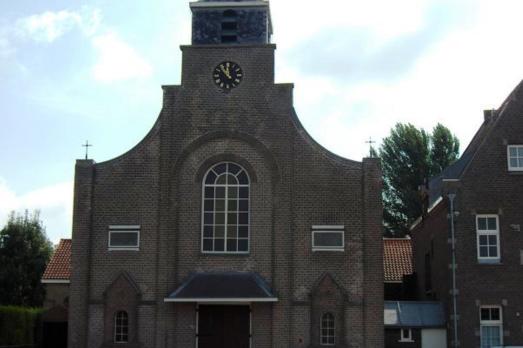
Achthuizen, NL
The church of Onze Lieve Vrouw ten Hemelopneming (Our Lady of Hemelopneming) is a Roman Catholic Church built in 1846 in Achthuizen. It is listed as a National Monument of the Netherlands.
De Meern, NL
Simple church with tower. Built to replace the neo-Gothic Roman Catholic church in the hamlet of Oudenrijn (now "de Metaal Kathedraal") that had become too small. Simple version of the expressionist style of Dom Bellot / Delft School. The parish of Our Lady of the Assumption in Oudenrijn / De Meern first used a church on the Rijksstraatweg. Around 1937 plans were made to build a new, larger place of worship, and the Nijmegen architect Hendrik C. van de Leur was commissioned to do so. The church has a robust appearance, largely due to the large tower with an octagonal spire. The tower is in the middle of the front and is Romanesque in shape, with round-arched windows. The church has a basilica nave with lower transepts. The transept on the south side has a lower extension, which houses the sacristy. The end of this extension forms a chapel in the churchyard. Window shape often covered with a herringbone arch, characteristic of Bellot's style.
Prinsenbeek, NL
Interesting, large, modern church with detached tower, in which 3 bells. The 3 bells were transferred from the old church. In addition, there is a small bell from Schaft, cast in 1667 by François Delapaix. (This tower is very similar to that of the RK Kerk HH Harten in Eindhoven-Gestel, designed by the same architects). In the hall of this church is a model of the previous church.
Beltrum, NL
The current parish church of Our Lady of the Assumption of Mary in Beltrum was built after a period of renovations and expansions. At the beginning of the nineteenth century, a water board church stood here, which was expanded in 1862-1864 to a design by HJ Wennekers. In 1894, the church was again renovated by WVA Tepe; that is when the current neo-Gothic tower was built. The last major expansion took place in 1929-'30 under the direction of architect GAP de Kort. On the site of the former nave, the current nave and transept were built under slight influence of the brick expressionism of the 1920s.
s-Gravenzande, NL
The current church building 'De Hoeksteen' was consecrated on 23 March 1975 by the then bishop of Rotterdam, Mgr. dr. AJ Simonis. In mid-1989, the church building was expanded with a meeting and secretariat room. In 1996, the building underwent a major renovation. The stained glass windows, designed by the artist Carel Bruens, were also installed. Seven of the new windows depict the sacraments, the eighth window places the Church in relation to its faithful community. In this window, the text 'the Church is the human being in which Christ's message is central' is inscribed. On 19 October 1996, the current bishop of Rotterdam, Mgr. drs. AH van Luyn SDB, anointed both new altars with Holy Oil during the Eucharistic celebration.
Heino, NL
This church replaced an older church that was put into use on 16 February 1858. However, after more than half a century, it was in poor condition. Hence the new construction in 1923-'24. The new church, designed by architect M. Roebbers, is a large cruciform church on a centralising floor plan, with a narrowed and lowered semi-circular apse and a high tower to the side. The whole is built in light expressionist forms. The interior is largely executed in fair-faced brickwork and the crossing is covered by a large painted brick dome. During the Second World War, the church and the parish house were damaged and the bells were stolen by the occupier. The war damage has been repaired.
Reusel, NL
Three-aisled neo-Gothic cruciform church, built 1895-1896 to replace a medieval church. Design by PJ Bekkers and A. Bruning. After damage during the Second World War, the tower was rebuilt in a modified form.
Heemstede, NL
In several architectural respects this church is comparable to the Roman Catholic Church of Our Lady of Lourdes in Bergen op Zoom, designed at almost the same time, designed by the same architects, with almost the same floor plan, but higher (church hall, tower, dome). As such typical of the late oeuvre of Joseph Cuypers (1861 - 1949) (in collaboration with his son Pierre Cuypers Jr (1891 - 1982)), in which he experimented with the cross between the people's church and the central building.

new
For a long time, Europe was ruled by powerful monarchies. Monarchy and religion have been connected since time immemorial. Here are 7 sites across Europe where royalty historically bent the knee to a higher power and received their crown.

Stupas are symbols of enlightenment and peace that commemorate different stages of Buddha's life. Since the mid-20th century, thousands of stupas have begun to populate Europe. We have compiled some of the most impressive ones in this list.

Walter Maria Förderer (1928–2006) was a Swiss architect and sculptor renowned for his neo-expressionist church designs in the 1960s. In this list we have compiled 6 of his church designs that seamlessly integrate religious and secular elements.

How is Religiana helping to conserve and promote Religious Heritage in Europe and why should you get involved?
Find out about Religiana
Are you a tourism organisation or religious heritage sites manager? Discover the advantages of becoming a partner.
See current partners
We can keep you up to date with the latest news from Religiana and religious heritage conservation across Europe.
Sign up to the FRH newsletter