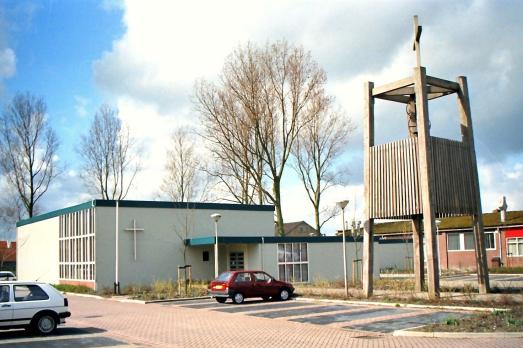
Onze Lieve Vrouw Geboorte
Dronrijp, NL
The Roman Catholic Church "Maria Geboorte" in Dronrijp was built in 1839, designed by architect A. van der Moer in the Water Board style; the contractor was PJ de Wal from Leeuwarden.
Here you can search for a building to visit. You can use the map find destinations, or you can use the filters to search for a building based upon what different criteria.
Dronrijp, NL
The Roman Catholic Church "Maria Geboorte" in Dronrijp was built in 1839, designed by architect A. van der Moer in the Water Board style; the contractor was PJ de Wal from Leeuwarden.
Ohé, NL
This church is listed as a National Monument of the Netherlands.
Oostrum, NL
Nave and slightly older narrower choir with three-sided closure, late Gothic, XV, restored in 1888, restored in 1952 after severe war damage. Later church perpendicular to the original building. Carved corbel and keystones in the choir. The inventory includes: statue of the Madonna, XIV; statue of Christ showing his wounds, XVd; Calvary group, XVd-XVIa, and some other statues. Mechanical tower clock, equipped with electric winding. This church is listed as a National Monument of the Netherlands.
Berkel en Rodenrijs, NL
Originally an early neo-Gothic church, WJ van Vogelpoel, 1864-1866. Major renovation and extension in 1925-1926, HCM van Beers. The side aisles were renewed, the tower was sheathed, the interior was executed in fair brickwork and the plastered wooden vaults were replaced by stone vaults.
Handel, NL
The rectory Roman Catholic Church (H. Maria Hemelvaart, already mentioned in 1434, consists of a nave, the western part of which was renovated in 1747 and the eastern part of which (probably the original choir) was renovated in 1696-1708. Side aisles along the eastern part, choir with extensions and tower (1902 and later by Dr. Pierre Cuypers (1827 - 1921) and the architect Joseph Cuypers (1861 - 1949)), the latter replacing a tower (XV). The western nave bays have bears, the eastern flat pilasters; simple windows closed with a segmental arch. In the eastern nave bay on the south side a support 1708. Above the closed entrances in the second bay stones with the coats of arms of the German Order: on the south side two with the coats of arms - Belderbusch (or -de Loe), -von Schonborn (?) and German Order Cross and on the north side a stone with the coat of arms of Hendrik van Wassenaar tot Warmond (around 1709). Internally, the western nave section has a slightly lower (stucco) vault than the eastern section. The church has: Wooden side altar (18th century) with altarpiece: Holy Family. Organ with 18th and 19th century components by an unknown maker. The Rugpositief was added in 1950 and is not protected. A carved oak organ counter (18th century), on which the coat of arms of Belderbusch (or -de Loe), with order cross. Two painted confessionals (18th century), one of which with carving and coat of arms of Belderbusch (or -de Loe) with order cross. Bell tower with chime consisting of three bells, of which two bells by A. Jullien, 1689, respectively diam. 59.5 cm and 51.5 cm and a modern clock. Mechanical tower clock, has been decommissioned.
Stein, NL
Third Roman Catholic church in Stein, in the post-war southern district and parish of Nieuwdorp.
Amsterdam, NL
The Parish Church of Our Lady Queen of Peace or Peace Church is a Roman Catholic church between the Pijnackerstraat and the Van Hilligaertstraat in the southwestern corner of the Pijp in Amsterdam-Zuid . The church has been the namesake of the Peace Church Square since 2004.
Andijk, NL
The Church of Our Lady of Seven Sorrows is a former Roman Catholic church building at Aalbersestraat 224 in the Geuzenveld district of Amsterdam .
Maria Hoop, NL
The Church of Our Lady Mother of Holy Hope is the parish church of Maria Hoop in the Dutch province of Limburg. It was built when the Passionist Fathers moved into the Passionist Monastery in 1925.
Amsterdam, NL
The Redemptorist Fathers commissioned the construction of this chapel next to their monastery at Keizersgracht 218. The monastery was consecrated on 5 November 1850.
new
For a long time, Europe was ruled by powerful monarchies. Monarchy and religion have been connected since time immemorial. Here are 7 sites across Europe where royalty historically bent the knee to a higher power and received their crown.
Stupas are symbols of enlightenment and peace that commemorate different stages of Buddha's life. Since the mid-20th century, thousands of stupas have begun to populate Europe. We have compiled some of the most impressive ones in this list.
Walter Maria Förderer (1928–2006) was a Swiss architect and sculptor renowned for his neo-expressionist church designs in the 1960s. In this list we have compiled 6 of his church designs that seamlessly integrate religious and secular elements.