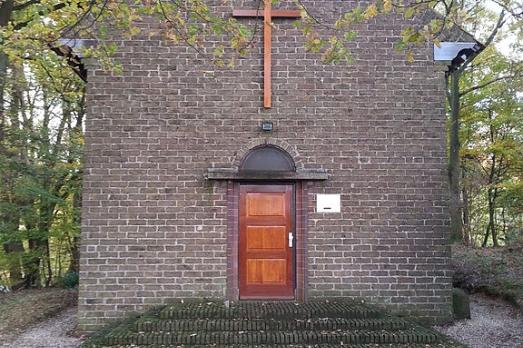
Onze Lieve Vrouw en al Haar Engelen
Arnhem, NL
Nice small church with roof turret situated on a hill. Year of construction: 1933; Architectural style: Delft School; Architect: G. Feenstra (1890-1985) .

Here you can search for a building to visit. You can use the map find destinations, or you can use the filters to search for a building based upon what different criteria.
Arnhem, NL
Nice small church with roof turret situated on a hill. Year of construction: 1933; Architectural style: Delft School; Architect: G. Feenstra (1890-1985) .
Leidschendam, NL
Extremely important modern church from 1960, designed by HC van de Leur. Round church hall with large windows on the south side. The roof is supported by concrete trusses that are centered in a skylight above the place of the celebration altar. On the east and north side of the round church hall is a lower extension, with open contact to the church hall: Intended to allow the faithful to take a seat in the light part of the church (at the front) but also to be able to offer sufficient seating when it is very busy. Entrance on the east side, with a day chapel and baptismal font. The baptismal font has its own skylight. Rectory in the same style by the same architect. Freestanding tower on the southwest side of the church, with a bell.
Kessel, NL
Damaged by war 1944, restored. Tower destroyed by war, rebuilt 1954.
Meije, NL
Single-nave neo-Gothic church without transept, but with tower. Many of such early neo-Gothic churches have disappeared in the meantime. That is also why the preservation of this church building is of great importance.
Blitterswijck, NL
Historic village church with tower. Tower 1455. Destroyed by war in 1944, rebuilt in 1951. (During this restoration the St. Anna chapel served as an emergency parish church).
Ohé, NL
This church is listed as a National Monument of the Netherlands.
Oostrum, NL
Nave and slightly older narrower choir with three-sided closure, late Gothic, XV, restored in 1888, restored in 1952 after severe war damage. Later church perpendicular to the original building. Carved corbel and keystones in the choir. The inventory includes: statue of the Madonna, XIV; statue of Christ showing his wounds, XVd; Calvary group, XVd-XVIa, and some other statues. Mechanical tower clock, equipped with electric winding. This church is listed as a National Monument of the Netherlands.
Berkel en Rodenrijs, NL
Originally an early neo-Gothic church, WJ van Vogelpoel, 1864-1866. Major renovation and extension in 1925-1926, HCM van Beers. The side aisles were renewed, the tower was sheathed, the interior was executed in fair brickwork and the plastered wooden vaults were replaced by stone vaults.
Lent, NL
Built in 1877-1879 to a design by architect G. te Riele Wzn. (1833-1911) in neo-Gothic style. The side aisles were added in style in 1925-1926. The church is of the cruciform basilica type with one west tower, a three-aisled nave, straight closed transepts, a short choir with three-sided closure and three-sided closed side chapels. The side aisles added in 1925 are one bay shorter on the west side than the central nave. The baptismal chapel is extended on the south side against the first bay of the central nave. The sacristy with hipped roof is located in the corner between the choir and the northern transept. The transepts do not extend beyond the nave. The ROOF of the central nave, the transept and the choir consists of two intersecting saddle roofs with the same ridge height. The roofs are placed between higher bricked gables with donkey backs and shoulders. The aforementioned saddle roofs, as well as the hipped roofs of the side aisles, chapels, sacristy and the constricted spire of the bell tower are covered with slates in Maasdekking. The spire is provided with four clocks at the point of constriction. The crowning consists of a wrought iron tower cross with weathercock. With the exception of the spire, the roofs drain via gutters laid on the bricked wall. A total of three dormers have been placed in the roof of the nave and the choir closure: wooden attic hatch, trefoil in gable top, hipped saddle roof with slates and piron.
Dronrijp, NL
The Roman Catholic Church "Maria Geboorte" in Dronrijp was built in 1839, designed by architect A. van der Moer in the Water Board style; the contractor was PJ de Wal from Leeuwarden.

new
For a long time, Europe was ruled by powerful monarchies. Monarchy and religion have been connected since time immemorial. Here are 7 sites across Europe where royalty historically bent the knee to a higher power and received their crown.

Stupas are symbols of enlightenment and peace that commemorate different stages of Buddha's life. Since the mid-20th century, thousands of stupas have begun to populate Europe. We have compiled some of the most impressive ones in this list.

Walter Maria Förderer (1928–2006) was a Swiss architect and sculptor renowned for his neo-expressionist church designs in the 1960s. In this list we have compiled 6 of his church designs that seamlessly integrate religious and secular elements.

How is Religiana helping to conserve and promote Religious Heritage in Europe and why should you get involved?
Find out about Religiana
Are you a tourism organisation or religious heritage sites manager? Discover the advantages of becoming a partner.
See current partners
We can keep you up to date with the latest news from Religiana and religious heritage conservation across Europe.
Sign up to the FRH newsletter