
Church of Saint-Ouen

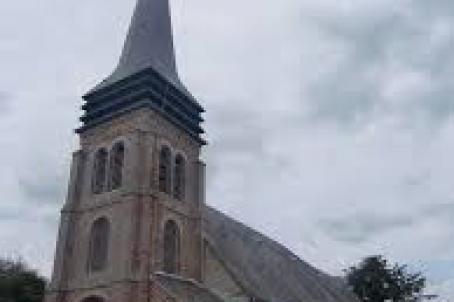
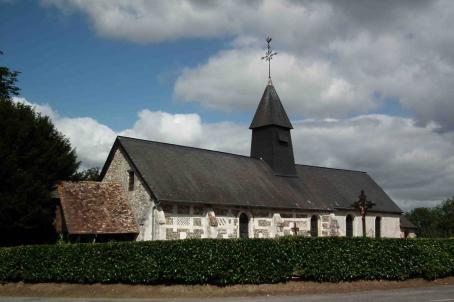
The Church of Saint-Ouen in Normandy was built around the 11th-12th century, and is composed of a Romanesque three span nave and a choir, set back, of three flat chevet bays. It is covered with a slate roof, and a sacristy rests against the east wall of the choir, and a belfry covers the cross of the transept. Inside the building, there are many classified objects.

About this building

The Church of Saint-Ouen is located in Saint-Ouen-des-Champs, in Normandy. It was built around the 11th-12th century, and is composed of a Romanesque three span nave and a choir of three flat chevet bays. It is covered with a saddle roof made of slates. A sacristy with cut sides leans against the east wall of the choir. A bell tower covers the crossing of the transept.

The nave was remodeled in the 15th century while the bell tower is rebuilt in the 17th century and the choir in the 18th century. The southern wall was rebuilt at the end of the 15th century, when the two flamboyant doors were created.

Inside the building, there are many classified movable objects, such as the tabernacle of the high altar, made of gilded wood in the seventeenth century and the wooden statues from the seventeenth century that represent the Madonna and Child, Saint Ouen, Saint Barbara, or Saint Charles Borromeo.
Key Features

  • Architecture

Other nearby buildings

Wikimedia Commons

Church of Saint-Grégoire

The Church of Saint Gregoire, listed as a Historic Monument, is located in Saint-Grégoire-du-Vièvre, Normandy. The church, built in the thirteenth century, was partly rebuilt after the Hundred Years War. The southern wall – rebuilt in the sixteenth century – has an alternating chessboard pattern of white stones and black-cut flint. You can see the graffiti of pilgrims representing characters and animals, as well as an amazing rebus that was probably made in the sixteenth century. The bell tower is from the 19th century.

Sauvegarde de l'Art Français

Church of Saint-Benoît

The Church of Saint-Benoît is found in Saint-Benoit-des-Ombres in Normandy. It was built in the 12th century, but today only part of the north wall of the nave and the chevet remain from the Romanesque period. Several changes were made in the sixteenth century. The entrance, which is molded with low arched lintel, is topped with an eighteenth century wooden statue representing Saint-Benoît. Among the furniture, several objects are classified, including a high relief representing the Martyrdom of St. Lawrence (fifteenth century) and the baptismal font (sixteenth century).

Jumièges Abbey

The complex is currently in ruins but remains part of the churches of Saint-Pierre and Notre-Dame. The abbey of Jumièges was founded in 652 by Saint Philibert. Following the Norman invasions in the 9th century, the Benedictine monks repopulated the abbey at the end of the 10th century, then William of Volpiano reformed the establishment. The abbey church of Notre-Dame was consecrated in 1067 and its choir was under construction in the 13th century. Saint-Pierre church combines pre-Romanesque (beginning of the nave) and Gothic (rest of the nave and choir).