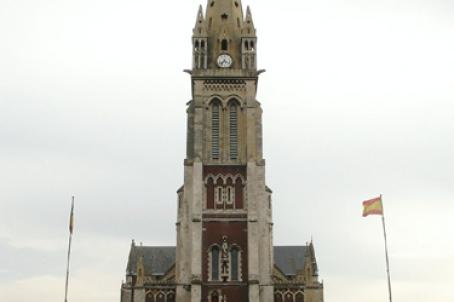
St-Nicolas de Calais Church

A new parish is erected in the eastern ZUP of Calais, developed for the housing of the workers of the Dunkirk ironworks. The religious authorities first foresee a large parish centre, on the scale of the number of inhabitants expected in the area. Calaisian architect Georges Wiart drew up a preliminary project corresponding to this ambition in 1965. But the reduction of the budget led in 1967 to changes in the project for the parish centre, which was built in 1971-1974.

About this building

The St. Nicholas Parish Centre is a modest building erected in reinforced concrete and covered with a flat roof. Located in the middle of the Beau-Marais ZUP, its volume blends discreetly into the high-rise apartment buildings. It includes a sanctuary, four meeting rooms and a dwelling, distributed around a covered patio. A bell tower rises on the street side, indicating the entrance to the sanctuary, marked by the presence of a large glass slab canopy. The church has a single nave and a metal roof terrace. The entire structure of the building is made of reinforced concrete.
Visitors information

  • Bus stop within 100m
  • Parking within 250m
  • Accessible toilets in the building

Other nearby buildings

Sainte-Marie-Madeleine au Petit Courgain Church, Calais

The work was quickly carried out and the building was completed well before St. Peter and the Sacred Heart, at a cost of 27,000 francs for the church and 8,000 francs for the presbytery. On March 8, 1868, the dean of Notre-Dame, Canon de Lencquesaing, delegated by Mgr. Lequette, Bishop of Arras, proceeded to the blessing and inauguration of the church, which was placed under the patronage of Saint Madeleine.

Saint-Joseph de Calais, Church

Father Georges Sauvage, appointed parish priest of Sainte-Madeleine on August 18, 1921, conceived the project of building a church that he planned to be quite large, as well as a presbytery and a workroom. Work was quickly undertaken. From September 1923 to December 1924, the work began under the direction of the architect Poyé. However, the ?nances were insufficient, and the work was interrupted. On December 24, 1924, Monseigneur Julien inaugurated the choir and a transept completed in the apse on the north side. From March 1924 to March 1925, a presbytery was created and on March 19, 1925, the church of Saint-Joseph was opened for worship.