Explore Religious Heritage Across Europe

Here you can search for a building to visit. You can use the map find destinations, or you can use the filters to search for a building based upon what different criteria.

Refine search

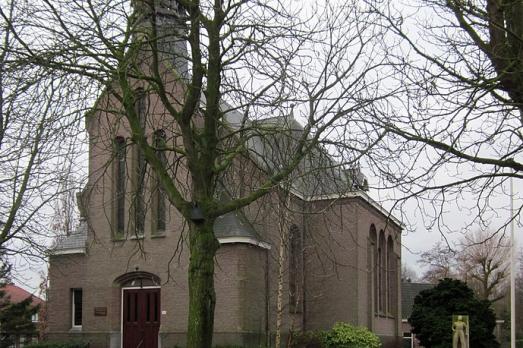
Reformed church

Nieuwerkerk aan den IJssel, NL

According to the church yearbook, the congregation of Nieuwerkerk aan den IJssel was founded on 28 June 1925. But it had already been happening for several years that the church council of Moerkapelle had been holding services in Nieuwerkerk. The reason is that there were a few in Nieuwerkerk and Ouderkerk aan den IJssel who wanted to join the old truth, but for whom the distance was too great to join Gouda, Moerkapelle, Rotterdam or Berkenwoude. There was also no Reformed Congregation in Capelle. The first service was held on Ascension Day 1919. At first, elders from Moerkapelle came to read, while Rev. Overduin catechised. But in 1920, an elder and a deacon were confirmed for the Nieuwerkerk aan den IJssel branch. On 28 June 1925, the Nieuwerkerk aan den IJssel branch became independent. Initially, church was held in a cleaned-up carriage factory. But in 1927 a piece of land could be bought for f. 250,-. The church was built on it, where the congregation still meets today. The total construction costs amounted to f. 8,000,-. The location was chosen between Nieuwerkerk and Ouderkerk, because in those early days a relatively large number of members came from Ouderkerk. The church still stands in a quiet place outside the village centre. In the thirties the church council was in dire straits. In order to build the church the congregation had had to borrow a lot of money, in the form of bonds. The church council was therefore no longer able to repay, and even saw no chance to pay interest for a year. On the advice of Rev. A. van Stuijvenberg, the consultant at the time, a seat fee was introduced: f. 2.50 per year. Nevertheless, the first 25 years of the congregation's existence were a time of steady growth. In 1925 it started with 28 professing members and 36 baptized members, together 64; in 1949 there were 203. Then a slow decline followed, so that in 1983 the congregation had dropped to 148 professing members and baptized members. Since then the number of members has been rising again, so that the latest yearbook mentions 89 professing members and 101 baptized members.

Reformed church

Rotterdam, NL

Built as a Reformed Church of the former village of Kralingen. Nice hall church with roof turret on the front facade.

Reformed Church, Szolnok

Reformed Church, Szolnok

Szolnok, HU

The reformed church was built in 1893-1894 and designed by the architect Sztehlo Otto in the neo-gothic style. It is the first Reformed church in the town.

Reformed church

Spijkenisse, NL

Beautiful modern church. The first members of Spijkenisse initially attended church in the Reformed Church in Poortugaal. On 1 January 1961, the first Sunday church service was held in Spijkenisse, in the Kontakt association building on Vredehofstraat. After first being a department of the church in Poortugaal, the church was established as an independent church on 21 March 1963. In 1967, the church community decided to build a church building. This church building was put into use on 22 February 1968, with 160 seats. In 1974, the number of seats was expanded to 280.

Reformed church

Ouderkerk aan de Amstel, NL

Reformed Church, built in 1773-1775 in the shape of a Greek cross, designed by the Amsterdam city architect JE de Wit. Beautiful lead-covered tower. Internal wooden barrel vaults. Furniture (pulpit, pew) from the 17th and 18th centuries. Organ with main work, upper work and pedal, made in 1865 by Flaes and Brünjes (Amsterdam). Bell frame with clock by Cornelius van Ammeroy, 1603, diam. 118.1 cm. Mechanical tower clock, circa 1880.

Reformed Church

Kattendijke, NL

This church stands on a mound. The current church originally dates from the beginning of the 15th century, but a lot was demolished and added. For example, the tower was added in 1630, and the choir was demolished in 1768.

Reformed Church, Avas

Reformed Church, Avas

Miskolc, HU

The Gothic Reformed Church of Avas is the oldest building in the centre of Miskolc. The construction of the church began in the 13th century in the Romanesque style. In 1544 the Turks set fire to the church, which was rebuilt from 1563 to 1569 and made Protestant. The Baroque mortuary in the south was built in 1760 and the neo-Gothic in the north in 1896.

Reformed church

Giessen-Oudekerk, NL

The church is a Gothic building of brick on a tuff base. The single-nave nave dates from the end of the fifteenth century or the beginning of the sixteenth century with a heavy, brick west tower. The wooden barrel vault was restored in 1657, according to the inscription on one of the tie beams. In 1838 the choir was demolished and the consistory was built in its place. During a restoration in 1952-1953 the floor was renewed and the window tracery in the windows changed. On this occasion the pulpit was moved. The ceiling was replaced in 1995.

Reformed Church Aarlanderveen

Reformed Church Aarlanderveen

Aarlanderveen, NL

The Hervormde Kerk (Reformed Church) in Aarlanderveen was built in 1905. It replaced an earlier church, which was demolished. Several artefacts were transferred from the older church to the new one including a pulpit with baptismal fence from the second half of the 17th century; a stone late Gothic baptismal font, used as a base for the pulpit; fronts of pews from the 18th century and two copper lecterns from the 17th century.

Reformed Church of St. Francis

Reformed Church of St. Francis

Lausanne, CH

The Reformed Church of St. Francis was built in the middle of the 13th century as a convent church. The complex burned down in 1368, but the church was rebuilt. In the late 19th and early 20th centuries, the church was threatened with destruction for town planning reasons, but it was eventually conserved and is now classified as a Swiss cultural property of national importance.

Be inspired

Stupkalnis.lt

10 Buddhist stupas to discover in Europe

Stupas are symbols of enlightenment and peace that commemorate different stages of Buddha's life. Since the mid-20th century, thousands of stupas have begun to populate Europe. We have compiled some of the most impressive ones in this list.