
Explore Religious Heritage Across Europe

Here you can search for a building to visit. You can use the map find destinations, or you can use the filters to search for a building based upon what different criteria.

Refine search

Reformed church

Langerak (ZH), NL

Brick Gothic village church with three-sided closed choir without buttresses (possibly 14th century), wide, single-nave nave with lower transept arms (16th century). The church is covered by wooden barrel vaults and was restored in 1912; the tower was restored in 1953. Inventory: pulpit (18th century); choir screen and baptismal screen (17th century); four copper chandeliers (18th century); two tombstones (17th century).

Reformed church

Rozenburg, NL

The Reformed Church in Rozenburg was instituted on 15 March 1855 and on 13 May 1888. In December 1944, a small part of the congregation declared itself Free. This is how the Reformed Church (Liberated) in Rozenburg was founded. The church building at Emmastraat 75 was built in the 1950s on a plot of land between the back gardens of two parallel streets. Partly due to its recessed location, the building is hidden between the surrounding buildings. The architect of the building was A. Warnaar in Maasland. In 1973, the church building was expanded on both sides. In 1983, the church building was expanded again for more spacious meeting facilities. The attention of the interior, which appears square due to the widening, is drawn to the organ front that has been expanded opposite the large church window.

Reformed church

Loppersum, NL

Modern church, built as Reformed Church (Liberated) to replace an earlier temporary home of this denomination. Since 2023 NGK

Reformed church

s-Gravenpolder, NL

Expansion 2005. The Old Reformed Church also struggles with a lack of space. Nothing changes at the front. Plans are made to build new buildings at the back, so that the current consistory can be incorporated into the church.

Reformed church

Ochten, NL

From the end of 1932 until its establishment as an independent municipality in 1946, Ochten was a department of Opheusden. In 1956, the municipality, previously also called the 'Keukenskerk', together with the mother municipality of Opheusden, left the association of Reformed congregations to join the 'withdrawn' Reformed Church in the Netherlands .
Reformed church

Sprang, NL

Reformed Church. Late Gothic church, consisting of a three-sided closed choir from around 1400, a three-sided closed southern transept from the beginning of the 15th century, a straight-closed northern transept from the middle of the 15th century; a three-aisled nave of which the three eastern bays are from the same period and of the same style as the choir, the three western bays are higher and wider, belong to a new building plan from the end of the 15th century, as does the west tower.

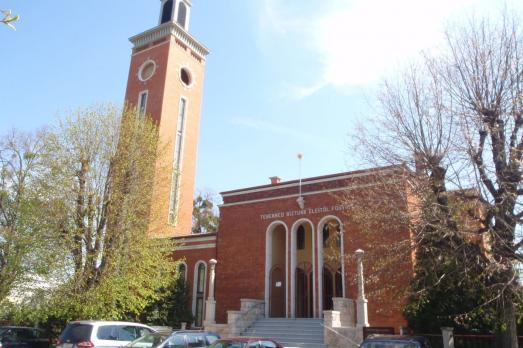
Reformed Church, Szolnok

Reformed Church, Szolnok

Szolnok, HU

The reformed church was built in 1893-1894 and designed by the architect Sztehlo Otto in the neo-gothic style. It is the first Reformed church in the town.

Reformed church

Lexmond, NL

Dutch Reformed cruciform church, Gothic building with tower from the first half of the 14th century and nave and choir from the second half of the 14th century. The interior contains a Strumpfler organ from the 18th century. The church also contains the coat of arms of the shooting guild and a funeral board of the Lords of Brederode. The church contains gravestones from the 17th and 18th centuries.

Reformed church

Sint Maartensbrug, NL

Building from 1696, later plastered with wooden tower on the west facade. Internally two rows of Ionic columns, wooden mirror vault. Oak pulpit, oak baptismal fence, two pews with canopy. Two copper lecterns, copper baptismal font holder, all last quarter 17th century; 17th century copper crown; tombstones. Small mechanical tower clock, 1872 (probably a Batstra clock), hook escapement with striking mechanism, electric winding. Three dials, each with one beautifully shaped hand.

Reformed church

Giessen-Oudekerk, NL

The church is a Gothic building of brick on a tuff base. The single-nave nave dates from the end of the fifteenth century or the beginning of the sixteenth century with a heavy, brick west tower. The wooden barrel vault was restored in 1657, according to the inscription on one of the tie beams. In 1838 the choir was demolished and the consistory was built in its place. During a restoration in 1952-1953 the floor was renewed and the window tracery in the windows changed. On this occasion the pulpit was moved. The ceiling was replaced in 1995.

Be inspired

Stupkalnis.lt

10 Buddhist stupas to discover in Europe

Stupas are symbols of enlightenment and peace that commemorate different stages of Buddha's life. Since the mid-20th century, thousands of stupas have begun to populate Europe. We have compiled some of the most impressive ones in this list.