Village church
Heerlen, NL
Simple church without tower. Various renovations. This church was in service until Sunday 15 November 2015. Then the church was closed for worship. The members of Heerlen are included in the municipality of Kerkrade.

Here you can search for a building to visit. You can use the map find destinations, or you can use the filters to search for a building based upon what different criteria.
Heerlen, NL
Simple church without tower. Various renovations. This church was in service until Sunday 15 November 2015. Then the church was closed for worship. The members of Heerlen are included in the municipality of Kerkrade.
Sleen, NL
In 1846, Vollebregt built an organ for the Kruisherenkapel in Sint Agatha. It had one keyboard and attached pedal. In 1871, Leonardus van Nistelrooij transferred it to the Kruisherenkapel in Uden. Van Nistelrooij probably expanded the organ with a positive. There are no indications that this happened in Sint Agatha, and in 1878 Kuijte noted the disposition with a positive. Around 1900, it was thoroughly restored. In September 1905, the organ was sold to Van Ingen. He placed it in the Reformed Church in Driebergen. After a restoration by Dekker in 1918, the organ remained unchanged until 1949. In that year, it was moved to Sleen by Hoogenboezem. In 1967, new wings, two pots and a harp were placed on the case, originating from the demolished organ from the Reformed Church of Dwingeloo. In 1968 W. Eppinga carried out work. He installed a new Mixture and a new Cymbel. In 1980 the wind chests were sealed and the mechanism was restored by Mense Ruiter. He later carried out another restoration, during which the pipework was restored. The starting point was the situation in 1871. On the main work the Gamba 8' was replaced by a Cornet III strong, and the Trumpet 8' that had never been installed was placed. The positive was also restored: the Sifflet 2' was replaced in the place where an Octave 2' stood, and the side slide with Cimbel III strong from 1968 was removed. Finally Mense Ruiter made an independent pedal with a Bourdon 16'. The instrument was put back into use on 8 May 1992.
Doornspijk, NL
Neoclassical church with tower. Extensions in 1950 and 1996. Since 2004 also in shared use as a Reformed Reformed Church.
Leiden, NL
Built as a Reformed Church. Church building without a tower, with, among other things, windows in neo-Gothic style. Replaced an earlier church hall from 1854. Restoration 1903. Out of use as a Reformed Church in 1957, when it was taken over by the Reformed Church (Liberated). After the merger in 2023, it became the NGK.
Heemskerk, NL
This church was first mentioned in 1063. It is unknown what it looked like. Over the centuries, a church was built of tuff, a grey volcanic stone from the Eifel, on the site of the current one. The tower was built in the 13th century from the so-called monastery bricks, these are large baked bricks that were used to build monasteries. The tower, built in Gothic style, probably originated in the first half of the fifteenth century. This can be deduced from the year 1464 on the bell. Just like the church, the bell was dedicated to Saint Laurentius. The bell had a social warning function. In the event of a storm, fire or other danger, the population was called to help or warned by ringing the bell. During the siege of Alkmaar in 1573, the Spanish demolished everything that was flammable from the church. Only the tower remained intact. In the meantime, the Reformation had taken place. After the departure of the Spanish soldiers, the reconstruction by the Protestants began. It became a hall church without a choir in Gothic style. The church was rebuilt in 1628. A year later the church was completely finished. Since 1798 the tower has been municipal property. In 1970-1971 the tower and the church were restored
Nieuw-Lekkerland, NL
Church building, because of the organ, a pulpit, a baptismal fence and a pew in it. The church building was built in 1847-1848 to a design by D. Slingerland from Meerkerk on the site of an older predecessor. The church was expanded several times in later times, most recently in 1994, when the layout in the church was changed. The inventory mentioned is partly from the predecessor of the current church, which dates from 1646 and was built on the site of a burnt-down church from the 15th century. The organ and the pew were added in the 19th century by order of the lords of the manor Smit from Nieuw-Lekkerland. In addition to the parts that are worthy of protection by the state, the church building also contains five 17th-century gravestones, three copper church crowns, which have been modified and partly renewed, and 12 cast-iron wall fixtures (1881). The protection does not apply to these parts.
Durgerdam, NL
Small village church with tower. The Dorpskerk Durgerdam, originally the Hervormde kerk van Durgerdam, is the Protestant church in Durgerdam in Amsterdam-Noord. The church building is not along the Durgerdammerdijk, but a little lower behind it.
Leusden, NL
Dutch Reformed Church, 1828; hard stone entrance, pointed arch windows, bell tower on the roof. Single manual organ, made in 1871 by H. Knipscheer. Mechanical tower clock on oak chair, 1870, Firma Haak, Gebr. Caminada and Dupont in Rotterdam, has been decommissioned.
Leiderdorp, NL
The predecessor of this church was the St. Michael or St. Pancratius Church, which was built around 1200. In 1470, the English king Edward IV was locked up in the dungeon of the old church for a night. During the siege of Leiden in 1573-1574, the church was destroyed by the Spanish. In 1620, the current church was built on the same spot. The original building was rectangular with a high window in the west and east facades. That high window is now only visible in the east facade, because an organ was built in 1781. A portal was built and the bellows of the organ were placed in the attic. In 1846, a tower was built on the entrance portal and the roof turret was demolished. In 1965 this tower was demolished again, and the roof turret was rebuilt, during the major restoration that was carried out in the years 1965-1970. In the interior two pews against the facades stand out, both from the year 1687: the government pew against the north facade and the canopy pew against the east facade. During the restoration, the original pulpit was replaced by a pulpit with baptismal fence from the 17th century, originating from the church of Opmeer in North Holland. The lighting in the church has consisted successively of candlelight, kerosene lamps, gas lamps and electric lamps. In the church floor you will find gravestones from the 16th, 17th and 18th centuries. The cemetery behind the church is no longer in use as such. Next to the church is a large building, the Trefpunt. This building served as a parsonage until 1946. It is now a building in which church and social activities take place.
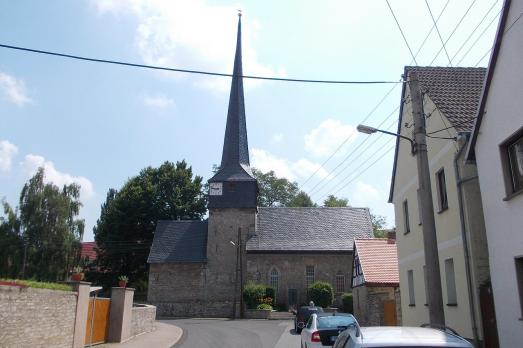
Weimar, DE
The village church of Gelmeroda was built from the 13th century. At the beginning of the 13th century, the oldest part of the choir tower church was built. The nave was built in the 14-15th century and rebuilt later. During the GDR era, the church was abandoned. The citizens of the village and the surrounding area became active as members of an association and saved the building from decay. After extensive renovation work, the church was consecrated again in 1991 and in 1994 it became the first church in the new Länder to be granted the status of a motorway church.

new
For a long time, Europe was ruled by powerful monarchies. Monarchy and religion have been connected since time immemorial. Here are 7 sites across Europe where royalty historically bent the knee to a higher power and received their crown.

Stupas are symbols of enlightenment and peace that commemorate different stages of Buddha's life. Since the mid-20th century, thousands of stupas have begun to populate Europe. We have compiled some of the most impressive ones in this list.

Walter Maria Förderer (1928–2006) was a Swiss architect and sculptor renowned for his neo-expressionist church designs in the 1960s. In this list we have compiled 6 of his church designs that seamlessly integrate religious and secular elements.

How is Religiana helping to conserve and promote Religious Heritage in Europe and why should you get involved?
Find out about Religiana
Are you a tourism organisation or religious heritage sites manager? Discover the advantages of becoming a partner.
See current partners
We can keep you up to date with the latest news from Religiana and religious heritage conservation across Europe.
Sign up to the FRH newsletter