
Explore Religious Heritage Across Europe

Here you can search for a building to visit. You can use the map find destinations, or you can use the filters to search for a building based upon what different criteria.

Refine search

Grote Kerk

Neede, NL

In May 1929, the restoration of the Reformed Church in Neede was started. In order to install the central heating, the wooden floor was broken open. In the process, fragments of a sculpture were found in the middle of the building.

Grote Kerk

Drachten, NL

The first stone of this church was laid in 1742 by Hector Livius van Haersma, aged 5. Because Drachten was a peat digging village at the time, the weather vane shows 3 peat pieces.

Grote Kerk

Grote Kerk

Alblasserdam, NL

The Grote Kerk in Alblasserdam is a historic church erected in 1899 in a Neo-Gothic style. The last restoration took place in 2004. It is listed as a National Monument of the Netherlands.

Grote Kerk

Oostzaan, NL

Important large church with a defining wooden tower. Since 1986 Samen op Weg (merger process Dutch Reformed, Reformed and Lutheran). In 2004 a modern multifunctional centre was built against the left side wall of the church, named "Bartel Jacobsz Centrum". In the early 2010s managed by a Foundation, which campaigns for preservation and necessary restoration, which took place in 2015 - 2017. This church is listed as a National Monument of the Netherlands.

Grote Kerk

Nieuwleusen, NL

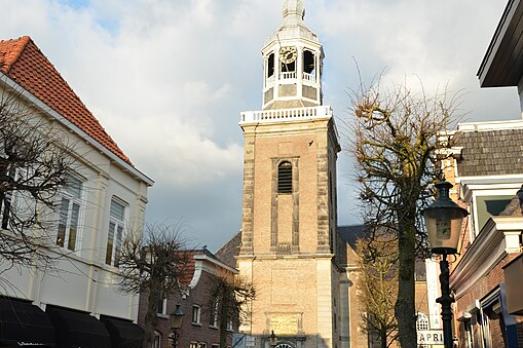
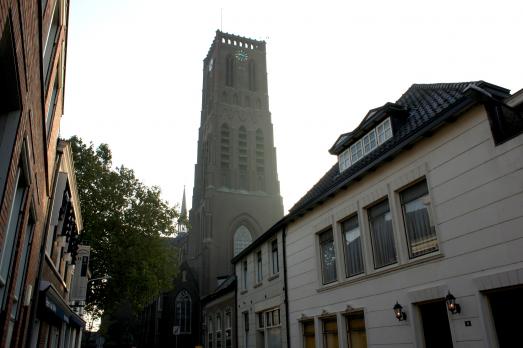
On 21 March 1829 it was decided to demolish the old church, which dated from 1662, and to build a new church. The tender for the construction took place on 2 May 1829 and the construction was awarded to Gebr. A. Brouwer, contractors in Meppel. The contract price was 7,500 guilders. On 9 June 1829 the demolition of the old church was started. The then mayor Van der Gronden laid the first stone. The church was completed on 1 July 1829.
Grote Kerk

Driebergen-Rijsenburg, NL

The current reformed church stands on the site where a chapel was built in the fourteenth century. The first mention of the chapel dates from 1381. The then lord of Driebergen is considered the founder of the chapel: Willem van Abcoude.

Grote Kerk

Hoogeveen, NL

Built as a Reformed Church. Expansions 1766, 1801 and 1804. The Grote Kerk is closely linked to the history of the place Hoogeveen. At the beginning of the dyeing in 1631, by the General Company of the 5000 Tomorrow, it was determined that an area of 100 tomorrow had to be kept separate from peat including ground. The proceeds were for church, school and the poor.

Grote Kerk

Gorinchem, NL

Built in 1849-51 to a design by I. Warnsinck on the site of the Gothic hall church that had been demolished in 1844 and in connection with the - separately protected - medieval Sint Janstoren. The church building, built in red brick, alternating with yellow ornamental bricks, on a natural stone plinth under slate-covered saddle and lean-to roofs, is straight-ended and contains an extended entrance portal on the east side, with the main entrance fitted with double panelled doors, a semi-circular and subdivided fanlight, a wooden pilaster frame and two lanterns with a wrought-iron volute arm, as well as a rose window in the pointed top and narrow side entrances on either side of the portal.

Grote Kerk

Sliedrecht, NL

Dutch Reformed Church. Simple building of late 18th century character, with three-sided closures on the east and west sides, an extension with pediment on the north side and a heavy brick tower on the west side, the lower part of which gives the impression of being late medieval, but which otherwise dates from the 19th century. Inventory: beautifully carved pulpit with baptismal fence and decorated psalm boards in Lod. XV shapes. Richly carved organ case in transition Lod. XIV-Lod. XV. In it an organ with main work, upper work and free pedal, built in 1852 by CFA Naber (Deventer). Bell tower with bell by H. Meurs, 1604, diam. 91 cm.

Grote Kerk

Harlingen, NL

Reformed Church. The Reformed Church was built in 1772-1776 on a cruciform plan, replacing a Romanesque church, of which the tall tuff stone tower was preserved. Three natural stone entrance frames. Interior completely plastered to a design by JOHusley; in one of the walls at the top a clock face framed by stucco. Circulating gallery on marble columns; on the corners groups of benches. Organ with Hoofdwerk, Rugwerk and free Pedal, made in 1776 by AA Hinsz on gallery with associated pulpit below, all with carvings by JG Hempel. Many gravestones.

Be inspired

Stupkalnis.lt

10 Buddhist stupas to discover in Europe

Stupas are symbols of enlightenment and peace that commemorate different stages of Buddha's life. Since the mid-20th century, thousands of stupas have begun to populate Europe. We have compiled some of the most impressive ones in this list.