
Explore Religious Heritage Across Europe

Here you can search for a building to visit. You can use the map find destinations, or you can use the filters to search for a building based upon what different criteria.

Refine search

H.H. Petrus en Paulus

Maassluis, NL

This church building replaced the Andreaskerk and the Petrus & Pauluskerk . The first pile for the new parish church of the HH Andreas, Petrus and Paulus was driven on 21 September 2004. The church replaced two other Roman Catholic church buildings in Maassluis.

H.H. Petrus en Paulus

H.H. Petrus en Paulus

Aarlanderveen, NL

The church of SS Peter and Paul in Aarlanderveen is a Neo-Gothic church with a high tower built in 1897 according to the designs of Joseph Cuypers (1861 - 1949). It is listed as a Municipal Monument.

H.H. Petrus en Paulus

Den Helder, NL

Important neoclassical church, with tower/roof turret from 1844. Also called "PP church". Meritorious refurbishment of the interior in 2002. After the closure of 2 other churches, the OL Vrouw Onbscherpen Ontvangen in 1990, and the St. Nicolaas in 2009, this is the only Roman Catholic parish church in the whole of Den Helder. On 11 October 2015, festive attention was paid to the 175th anniversary of this church building.
H.H. Petrus en Paulus

Schaesberg, NL

Roman Catholic Church. Tower, single-aisled nave and two transepts against the nave from the years 1649-'99. Choir and transept, 1914. Pulpit, approx. 1700, baptismal font 17th century, 8 paintings, four pairs of cast copper candlesticks (17th century). Gravestone of Frederik van Schaesberg, approx. 1733. In the churchyard a hardstone cross, on which a small Calvary and 'memento mori'; ten stone grave crosses, 1710-1811; some fragments of sculptures. Mechanical tower clock.

H.H. Petrus en Paulus

Goor, NL

Three-aisled neo-Gothic pseudo-basilica without transept and tower, built under slight influence of the late Lower Rhine and Westphalian Gothic. Facade flanked by two low stair towers, simple roof turret above the choir. Plastered interior, provided with cross-ribbed vaults. During the liturgical renovations in the 1960s, the interior was simplified, whereby the neo-Gothic altars disappeared. The glazing is still intact. Behind the choir, modern extension De Borgh.

H.H. Petrus en Paulus / Paradijskerk

Rotterdam, NL

Old Catholic Church of Sts. Peter and Paul. Church in neo-baroque style by PA Weeldenburg, 1908. Altar, communion bench, pulpit, baptismal font 18th century, as well as rich silverware, all from the clandestine church built in 1718 on the Delftsevaart.

H.H. Petrus en Pauluskerk

H.H. Petrus en Pauluskerk

Arcen, NL

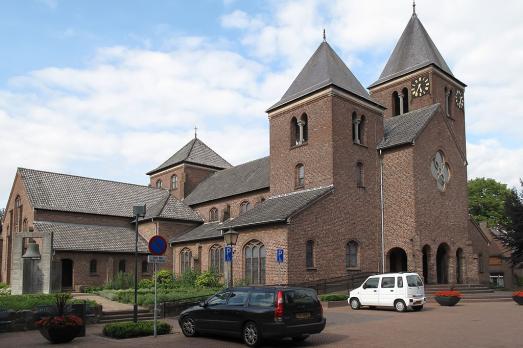
Important reconstruction church, which replaced the predecessor destroyed in 1944. The current church from 1959 was designed by Hendrik W. Valk, in collaboration with FH Stoks. One of the last works from Valk's oeuvre, in traditionalist forms, on a so-called Christocentric floor plan. Asymmetrical front with two towers of different heights.

H.H. Philippus en Jacobus

Koewacht, NL

This (interesting) church has always been on Belgian territory. The Dutch in the Zeelandic Flemish Koewacht initially went to church in the Belgian Koewacht, from 1687 in a chapel, later in a new church that was consecrated in 1714. After the border was closed during the First World War, a Roman Catholic emergency church was built on the Dutch side of the border. This was replaced in 1922 by the definitive church of the HH Philippus en Jacobus, the church that is still in use today.

H.H. Simon en Judas

Reutum, NL

Reconstruction church with tower. On the site of the previous church.

H.H. Simon en Judas

Lattrop, NL

Protestant families in Lattrop and Breklenkamp were prepared to sign a petition from G. Rikkink and J. Groeneveld in 1816 to help the parishioners in Lattrop and Breklenkamp to their own church. In addition to the reasons already given by Bentinck about the distance to Ootmarsum and the large amount of water in the Dinkel in the winter, the unsuitability of the current location is now discussed in detail: “In the aforementioned farmhouse, which according to local custom contains the home of the householders and the stable for the cattle without a partition or dividing wall, and therefore directly with and in the presence of horses and cows to attend the Holy Mass and sermon”. According to tradition, three locations are eligible for these special clandestine churches: 1. A barn on the Bodde farm on the Bergvennenweg. 2. The barn on the former Pikkemaat farm on the Frensdorferweg. 3. On the Scholte Lubberink estate on Dorpsstraat. Coach house with wall of former peat storage at church in Lattrop

Be inspired

Stupkalnis.lt

10 Buddhist stupas to discover in Europe

Stupas are symbols of enlightenment and peace that commemorate different stages of Buddha's life. Since the mid-20th century, thousands of stupas have begun to populate Europe. We have compiled some of the most impressive ones in this list.