Heilige Johannes' Onthoofding
Nuland, NL
This church is listed as a Municipal Monument of the Netherlands.

Here you can search for a building to visit. You can use the map find destinations, or you can use the filters to search for a building based upon what different criteria.
Nuland, NL
This church is listed as a Municipal Monument of the Netherlands.
Eindhoven, NL
Until 1796 a reformed (also called: reformed) church, then Roman Catholic, demolished in 1885. In 1884 the foundation stone was laid for the current Roman Catholic St. Joriskerk. Hendrik van Tulder from Tilburg drew the design. The church was put into use in 1885. A tower with side chapels was added in 1910 to a design by Jac. van Gils. Restoration started in 2003.
Haarlem, NL
Exceptionally important neoclassical church. Main work of architect HH Dansdorp. Roman Catholic Church of St. Joseph, consecrated 1843. From 1853 to 1898 cathedral of the re-established Diocese of Haarlem. Extended for this purpose in 1856. Large neoclassical church with turret on the front facade. Architect: HH Dansdorp; three-aisled neoclassical church, provided with a barrel vault over the central nave. Façade of natural stone; high round columns carry tympanum, round dome tower on Corinthian columns. Largely late nineteenth-century decoration and inventory.
Enschede, NL
Extremely important, iconic, late neo-Gothic church with a high tower.
Doenrade, NL
Charming neo-Gothic village church with tower.
Meers, NL
The St. Josef Church is a Roman Catholic Church built in 1910 and expanded in 1932.
Smakt, NL
Before the war, there were already plans to replace the previous neo-Gothic pilgrimage church from 1886 with a new building. The intention was to be able to put a new church into use in 1949 - then the Smakt would have been a place of pilgrimage for 250 years. However, these plans led to nothing. However, the rectorate of De Smakt was transferred to the Discalced Carmelites in 1949. The existing church was renovated. In 1965 it became clear that the old church was becoming too small. The new church would have to have at least 200 seats with wide aisles and plenty of standing room with a view to the pilgrims. Money had been collected for a new church since 1963. The pilgrims donated approximately 100,000 guilders in three years. In 1966, the Carmelites approached architect JJ Fanchamps to draw up the new building plans. The foundation stone was laid on 24 June 1968, after which contractor Koenen from Holthees completed the church, so that it could be blessed by Mgr. Beel on 11 March 1969. The new church is connected to the Carmelite monastery. De Smakt is the only place of pilgrimage in the Netherlands where St. Joseph is specifically venerated. Every year, around 20,000 people visit De Smakt, especially in the month of March, to venerate St. Joseph. The pilgrimage complex currently consists of the Joseph Chapel (1699), procession park (ca. 1900), the Pilgrim House (1910), the Carmelite monastery (1949) and the Joseph Church (1969). The Pilgrim House should have been demolished to create a better entrance and improve the view of the church, but this plan was not carried out due to a lack of finances. Something similar applied to the monastery: only half of it was built.
Hooglanderveen, NL
During the Reformation, the Catholics in this region were served by Jesuits from Nijkerk. Services were held in 't Veen in the 'Sandhuysken'. Later, the residents of 't Veen came under Hoogland and went to church in Hoogland (an hour and a quarter's walk) or Amersfoort (no less than 1 to 2 hours' walk). Around 1853, the desirability of establishing a separate parish for this part of Hoogland and Hoevelaken was first mentioned. Due to all kinds of difficulties, the plans for a separate parish could not be realised until 1917. The population of Hooglanderveen had increased in the meantime, partly due to the construction of the railway. This increase in families also caused problems with regard to catechism education for children who had to travel far too far for this.
Noordwijkerhout, NL
Roman Catholic Church built in 1916. This church is listed as a National Monument of the Netherlands.
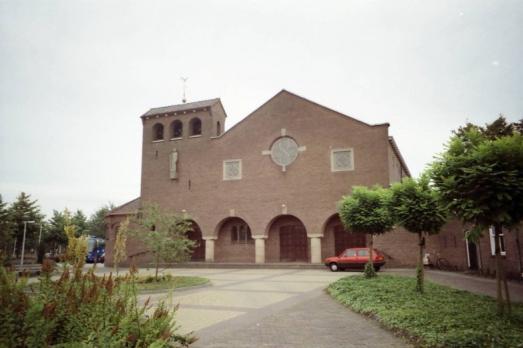
Almelo, NL
Heilige Jozef is a Roman Catholic church built in 1953 in Almelo. It was built in the style of the Delft School.

new
For a long time, Europe was ruled by powerful monarchies. Monarchy and religion have been connected since time immemorial. Here are 7 sites across Europe where royalty historically bent the knee to a higher power and received their crown.

Stupas are symbols of enlightenment and peace that commemorate different stages of Buddha's life. Since the mid-20th century, thousands of stupas have begun to populate Europe. We have compiled some of the most impressive ones in this list.

Walter Maria Förderer (1928–2006) was a Swiss architect and sculptor renowned for his neo-expressionist church designs in the 1960s. In this list we have compiled 6 of his church designs that seamlessly integrate religious and secular elements.

How is Religiana helping to conserve and promote Religious Heritage in Europe and why should you get involved?
Find out about Religiana
Are you a tourism organisation or religious heritage sites manager? Discover the advantages of becoming a partner.
See current partners
We can keep you up to date with the latest news from Religiana and religious heritage conservation across Europe.
Sign up to the FRH newsletter