Explore Religious Heritage Across Europe

Here you can search for a building to visit. You can use the map find destinations, or you can use the filters to search for a building based upon what different criteria.

Refine search

Heilige Nicolaas

Haren, NL

New Roman Catholic parish church for Haren, consecrated in 1959. Hall church on an asymmetrical floor plan, with a roof that slopes gently towards the apse, symbolically creating the shape of a ship. On the north side there is a side aisle closed off by a stained glass wall with main portal, baptismal chapel and a small bell tower. An important work in the oeuvre of JAA Dresmé, also a remarkable and important example of (liturgical) innovation in Roman Catholic church building around 1960, stylistically slightly influenced by the work of Le Corbusier. As an example of post-war Roman Catholic church building in the province of Groningen, the church has a rarity value.

Heilige Nicolaas

Lutjebroek, NL

St. Nicholas, 1876-1877, Pierre Cuypers (1827 - 1921). Three-aisled neo-Gothic pseudo-basilica with octagonal crossing, covered by a star vault. Round pillars with moulded capitals. According to the first design, the church had almost the layout of a central building; during the execution, the nave and transept were extended and later Cuypers added two rectangular, diagonal chapels in each of the corners of the crossing. Next to the nave a sober tower, decorated with pointed arch niches and crowned by a high spire. Extension 1924-1925 with, among other things, widening of the side aisles and porch, to a design by Joseph Cuypers (1861 - 1949) and Pierre Cuypers Jr (1891 - 1982). During a modernisation of the interior in 1966-1967, much of the neo-Gothic inventory was removed, including three altars; the five stained glass windows in the apse windows have been preserved. Mechanical tower clock by Eijsbouts, 1917, equipped with electric drive. Restorations in 1982 and 2010.

Heilige Nicolaas

Meijel, NL

This church was a neo-Gothic cruciform church by father and son Van Groenendael, probably in collaboration with mgr. H. Wouters, director of the Episcopal College in Weert and a brother of the pastor in Meijel. The church thus obtained was called the 'cathedral of the Peel' because of its beauty and large size. Because the new church was built on the same site as the old one, the parish was dependent on an emergency church, which remained in use from 1901 until the blessing of the new building in 1904. The church was not yet fully furnished upon completion, a process that continued until 1944.

Heilige Nicolaas en Antonius

Monnickendam, NL

Neo-Gothic church with tower. Beautiful stained glass windows. This church is listed as a Municipal Monument of the Netherlands.

Heilige Nicolaasbasiliek

Heilige Nicolaasbasiliek

Amsterdam, NL

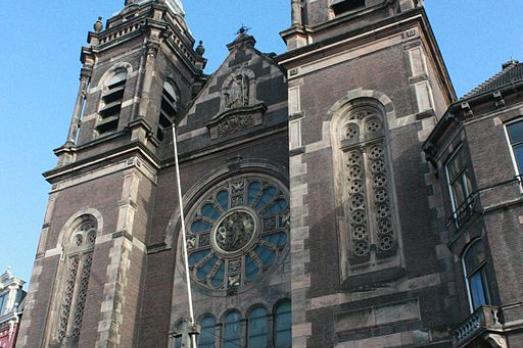
The Basilica of St. Nicholas ( St. Nicholas Church ) is a Roman Catholic church in the city centre of Amsterdam . The church, officially called St. Nicholas within the Veste , was built in the period 1884-1887 to a design by the architect Adrianus Bleijs (1842-1912).

Heilige Nikalaos

Rotterdam, NL

Nice little church, designed after Greek Orthodox churches, but with Dutch unpainted brick material. This Greek Orthodox church was built in Rotterdam in 1957. The church, which is dedicated to Saint Nicholas, is an important symbol for the Greek community in the Netherlands. The construction of the church was a long process. Shortly after the Second World War, the Association of Greeks in the Netherlands started a fundraising campaign to finance the construction. The Greek community in the Netherlands was still small at the time, but the need for its own church was great. The church was designed by the Dutch architects ir De Jongh, Taen and dr ir Thomas Nix. The design was inspired by Byzantine architecture, which plays an important role in the Greek Orthodox tradition. The church has a cross-shaped floor plan and is built of brick. The facade is decorated with a mosaic of Saint Nicholas. The construction of the church was completed in 1957 and was consecrated by the Greek Metropolitan Damaskinos of Chios. The church has since become an important centre for the Greek community in the Netherlands. Here Greeks from all over the Netherlands come together to pray, celebrate and meet each other.

Heilige Norbertus

Gennep, NL

The St. Norbertus parish was founded on 24 June 1980. The church board wanted a sweet and atmospheric church building, which would be inviting for church services, whereby the forest edge had to be taken into account on behalf of the municipality. In May 1981, pastor Celie announced that the church board had chosen the architectural firm Renser Van Groningen from Boxmeer. The first stone was laid on 8 September 1985. Mgr. A. Castermans consecrated the church on 15 June 1986.

Heilige Oda

Melderslo, NL

The first church was built in 1921 to a design by Joseph Franssen. This was destroyed by war in 1944 and replaced with the current one from 1952.

Heilige Odulphus

Assendelft, NL

The first Sint-Odulpuskerk in Assendelft was built around 1410, but was transferred to the Protestants during the Reformation in 1582. The Catholics of Assendelft used clandestine churches in the centuries that followed , until a new church was built in 1853. However, this water board church turned out to be too small and dilapidated after a few decades, which is why it was decided to build a new church in 1883.

Heilige Odulphus

Best, NL

Beautiful neo-Gothic church with a defining tower. 1884 tower, spire destroyed by war in 1944, renewed in 1959. In the middle of last (which?) year the clock on the railway side in the tower of the Roman Catholic St. Odulphus Church stood still. Worn out. A restoration would cost over 7000 euros. A well-organized campaign yielded over 12,000 euros in a short time. The clock was restored in the fall of 2006. And with the money that was left over, the bell of the St. Odulphus Chapel next to the church could be repaired so that it can make its voice heard again.

Be inspired

Stupkalnis.lt

10 Buddhist stupas to discover in Europe

Stupas are symbols of enlightenment and peace that commemorate different stages of Buddha's life. Since the mid-20th century, thousands of stupas have begun to populate Europe. We have compiled some of the most impressive ones in this list.