Heilige Willibrordus
Berkel (NB), NL
A church was already mentioned in Berkel in 1214. It is known that the building was renovated in 1440. In 1983, large foundations of that church were exposed in, among other places, the garage of the rectory.

Here you can search for a building to visit. You can use the map find destinations, or you can use the filters to search for a building based upon what different criteria.
Berkel (NB), NL
A church was already mentioned in Berkel in 1214. It is known that the building was renovated in 1440. In 1983, large foundations of that church were exposed in, among other places, the garage of the rectory.
Middelbeers, NL
This church is listed as a National Monument of the Netherlands.
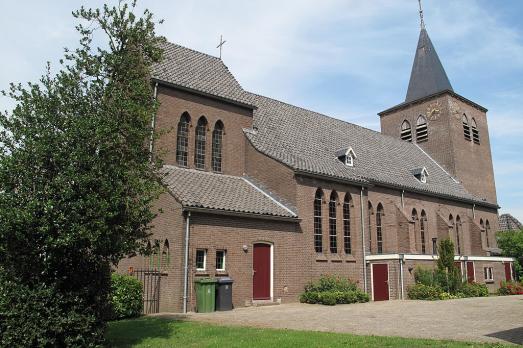
Achter-Drempt, NL
The Heilige Willibrordus church is a Roman Catholic temple dating from 1936. It was built according to the designs of HCM van Beers in traditionalist forms and influenced by the Delft School.
Oegstgeest, NL
Iconic neo-Gothic church with a tower placed sideways, next to the choir. Around 1900, the church from 1772 became too small and it was decided to build a new church and parsonage. The architectural firm Cuypers/Stuyt was commissioned to do this. Father Cuypers was the builder of the Central Station and the Rijksmuseum in Amsterdam. Son Cuypers built the new St. Bavo Cathedral in Haarlem. The Holy Willibrord Church was therefore not built by just anyone. The church is a fine example of neo-Gothic church architecture from that period.
Sint Willibrord, NL
In 1841 a parish was founded and a church built. Since 1885 Sint Willebrord has been a place of pilgrimage. In that year a first Lourdes grotto was built. In 1925 a new church was built. The original design by pastor Bastiaansen, a representation of the Basilica of Lourdes, was elaborated by the architect Jacques (NJH) van Groenendael from Breda. In front of the church is a procession park.
Klein Zundert, NL
Originally, Klein Zundert had a medieval church. This building was restored somewhat around 1610, after severe damage in the Eighty Years' War, and made usable, and partly provided with a new interior. In 1645, further renovation and restoration followed, during which armorial glasses were also installed, made by the 'glass writer' Jean de la Habarre. Again, new altars were installed, including two side altars with lecterns, by Alph. Jordaens, and a pulpit by Hendrik van Velmen, modelled on the one in Minderhout.
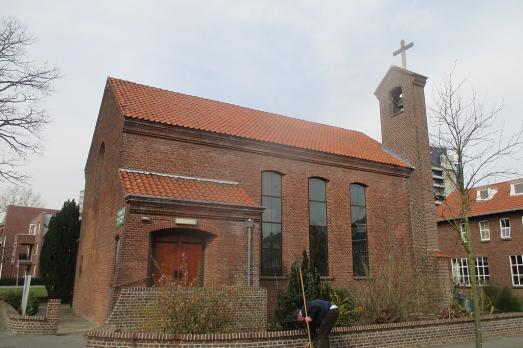
Arnhem, NL
The church building dates from 1941, which was of course a strange time to build a church. On the other hand, it was not yet known at that time whether the German occupation would be permanent.
Neerkant, NL
Hall church on an almost rectangular plan, consisting of a partly exposed concrete skeleton, filled with brick. A detached, openwork bell tower and semi-detached baptismal chapel to the side. Front facade with simple narthex. The central nave is covered by a curved concrete shell roof. As a whole, the church is an important example of renewal, also a fairly exceptional early example of modernism in Roman Catholic church architecture from the 1950s. This church is listed as a Municipal Monument of the Netherlands.
Heiloo, NL
Interbellum church, characteristic work by J. Stuyt. Three-aisled basilica with a far projecting transept on either side. Tower to the right of the front facade. The exterior was plastered white until about the mid-1980s.
Deurne, NL
The Saint Willibrordus Church in Deurne is a Gothic church with a tower, with elements from the neo-Gothic style.

new
For a long time, Europe was ruled by powerful monarchies. Monarchy and religion have been connected since time immemorial. Here are 7 sites across Europe where royalty historically bent the knee to a higher power and received their crown.

Stupas are symbols of enlightenment and peace that commemorate different stages of Buddha's life. Since the mid-20th century, thousands of stupas have begun to populate Europe. We have compiled some of the most impressive ones in this list.

Walter Maria Förderer (1928–2006) was a Swiss architect and sculptor renowned for his neo-expressionist church designs in the 1960s. In this list we have compiled 6 of his church designs that seamlessly integrate religious and secular elements.

How is Religiana helping to conserve and promote Religious Heritage in Europe and why should you get involved?
Find out about Religiana
Are you a tourism organisation or religious heritage sites manager? Discover the advantages of becoming a partner.
See current partners
We can keep you up to date with the latest news from Religiana and religious heritage conservation across Europe.
Sign up to the FRH newsletter