Kruisheuvelkerk
Leidschendam, NL
Built as a Reformed church. Interesting modern church with tower.

Here you can search for a building to visit. You can use the map find destinations, or you can use the filters to search for a building based upon what different criteria.
Leidschendam, NL
Built as a Reformed church. Interesting modern church with tower.
Buitenpost, NL
Neo-Gothic church without tower. Expansion 1923 to T-shape, 2008 Kruiskerk. As of January 1, 2008, the PKN congregation was formed. The Reformed Church is now called Kruiskerk. (59-08)
Delfzijl, NL
Reformed church building, cruciform church with small spire. Even before the war, attempts were made to create a new church building to replace the existing Reformed church from 1859. A new rectory was the result, but the war prevented further plans. The originally desired high tower was not permitted. In the end, it became a small spire. The executing architectural firm was F. van der Laan from Delfzijl, who also designed the 22 narrow stained glass windows. The opening took place on 24 June 1953.
Heerde, NL
Interesting interbellum church, designed by the famous architect FB Jantzen. Renovated and expanded in 1985.
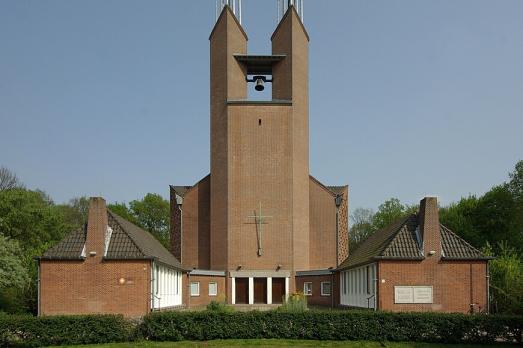
Amstelveen, NL
The Kruiskerk in Amstelveen , located at Van der Veerelaan 30a, was designed by architect Ir. Marius Duintjer . The church was built in 1949 - 1950 by order of the Reformed Church and put into use on 11 May 1951.

Amsterdam, NL
The church has been in use as a Christian Church from its construction until now. For a number of years this was CGK/NGK. A multicultural mission church since 2004.
Marum, NL
The Kruiskerk is a church of the Protestant Community of Marum built in 1926.
Baarn, NL
Until 1965, this church was simply called "Gereformeerde Kerk". A second Reformed church was named "Laanstraatkerk"; it was demolished in 1962. After the Opstandingskerk was put into use, early 1965, this older church was named "Kruiskerk". In 1965-1966, an internal renovation took place that was not very successful, including new pews and a new pulpit under the organ. Due to the demolition of the Opstandingskerk in 1995, the name of this older church was changed again to "Paaskerk". The symbolism in terms of naming over time is clear and logical. In 1995-1996, a more rigorous refurbishment and modernisation of the interior took place again, in which the visual axis on the liturgical centre was turned 180 degrees, so with the (maintained, good) organ at the back. The exterior of this church, in which the extension from 1904 can be reasonably distinguished, has remained almost completely intact and very interesting despite the various internal renovations.
Eerbeek, NL
Late neo-Gothic church with tower. This church replaced a neo-church from 1859 that had become too small, the "Oude Kerk" (Old Church) that was demolished in 1930. The original name of this interbellum church with tower was "Dorpskerk". Later, probably in the context of "Samen op Weg", the church name was changed to "Kruiskerk".
Burgum, NL
Reformed Church and Tower, situated on a churchyard. The building, founded as a parish church, developed in the 13th century under the Canons Regular into a three-aisled church with a vaulted stone choir with clear features of the Romanesque-Gothic style. The tower of tuff stone was preserved from the oldest church, later raised in brick, as well as part of the west walls. The side aisles were removed after the Reformation, but were mainly rebuilt for static reasons during the restoration around 1958. The church has a carved pulpit with backsplash and sounding board, and parts of ten family pews processed into two gentlemen's pews. Fragments of vault painting. Bell tower with bell by J. Balthasar, 1662, diam. 119.5 cm. Mechanical wrought iron tower clock.

new
For a long time, Europe was ruled by powerful monarchies. Monarchy and religion have been connected since time immemorial. Here are 7 sites across Europe where royalty historically bent the knee to a higher power and received their crown.

Stupas are symbols of enlightenment and peace that commemorate different stages of Buddha's life. Since the mid-20th century, thousands of stupas have begun to populate Europe. We have compiled some of the most impressive ones in this list.

Walter Maria Förderer (1928–2006) was a Swiss architect and sculptor renowned for his neo-expressionist church designs in the 1960s. In this list we have compiled 6 of his church designs that seamlessly integrate religious and secular elements.

How is Religiana helping to conserve and promote Religious Heritage in Europe and why should you get involved?
Find out about Religiana
Are you a tourism organisation or religious heritage sites manager? Discover the advantages of becoming a partner.
See current partners
We can keep you up to date with the latest news from Religiana and religious heritage conservation across Europe.
Sign up to the FRH newsletter