
Explore Religious Heritage Across Europe

Here you can search for a building to visit. You can use the map find destinations, or you can use the filters to search for a building based upon what different criteria.

Refine search

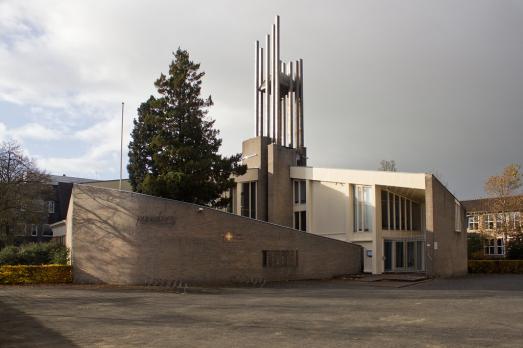
Protestantse Gemeente te Oss, Paaskerk

Protestantse Gemeente te Oss, Paaskerk

Oss, NL

On April 2, 1966, the church building was inaugurated as a new Reformed Church. The church replaced the older church in the centre of Oss, which was demolished after the move. Around 1978 the old church of the Reformed congregation on the Burgemeester Van den Elzenlaan in Oss had become too small and people started using the building of the Reformed congregation. A few years later, in 1980, a second church building was built behind the existing Reformed church building for the Reformed congregation. A few years later, only joint church services were held. In 1989 the Reformed Church and the Reformed Church federated. In addition, the church building was given the name Paaskerk and the annex has since been called Pentecost mound. In the years that followed, a new entrance and entrance hall were built that connected the two buildings. The non-oriented church building is a modern church in the style of post-war modernism. It has an eight-sided ground plan from which a quarter has been cut. In the centre is a tower of metal columns with a belfry. Inside, the building consists of two rooms next to the entrance, with the second room being used for smaller services.

Protestantse Kapel

Megchelen, NL

The Reformed Church , also known as the Protestant Chapel , is a Protestant church in the Dutch town of Megchelen. It was built in the 18th century.

Protestantse Kerk

Heesselt, NL

The single-nave neo-Gothic church built in 1887 with a three-sided choir closure under a saddle roof is built against the late 15th-century tower; the church and tower are strikingly situated near the Waaldijk. Built in brick and on a plinth, a four-bay long nave with buttresses cut between the windows and the sides of the choir with natural stone covering on the cutting and at the top; decorative brickwork molding under the gutter; wide lancet-shaped windows with tracery and in a frame of bright red brick and accents in natural stone; stained glass in a pointed diamond motif in green and white, along the edges of the windows strips in red and blue glass; on the roof covered with braised tiles three dormers covered with slates and provided with a piron; on the north side of the nave an extended entrance with double wooden door with fittings, set in a bright red brick frame; there also, the consistory room built against the tower under a hipped saddle roof with dormer; in the consistory room large windows with cross-bar division and slightly recessed round-arched fields above; the frame of the fields and the window styles in bright red stone; on the south side of the tower a mortuary house. In the interior a wooden barrel vault with tie rods and on cove, the ribs resting on consoles with decorative carvings; hexagonal pulpit and rear bulkhead with Gothic decorations from 1864, organ balcony on three simple wooden columns; wainscoting, gentlemen's pews and general pew plan made of wood; two late 19th-century psalm and hymn boards; two twelve-arm copper crowns from the construction period with tronies on the inside. At the entrance to the church two memorial stones from 1849 and 1887. Intact single-manual organ, made in 1857 by H. Knipscheer from Amsterdam. The neo-Gothic village church, built in 1887, is of cultural and architectural-historical value due to its location and the intactness of its interior and exterior, so that protection as a national monument is justified.

Protestantse Kerk

Sirjansland, NL

In 1956, a new Mennonite Church was built in Amsterdam-Slotermeer at Arthur van Schendelstraat 17. The building was designed by Karel Sijmons. In 1957, Willem van Leeuwen installed a new organ in this church with two keyboards and sixteen registers. In 1969, the church building was sold to the Reformed Church Slotervaart/Osdorp, who took over the building including the organ. It was then named De Olijftak. In 1993, the church was closed for worship. The organ was sold to the Reformed Church in Sirjansland in 1996. De Olijftak has been in use as a Moroccan mosque since 2000. The organ was moved to Sirjansland by the firm Pels & Van Leeuwen. The organ was put into use on 11 February 1996. The organ was not changed during the move. However, the front was decorated with several wooden ornaments.

Protestantse Kerk

Bergharen, NL

The Herv. CHURCH consists of the 15th century three-aisled, pseudo-basilica-shaped nave of the old village church, whose choir has been demolished. The building has pillars, cross-ribbed vaults and sculpture on capitals and corbels. The church has a simple pulpit, 17th century; a baptismal fence, 18th century and two covered benches, first half of the 19th century. Two tombstones, 17th century.

Protestantse Kerk

Ommelanderwijk, NL

At the end of August 2008, a start was made with the restoration of the 19th century reformed church. The church and tower were given a new roof, walls were repointed, etc. And especially the Roelf Meijer organ from 1874 was restored. This church is listed as a Municipal Monument of the Netherlands.

Protestantse Kerk

Oud Gastel, NL

Built as a Reformed Church. Now a church of the Protestant Community of Gastel and Kruisland. A classicist hall church in the so-called Waterstaat style. It dates from 1811 and is a gift from King Louis Napoleon. After a restoration in 1960, the church was restored again in 2000. In addition to the renovation of the exterior, which was carried out by contractor Van Agtmaal, the interior was tackled by the Gastelse former furniture maker Van der Zee, who refurbished the pews and made a new pulpit and cross. This church is listed as a National Monument of the Netherlands.

Protestantse Kerk

Noorddijk, NL

This historic church is owned by the Protestant Community of Damsterboord, on the second and fourth Sunday of the month there is a service at 10:00 am. This church is listed as a National Monument of the Netherlands.

Protestantse Kerk

Schore, NL

Reformed church with front tower and attached consistory, built in 1942 to replace its predecessor that was destroyed by war.

Be inspired

Stupkalnis.lt

10 Buddhist stupas to discover in Europe

Stupas are symbols of enlightenment and peace that commemorate different stages of Buddha's life. Since the mid-20th century, thousands of stupas have begun to populate Europe. We have compiled some of the most impressive ones in this list.