Reformed church
Polsbroek, NL
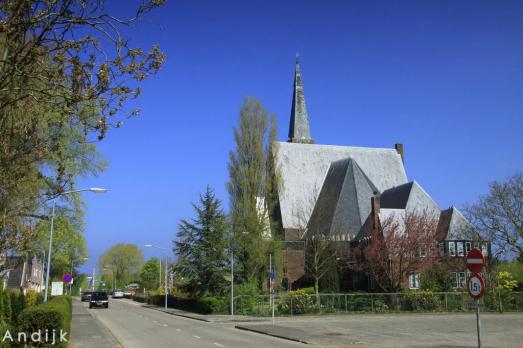
Reformed church. 19th century hall building with mansard roof. Inventory. Single manual organ. made in 1879 by HG Holtgrave.
Here you can search for a building to visit. You can use the map find destinations, or you can use the filters to search for a building based upon what different criteria.
Polsbroek, NL
Reformed church. 19th century hall building with mansard roof. Inventory. Single manual organ. made in 1879 by HG Holtgrave.
Lopikerkapel, NL
The church is a single-nave brick building (plastered) with a high choir. (XV). In 1832 the church was significantly restored with the help of the States of Utrecht and completely restored again in 1950. Internal pulpit 18th century, a copper lectern, a copper chandelier 17th century. The organ front is from 1915. On the west wall (wooden partition between church and consistory) are two inscriptions, namely the Ten Commandments and the Twelve Articles of Faith, painted in 1771 by P. Landzaat. On a balcony under the organ two texts between which a dial of the 19th century clock. In the consistory a memorial board circa 1621. Bell tower with clock by G. Schimmel, 1682, diam. 56.5 cm. Mechanical tower clock, B. Eijsbouts, circa 1927, electric winding.
Klundert, NL
Church with roof turret. On July 2, 1889, the foundation stone of this church was laid. The building suffered considerable damage in 1944. The flood disaster on February 1, 1953 caused considerable damage to the interior of this church. The water was approximately 2.50 meters high. Temporarily, church services were held in "De Gouden Leeuw". But in the first week of March 1953, the damage had been repaired to such an extent that the church itself could be used again. Complete renovation in 1955/1956.
Szombathely, HU
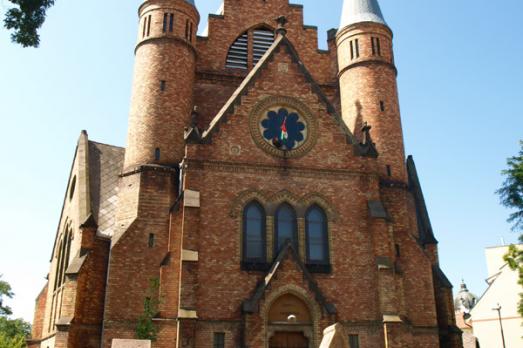
The Reformed Church was completed in 1939 and consecrated the same year by Bishop Vince Medgyasszay. The interior paintings of the church were made by Ilona Biczó and her husband. They contain biblical motifs, mixed with elements of Hungarian folk painting. The church survived the bombings of World War II unscathed, but underwent a major renovation in 1988. Its two-manual electric organ was built by Albert Péter.
Hoornaar, NL
Single-nave, 15th century village church with a five-sided closed choir, which was extensively modified in 1842, and a monumental tower, 1555 by Cornelis Frederiks van der Goude, consisting of three brick sections with natural stone bands and slender, Ionic pilasters on the corners (the capitals of the upper pilasters were not executed).
Landsmeer, NL
Dutch Reformed Church. Hall church from 1852 with built-in tower, provided with a wooden crowning. Carved pulpit with, among other things, a representation of Moses, Aaron and the evangelists, the whole above a pelican with young, mid 17th century. Two lecterns (17th century and 18th century) and a baptismal font holder (17th century) made of copper. Two wall plaques with the names of the ministers; 1766 and 1795. Bell tower with bell by A. Koster, 1639, diam. 113.7 cm. Mechanical tower clock by Eijsbouts, 1919.
IJzendoorn, NL
Historic village church with tower. The Reformed Church in IJzendoorn is one of the oldest buildings in the village. Construction began shortly after 1384 and the church has been renovated and restored several times over the centuries. The church has a single nave and a Gothic appearance. The nave and choir are covered with wooden barrel vaults. The tower is a late Gothic building, the sections of which are decorated with pointed arch niches. The church has a number of special elements, including a pulpit from the second quarter of the 17th century and a pew with a canopy and a carved alliance coat of arms from the 18th century.
Loenen aan de Vecht, NL
Beautiful reconstruction church with roof turret.
Rotterdam, NL
Built as a Reformed Church (Liberated) in the IJsselmonde district. Now in use (since when?) by Jehovah's Witnesses. Between 2014 and 2019, the Jehovah's Witnesses left this building. Today, the building is used as a mosque.
Kattendijke, NL
This church stands on a mound. The current church originally dates from the beginning of the 15th century, but a lot was demolished and added. For example, the tower was added in 1630, and the choir was demolished in 1768.
new
For a long time, Europe was ruled by powerful monarchies. Monarchy and religion have been connected since time immemorial. Here are 7 sites across Europe where royalty historically bent the knee to a higher power and received their crown.
Stupas are symbols of enlightenment and peace that commemorate different stages of Buddha's life. Since the mid-20th century, thousands of stupas have begun to populate Europe. We have compiled some of the most impressive ones in this list.
Walter Maria Förderer (1928–2006) was a Swiss architect and sculptor renowned for his neo-expressionist church designs in the 1960s. In this list we have compiled 6 of his church designs that seamlessly integrate religious and secular elements.