Christelijke Gereformeerde Kerk
Sint Jansklooster, NL
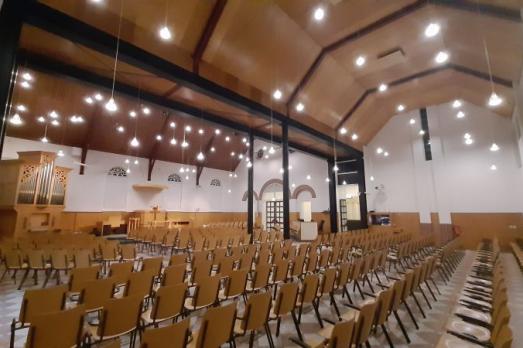
Hall church with roof turret.

Here you can search for a building to visit. You can use the map find destinations, or you can use the filters to search for a building based upon what different criteria.
Sint Jansklooster, NL
Hall church with roof turret.
Nieuwe Pekela, NL
Enlarged in 1912, damaged by fire in 2003. In the night of 20/21 June 2003 there was a fire in the CGK. A short circuit is probably the cause. Renovation of the church building was already underway. Unfortunately, they can now start all over again. A year later, on 18 June 2004, the rebuilt and renovated church building was put back into use in a festive service. Using old photographs, the interior has been restored to its original state of construction in 1911, whereby a later renovation has also been undone. A "Johannus organ" has been placed behind an organ front purchased in Urk. This church is listed as a Municipal Monument of the Netherlands.
Huizen, NL
Nice modern church without tower. Built to replace a church building on Kortenaerstraat that had become too small.
Broek op Langedijk, NL
Modern church built in 1963.
Nieuwkoop, NL
New church hall, with small roof turret, next to the former Chr. Geref. Church. The organ was built by Hendriksen & Reitsma in 1977. The organ was moved to the new church in 1986.
Nieuwpoort, NL
Interesting church building without a tower. The building was originally a cheese warehouse. Due to the silting up and silting up of the northeastern canal, it became difficult to reach the river to transport the cheese further by ship. The interior of the church with 270 seats has been regularly improved and adapted with much self-initiative, the adjacent plots are intended for a consistory and association building. The members come from Nieuwpoort, Langerak and Groot-Ammers as well.
Aalten, NL
The Christelijke Gereformeerde Kerk (Christian Reformed Church) in Aalten was commissioned in 1924 and extended in 1998. The church organ was built in 1977 by KB Blank & Zoon (Herwijnen), and extended with a free pedal in 1999 by Mense Ruiter Orgelbouw (Zuidwolde, Gn.).
Mijdrecht, NL
At the beginning of the twentieth century, several people in Mijdrecht left the Reformed Church. They then went home to read a sermon on Sunday. Around 1920, weekly services were also held. In 1927, they joined the church association of the Reformed Congregations. Under the responsibility of the Reformed Congregation in Utrecht, services were then held on Sunday. In the same year, a small church building was built on the premises of the G. Den Hertog company at Bosenhoven 47. At the beginning of 1928, this church building was put into use by Rev. GH Kersten. On November 25, the congregation was instituted as an independent congregation within the church association of the Reformed Congregations. After Rev. R. Kok was suspended in 1950 (minister within the church association in Veenendaal), the congregation split in two. The part that continues to use the church building joins the church association of the Christian Reformed Churches and is officially included in the association of the Christian Reformed Churches by the Classis Utrecht on January 19, 1954, following a decision of the ll class meeting. The members who wish to remain with the Reformed Church only start using their own church building in 1966 , after having met at various locations for years.
Genemuiden, NL
The church was founded in 1981, after a small number of people were excluded from the Reformed Church of Genemuiden due to a conflict. In 1985, the church building on Stuivenbergstraat was put into use. In 2011, the church building was expanded.
Feanwâlden, NL
Initially in Hotel Schoonoord.

new
For a long time, Europe was ruled by powerful monarchies. Monarchy and religion have been connected since time immemorial. Here are 7 sites across Europe where royalty historically bent the knee to a higher power and received their crown.

Stupas are symbols of enlightenment and peace that commemorate different stages of Buddha's life. Since the mid-20th century, thousands of stupas have begun to populate Europe. We have compiled some of the most impressive ones in this list.

Walter Maria Förderer (1928–2006) was a Swiss architect and sculptor renowned for his neo-expressionist church designs in the 1960s. In this list we have compiled 6 of his church designs that seamlessly integrate religious and secular elements.

How is Religiana helping to conserve and promote Religious Heritage in Europe and why should you get involved?
Find out about Religiana
Are you a tourism organisation or religious heritage sites manager? Discover the advantages of becoming a partner.
See current partners
We can keep you up to date with the latest news from Religiana and religious heritage conservation across Europe.
Sign up to the FRH newsletter