Doopsgezinde Kerk
Balk, NL
Three-sided closed hall church with round arch windows, built in 1862. Single-manual organ by Bakker & Timmenga (Leeuwarden) from 1908.

Here you can search for a building to visit. You can use the map find destinations, or you can use the filters to search for a building based upon what different criteria.
Balk, NL
Three-sided closed hall church with round arch windows, built in 1862. Single-manual organ by Bakker & Timmenga (Leeuwarden) from 1908.
De Westereen, NL
In Kollumerzwaag a Mennonite community was founded between 1600 and 1620. At the beginning of the 19th century this community declined and was threatened with dissolution. Around 1816 the Vermaning was demolished and rebuilt in 1816 in Zwaagwesteinde. There was not a single church there at the time. After the death of Rev. Bosma the community ceased to exist in 1844. The Vermaning was sold and converted into a smithy. Later it became two workers' houses and in 1934 family doctor Noordhof bought the old Vermaning, had it demolished and built his doctor's house on the foundation.
Grou, NL
Frontage of the Mennonite Church. Above the gate passage, next to which two six-pane windows, floor with three such windows. Facade closed off by block moulding. Hidden church in a three-sided closed hall building covered by a barrel vault from 1829. Simple pulpit. Originally a single-manual organ made in 1872 by the Gebr. Adema from Leeuwarden. Modified in 1920 by Bakker and Timmenga.
Bussum, NL
Church building without a tower.
Almelo, NL
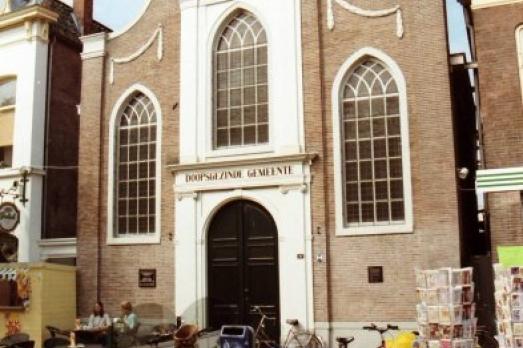
The Doopsgezinde Kerk (Mennonite Church) in Almelo was built in 1684. In 1732, the church was expanded and the current facade was added. The building was restored in 1978. It is listed as a National Monument of the Netherlands.
Hoofddorp, NL
Hall church in neo-Romanesque style without tower. Out of use as a church building NPB 1948. Then in use as a church of the Mennonite Community. The roof turret, present on the old black and white image, disappeared decades ago.
Harlingen, NL
In 1996, the beautiful church from 1853 was demolished because it had become too expensive to maintain. The adjacent buildings, which were also owned by the Mennonite Community, were then restored and converted into a new church.
Alkmaar, NL
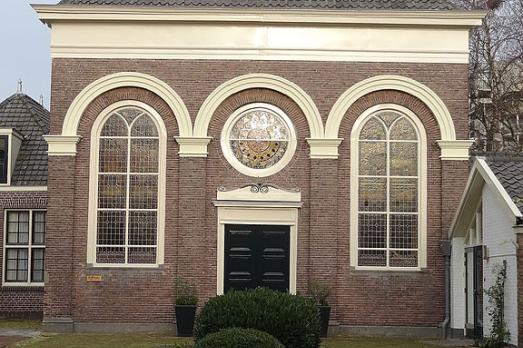
The Doopsgezinde Kerk (Mennonite Church) was initially built as a clandestine church in 1617. In 1856, the buildings on the Koningsweg that hid the church from view were demolished and the church came into view. In 1854, the church received its current facade with round-arched windows. This facade was designed by CW Bruinvis, city archivist of Alkmaar. It is listed as a National Monument of the Netherlands.
Baarn, NL
Simple hall church without tower. Inaugurated on 19 February 1928.
Beverwijk, NL
Hall church in neo-Romanesque forms, with a roof turret on the front facade. Since 2010 (after the Mennonite Meeting House in IJmuiden was decommissioned), this has been the Mennonite Church for "De IJmond". In 2012, extensive attention was paid to the centenary of this church building. Among other things, with an exhibition about the Danish artist Thorvaldsen.

new
For a long time, Europe was ruled by powerful monarchies. Monarchy and religion have been connected since time immemorial. Here are 7 sites across Europe where royalty historically bent the knee to a higher power and received their crown.

Stupas are symbols of enlightenment and peace that commemorate different stages of Buddha's life. Since the mid-20th century, thousands of stupas have begun to populate Europe. We have compiled some of the most impressive ones in this list.

Walter Maria Förderer (1928–2006) was a Swiss architect and sculptor renowned for his neo-expressionist church designs in the 1960s. In this list we have compiled 6 of his church designs that seamlessly integrate religious and secular elements.

How is Religiana helping to conserve and promote Religious Heritage in Europe and why should you get involved?
Find out about Religiana
Are you a tourism organisation or religious heritage sites manager? Discover the advantages of becoming a partner.
See current partners
We can keep you up to date with the latest news from Religiana and religious heritage conservation across Europe.
Sign up to the FRH newsletter