
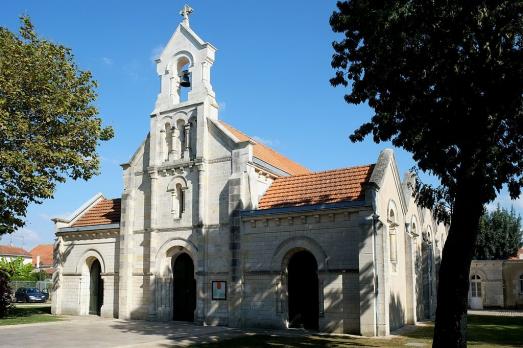
Église Sainte-Aldegonde, Malzy
Malzy, FR
Église Sainte-Aldegonde is located in Malzy, a commune with 200 inhabitants about 8 km east of the town of Guise in the Département Aisne in the région Hauts-de-France.
Here you can search for a building to visit. You can use the map find destinations, or you can use the filters to search for a building based upon what different criteria.
Malzy, FR
Église Sainte-Aldegonde is located in Malzy, a commune with 200 inhabitants about 8 km east of the town of Guise in the Département Aisne in the région Hauts-de-France.
Airion, FR
Built of dressed stone, it is a small building that has been extensively altered and renovated over the centuries: the bell tower, the choir and the underside of the bell tower, vaulted in the 16th century, bear witness to this.
Châtel-Guyon, FR
The church of Sainte-Anne was built in 1845 on a hill called "le Calvaire". It includes 800 m2 of astonishing frescoes created in 1956 by Nicolaï Greschny, an Estonian painter.
Paris, FR
Sainte-Anne de la Butte-aux-Cailles was built between 1894 and 1912 on the former Bréa chapel, built in memory of General Jean Baptiste Fidèle Bréa, who died during the days of June 1848. The church, in Romanesque-Byzantine style, was designed by the architect Prosper Bobin and built on the bank of the Bièvre.
Lerzy, FR
The Church of Sainte-Benoîte (Église Sainte-Benoîte) is located in Lerzy, a small village with 223 inhabitants about 4 km south-west of La Capelle in the Département Aisne in the région Hauts-de-France. This fortified church was built in the late twelfth century. The bell tower remains from this time and is listed as a historical monument. The building, in its current form, dates from the 16th and 17th centuries. On March 11, 2014, a fire destroyed the roof and caused extensive interior damage. Note the classified burial slab of Louis de Fournier, the Lord of Lerzy, who died in 1756.
Honfleur, FR
The first church, destroyed following the English invasion of 1419, stood on the site of the present 15th century church. A nave was added in the 16th century. In the 19th century the church underwent further modifications under the direction of Viollet-le-Duc.
Lille, FR
The church of Sainte-Catherine is linked to the history of Notre-Dame-de-la-Treille, patron saint of the city of Lille. The statue had been saved from the destruction of the collegiate church of Saint-Pierre, and was sheltered for a time in the church of Sainte-Catherine. The building, in its present state, was rebuilt in the 15th and early 16th centuries, and then remodelled in the late 17th and early 18th centuries.
Monceau-sur-Oise, FR
Église Sainte-Catherine is located in Monceau-sur-Oise, a small village with 127 inhabitants about 6 km east of Guise in the Département Aisne in the région Hauts-de-France.
Ixelles, BE
The Church of St. Croix is a Catholic church built in the mid-nineteenth century. The church displays an outdoor Art Deco style and a neo-Gothic interior. This building replaced the former little Sainte-Croix church, a traditional place of worship for charcoal workers.
Calais, FR
In 1923, the first stones and bricks are laid but the construction site is delayed. Finally, the work was spread out over about a decade, in particular because the ground was too muddy.
new
For a long time, Europe was ruled by powerful monarchies. Monarchy and religion have been connected since time immemorial. Here are 7 sites across Europe where royalty historically bent the knee to a higher power and received their crown.
Stupas are symbols of enlightenment and peace that commemorate different stages of Buddha's life. Since the mid-20th century, thousands of stupas have begun to populate Europe. We have compiled some of the most impressive ones in this list.
Walter Maria Förderer (1928–2006) was a Swiss architect and sculptor renowned for his neo-expressionist church designs in the 1960s. In this list we have compiled 6 of his church designs that seamlessly integrate religious and secular elements.