Golders Green Synagogue
London, GB
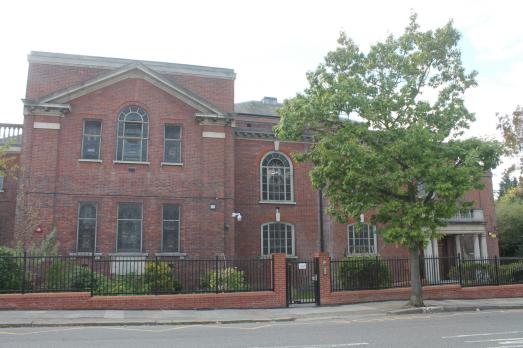
The Golders Green Synagogue in London was built in 1921-1922 by architects Digby Lewis Solomon and Joseph Messers. This brick building in the Neo-Georgean style still serves as a synagogue.
Here you can search for a building to visit. You can use the map find destinations, or you can use the filters to search for a building based upon what different criteria.
London, GB
The Golders Green Synagogue in London was built in 1921-1922 by architects Digby Lewis Solomon and Joseph Messers. This brick building in the Neo-Georgean style still serves as a synagogue.
, MK
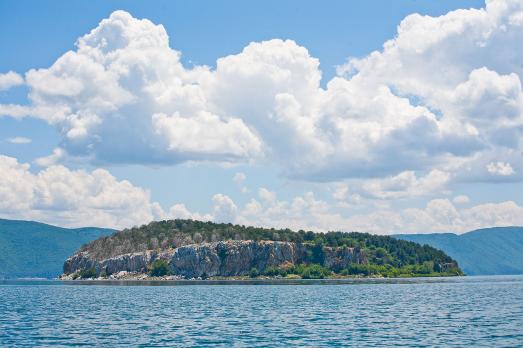
On this relatively small island of Lake Megali Prespa stretching into northern Macedonia, Albania and Greece, a large number of historical and cultural monuments are concentrated. The Golem Grad island has been inhabited continuously for 2000 years and the monastic life was thriving there from the 10th century until the 14th century. Thus, there are no less than seven remains of churches. Among them, the Church of St Peter of Golem Grad, the only fully preserved church. Built around 1360, its reconstruction was last carried out in 1934. The church has many frescoes to admire inside.
Musulini, HR
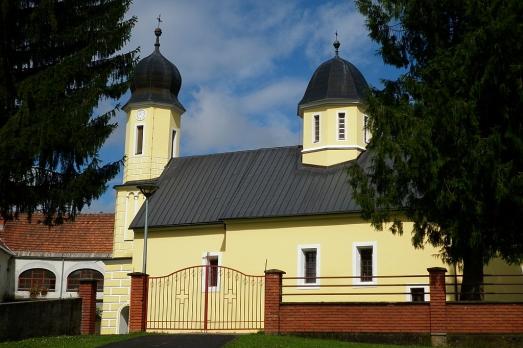
Gomirje Monastery is an Orthodox Monastery founded by Serbian monks. It was probably erected in 1600 around a primitive wooden church. The current church of Roždenije was in 1719 and is dedicated to St John the Baptist.
Kolymvari, GR
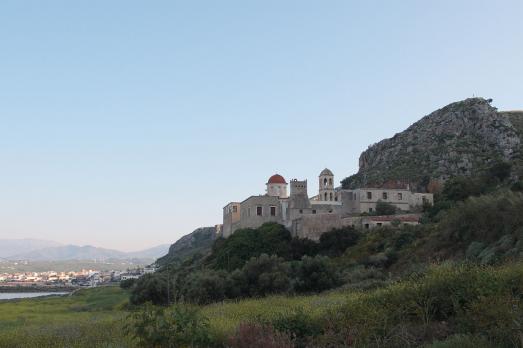
The monastery of Lady Gania was founded in the 9th century but the current building dates from the 17th century. Since then, the monastery was destroyed twice by the Turks (1652 and 1867) and used as a prison by the Germans during the Second World War.
Groningen, NL
Established as a Reformed church in Groningen-Noord. In use in 1956. Rectangular hall church with low, partly openwork tower. Characteristic work in the late oeuvre of the important architect Egbert Reitsma (1892-1976), also an important example of church building from the reconstruction period in Groningen. On the corner, above the main entrance, there is a sculpture depicting The Good Shepherd. Such works of art are often found in Reitsma's post-war churches (compare for example the Stadsparkkerk in Groningen). Also temporarily in use as a Roman Catholic Church (for the neighbouring parish of H. Hart, which sold its own church) until 1997.
Fochabers, GB
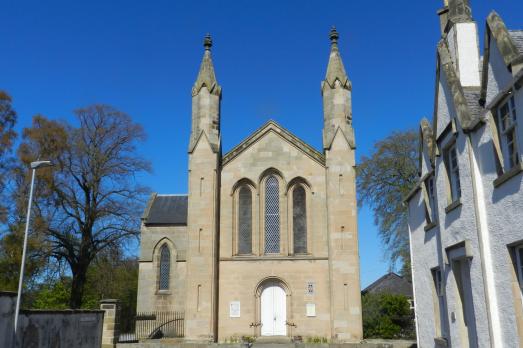
Gordon Chapel was built in 1834 to a design by Archibald Simpson, funded by George, 5th Duke of Gordon, and Duchess Elizabeth to serve as a place of worship for the Episcopalians of Fochabers who had been meeting in a thatched cottage for some 50 years.
Haren, NL
Large church with tower. Interior renovated and modernized in 1991. Also new spire.
Worthing, GB
4th August 1940 was the day that Goring Congregational Church was born [or inaugurated] after member of Shelley Road Congregation Church in the centre of Worthing saw a need for church of that denomination in Goring.
Görlitz, DE
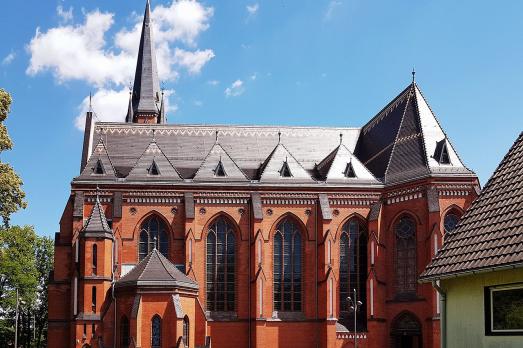
The present cathedral of St. James in Görlitz was built between 1898 and 1900 according to plans by the architect Joseph Ebers and consecrated on 6 October 1900. In March 1947, the then German chapter vicar Ferdinand Piontek had to leave the episcopal city of Wroclaw as a result of the Second World War. Görlitz thus became the seat in exile of the Wroclaw Metropolitan Chapter and the Wroclaw Ordinariate, and the parish church of St. James additionally became the episcopal church for the diocesan area of Görlitz-Cottbus.
Gornji Grad, SI
The Benedictine monastery in Gornji Grad was founded in 1140 and was dissolved in 1473 (after 333 years). Due to the moral decline of the monastery and the reduction in the number of monks due to the Turkish invasions - the Turks devastated Gornji Grad in 1471 - the Pope formally dissolved the monastery in 1473 at the suggestion of Bishop Lamberg. The old church of the monastery was demolished in 1752-1760, making way for the church of Sv. Mohor and Fortunato, which is beautifully preserved to this day.
new
For a long time, Europe was ruled by powerful monarchies. Monarchy and religion have been connected since time immemorial. Here are 7 sites across Europe where royalty historically bent the knee to a higher power and received their crown.
Stupas are symbols of enlightenment and peace that commemorate different stages of Buddha's life. Since the mid-20th century, thousands of stupas have begun to populate Europe. We have compiled some of the most impressive ones in this list.
Walter Maria Förderer (1928–2006) was a Swiss architect and sculptor renowned for his neo-expressionist church designs in the 1960s. In this list we have compiled 6 of his church designs that seamlessly integrate religious and secular elements.