Explore Religious Heritage Across Europe

Here you can search for a building to visit. You can use the map find destinations, or you can use the filters to search for a building based upon what different criteria.

Refine search

Grote Kerk

Groede, NL

NH Church. Three-aisled hall church with a three-sided closed choir, a north choir and a tower with an octagonal superstructure and a spire. The oldest parts of the church date back to the 13th century; the tower with perpendicular buttresses dates from the 14th century. The nave and the north aisle were built in the second half of the 15th century. The south aisle served as a Walloon Church from 1618 to 1808 and was separated from the rest of the church around 1685. During a major renovation in 1868, the church was completely plastered on the outside and the windows were given new traceries. After a lightning strike, the tower was restored and deplastered in 1950. The interior is covered by a flat stucco ceiling from 1868. An important part of the interior is the pulpit with surrounding baptismal garden in Louis XVI style: donated in 1794 by descendants of Jacob Cats. The single manual organ was built in 1903 by JF Kruse (Leeuwarden).

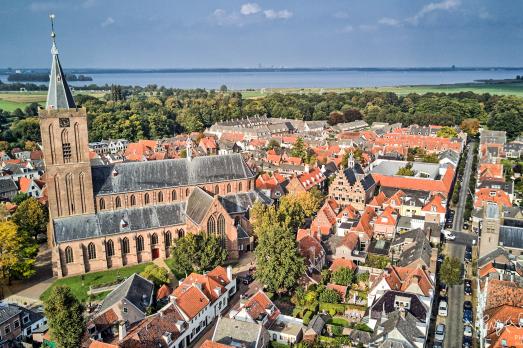
Naarden Church

Naarden Church

Naarden, NL

The first church was built from 1380-1440. In 1468 it largely burned down.

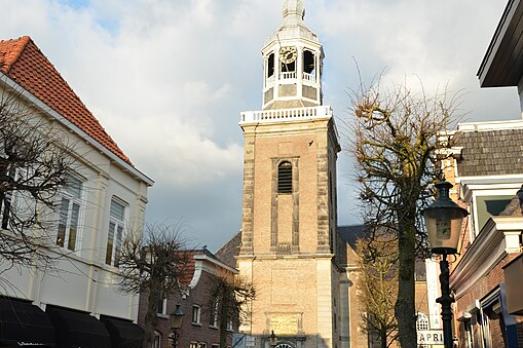
Grote of Catharinakerk

Doetinchem, NL

The church was built around 1200 and was dedicated to Saint Catherine of Alexandria. At the end of the Middle Ages, Doetinchem was regularly hit by fires. The largest fire on 19 April 1527 was caused by a baker who wanted to dry flax in the oven. Almost the entire city centre, including Saint Catherine's Church, was lost. The current hall church was built during the reconstruction. In March 1945, the centre was hit by a bombardment. The church was seriously damaged. In 1948, the church was restored, still without a tower, and in 1963 the reconstruction of the tower was completed.

Grote of Jacobijnerkerk

Leeuwarden, NL

Great or Jacobin Church. Former Dominican monastery church, founded in the 13th century, rebuilt in the 15th century. In the church pulpit with sounding board and rear bulkhead, 17th century. Kraak with carved parts, 1695 benches with carving, 17th century; tomb for JH Nieuwoldt, ca 1812 by PJ Gabriël. In the choir burial vault of the House of Orange; memorial plaque to the Peace of Münster 1648 from Landschapshuis. Tombstones. In the church three organs: A. Organ with main work, back work, upper work and free pedal, made in 1727 by Chr. Müller and extensively renovated in 1885 by L. van Dam and Sons. During the last restoration of 1978, Müller's disposition was restored and Van Dam's mechanical design and wind chests were maintained. B. In the choir a single manual organ by Vermeulen from 1977 with older components by Theodoor Smet from around 1850. C. In the southern chapel a positive by Joh. Meister from 1766.

Grote of Ludgeruskerk

Loenen aan de Vecht, NL

Dutch Reformed Church. Three-aisled late Gothic pseudo-basilica cruciform church, possibly retaining some of the masonry from the previous 13th century church. The low, five-sided closed choir and the sacristy are both covered with tuff and date from the middle of the 15th century. The choir, now used as a consistory, has stone vaults with carved corbels and keystones. The transept dates from the first quarter of the 16th century. The tower and the current nave were built after that.

Grote of Maria Magdalenakerk

Goes, NL

Great or Maria Magdalenakerk. Late Gothic cruciform basilica, of which the three-aisled choir dates from the third quarter of the 15th century, and the transepts were completed in the early 16th century. The nave was replaced by the current one after a fire in 1619-'21 (the architect was Marcus Antonius from Antwerp). Sacristy from around 1520.

Grote of Martinikerk

Doesburg, NL

Church building of the Protestant Community of Doesburg. Impressive late Gothic basilica with pillars in the Lower Rhine style. Built around 1490 - 1530. The 95-metre-high tower (one of the 10 highest in the Netherlands, and the highest in Gelderland) was blown up by the occupying forces on 15 April 1945, which also severely damaged the church. After decades of restoration work, the tower and church were put back into use in 1965 and 1972. The carillon - with Hemony bells, among others - originally dates from 1655, the large bell from 1649. Extremely important large organ. Church of the Protestant Community of Angerlo / Doesburg.

Grote of Martinuskerk

Dokkum, NL

Historic city church with tower. The name of the church refers to Martin of Tours, the saint who became famous because he gave half of his cloak to a beggar. The Sint Martinuskerk is originally a longhouse-hall church with sober Gothic windows, and is not the first church to stand on this site. At least three wooden churches preceded the current church made of tuff stone.

Grote of Onze Lieve Vrouwekerk

Dordrecht, NL

Large, exceptionally monumental historical city church with unfinished tower. Together with the Grote of Sint Janskerk in Gouda, the Grote of Sint Bavokerk in Haarlem and the Pieterskerk in Leiden, this is one of the four largest historical churches in the provinces of North and South Holland together. In the Sint Joriskapel in the Grote Kerk, three new stained glass windows were unveiled on 19 May 2006. They were designed by the artist Teun Hocks and made in the studio of Hagemeijer in Tilburg. In September 2006, a baroque organ was put into use in the Mariakoor of the Grote Kerk. It was built by the Verschueren company in Heythuysen.

Grote of Onze Lieve Vrouwekerk

Harderwijk, NL

The Grote Kerk in Harderwijk is a Gothic cruciform basilica dating partly from the 14th and 15th centuries. The originally much larger church was initially called the Onze-Lieve-Vrouwekerk and was dedicated to Mary. Since the Reformation in 1578, when the Catholic religion was banned and suppressed, the church has been used for Protestant services. After the parish church of St. Nicholas burned down in 1415, it was decided to enlarge a Mary chapel and use it as a church. The 14th-century building was given a new choir with ambulatory, a transept and a tower that exceeded that of the St. Eusebius Church in Arnhem in height and was thus the highest in Gelderland. A large part of the church was lost when the tower collapsed in 1797 and destroyed part of the nave.

Be inspired

Stupkalnis.lt

10 Buddhist stupas to discover in Europe

Stupas are symbols of enlightenment and peace that commemorate different stages of Buddha's life. Since the mid-20th century, thousands of stupas have begun to populate Europe. We have compiled some of the most impressive ones in this list.