
Explore Religious Heritage Across Europe

Here you can search for a building to visit. You can use the map find destinations, or you can use the filters to search for a building based upon what different criteria.

Refine search

H.H. Petrus en Paulus

Bergen (NH), NL

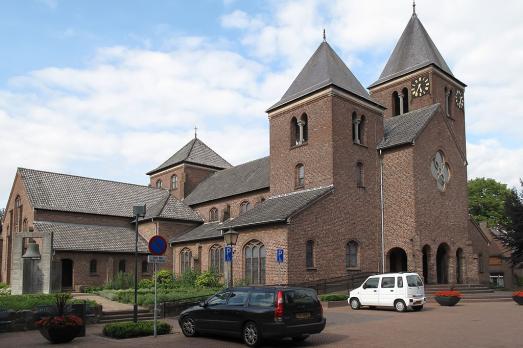
The Roman Catholic HH Petrus en Pauluskerk from 1924 replaced a church by architect Th. Asseler from 1867 that had become too small. It is a large church without a tower, in late neo-Gothic forms, designed by the Bergen architect Jan Leijen (1876-1958). At the crossing there is a small roof turret; semi-circular apse on the south side (the church is not oriented). To the right of the front facade is the parsonage, which is a remnant of the previous church from 1867. The spacious cruciform basilica was designed according to the guidelines of the Liturgical Movement from the early 20th century, in which all believers find a place in the wide central nave. The interior, executed as fair-faced masonry, is covered by rib vaults. Architecturally, there is a slight relationship, both externally and internally, with the church buildings of Joseph Cuypers from the 1920s. The seven stained-glass choir windows date from the construction period and represent the Seven Sacraments. They were made by Lou Asperslagh (1893-1949) from The Hague. The Stations of the Cross (1944) and a mural "The Miracle of Bergen" (1949) were made by the Bergen artist Jaap Min (1914-1987). The original main altar from the Haarlem studio Maas (ca. 1910) was initially in the previous church and was replaced in 1974 by a forward-placed altar table by the aforementioned Jaap Min. The organ by the Pels company (Alkmaar) dates from 1932.
H.H. Petrus en Paulus

Leidschendam, NL

Roman Catholic parish church of St. Peter and Paul, built around 1880 to a design by Evert Margry (1841 - 1891) (pupil of Pierre Cuypers (1827 - 1921)), in collaboration with (presumably) his brother AAJ Margry and JM Snickers, to replace a predecessor that had become too small. Three-aisled cruciform basilica in the characteristic and recurring style of the Margrys, inspired by early French Gothic, but in this case entirely in neo-Romanesque, round-arched shapes. Asymmetrical front with tower on the right corner, on the waterfront (see images below), simple staircase tower on the other corner. Internally covered by wooden barrel vaults (main naves). Stone cross vaults over the side aisles. The design shows many similarities with that of the H. Hartkerk in Rotterdam from the same period, also designed by Evert Margry (1841 - 1891), also neo-Romanesque, which was destroyed in the bombing of 1940 (the most important neo-Romanesque church by Evert Margry (1841 - 1891), however, was the St. Monicakerk in Utrecht, which was demolished in 1977).

H.H. Petrus en Paulus

Middelburg, NL

The church building has a somewhat dark interior, but that effect is partly taken away by the painting in the choir wall (apsis). What is special is that various liturgical objects in the interior were made of molten copper from the church on the Noordstraat that was destroyed in 1940. Worth seeing is the chapel with the painting of Our Lady of the Polder. This has to do with the veneration of Our Lady in Vrouwenpolder. The painting is said to have been created in a miraculous way. Around 1340, a resident of Vrouwenpolder wanted a painting of Mary to be hung in the church of his village. The painter who was given the assignment failed. Then an unknown man came along who painted the desired canvas and then disappeared without a trace. People saw the hand of God in this.

H.H. Petrus en Paulus

Maassluis, NL

This church building replaced the Andreaskerk and the Petrus & Pauluskerk . The first pile for the new parish church of the HH Andreas, Petrus and Paulus was driven on 21 September 2004. The church replaced two other Roman Catholic church buildings in Maassluis.

H.H. Petrus en Paulus / Paradijskerk

Rotterdam, NL

Old Catholic Church of Sts. Peter and Paul. Church in neo-baroque style by PA Weeldenburg, 1908. Altar, communion bench, pulpit, baptismal font 18th century, as well as rich silverware, all from the clandestine church built in 1718 on the Delftsevaart.

H.H. Petrus en Pauluskerk

H.H. Petrus en Pauluskerk

Arcen, NL

Important reconstruction church, which replaced the predecessor destroyed in 1944. The current church from 1959 was designed by Hendrik W. Valk, in collaboration with FH Stoks. One of the last works from Valk's oeuvre, in traditionalist forms, on a so-called Christocentric floor plan. Asymmetrical front with two towers of different heights.

H.H. Philippus en Jacobus

Koewacht, NL

This (interesting) church has always been on Belgian territory. The Dutch in the Zeelandic Flemish Koewacht initially went to church in the Belgian Koewacht, from 1687 in a chapel, later in a new church that was consecrated in 1714. After the border was closed during the First World War, a Roman Catholic emergency church was built on the Dutch side of the border. This was replaced in 1922 by the definitive church of the HH Philippus en Jacobus, the church that is still in use today.

H.H. Simon en Judas

Ootmarsum, NL

Pseudo-basilica in pure Westphalian Romano-Gothic from the middle of the 13th century. Choir closure and chapels in the corners of the choir and transept from 1491. The entire building is built of Bentheimer stone. The oldest part is the nave, of which the central nave has two and each of the side aisles four bays. Transept slightly later. Vaults of nave and transept are dome-shaped and provided with decorative ribs. Rectangular choir bay also still 13th century. The heavy sandstone tower on the west side was demolished in 1842 and replaced by a wooden tower on the roof. Important inventory. Organ with main work, subpositive and pedal, made in 1814 by FF Epmann. This organ builder from Essen used older pipework. Mechanical tower clock, Korfhage & Söhne, Buer, 1942. Restored in 1997 and fitted with synchronisation. This church is listed as a National Monument of the Netherlands.

H.H. Simon en Judas

Lattrop, NL

Protestant families in Lattrop and Breklenkamp were prepared to sign a petition from G. Rikkink and J. Groeneveld in 1816 to help the parishioners in Lattrop and Breklenkamp to their own church. In addition to the reasons already given by Bentinck about the distance to Ootmarsum and the large amount of water in the Dinkel in the winter, the unsuitability of the current location is now discussed in detail: “In the aforementioned farmhouse, which according to local custom contains the home of the householders and the stable for the cattle without a partition or dividing wall, and therefore directly with and in the presence of horses and cows to attend the Holy Mass and sermon”. According to tradition, three locations are eligible for these special clandestine churches: 1. A barn on the Bodde farm on the Bergvennenweg. 2. The barn on the former Pikkemaat farm on the Frensdorferweg. 3. On the Scholte Lubberink estate on Dorpsstraat. Coach house with wall of former peat storage at church in Lattrop

H.H. Simon en Judas

Reutum, NL

Reconstruction church with tower. On the site of the previous church.

Be inspired

Stupkalnis.lt

10 Buddhist stupas to discover in Europe

Stupas are symbols of enlightenment and peace that commemorate different stages of Buddha's life. Since the mid-20th century, thousands of stupas have begun to populate Europe. We have compiled some of the most impressive ones in this list.