
Explore Religious Heritage Across Europe

Here you can search for a building to visit. You can use the map find destinations, or you can use the filters to search for a building based upon what different criteria.

Refine search

Heilige Antonius van Padua

Lepelstraat, NL

The neo-Romanesque St. Antonius Church, as we know it today, was built in 1873-1875 as a replacement for the former barn church. The church was consecrated on 12 September 1875. At the end of the Second World War, the 63 m tower was blown up by the Germans, a large part of the church was destroyed. The church was then rebuilt in 1948 in neo-Romanesque style, without a tower. In the church there is a model of the church in all its glory, with the tower as it was the landmark of Lepelstraat until October 1944.

Heilige Antonius van Padua

Hellevoetsluis, NL

Beautiful small neo-Gothic church with a smaller, than originally designed, tower. Built to replace an earlier Roman Catholic church from 1835, which was demolished in 1891. In terms of the village image on site, an extremely interesting, and unique, ensemble of this church (tower) with the nearby situated, higher, certainly also interesting and beautiful, water tower (ao. 1896; architect N. Biezeveld). In the center of Barendrecht there is a similar ensemble: Historic Village Church with tower near the higher water tower.

Heilige Antonius van Padua

Oud-Beijerland, NL

This Roman Catholic Church is dedicated to Saint Anthony of Padua. The church building is a tall building with a short tower and a three-sided choir closure. The building was put into use in 1866. In the chancel there are two stained glass windows: one depicts Saint Anthony, the other Andreas Woutersz. van Heinenoord, one of the 19 Martyrs of Gorcum. In 2016, attention was paid to the 150th anniversary of this church. In the context of this anniversary, the stained glass windows were restored. The necessary money for this was donated in the course of 2016. This church is listed as a Municipal Monument of the Netherlands.
Heilige Antonius van Padua

Haarlem, NL

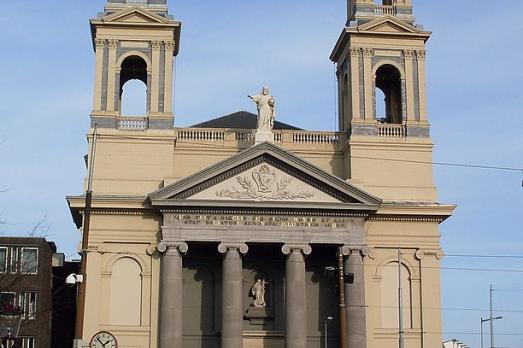
Roman Catholic Church St. Anthony of Padua, 1843 by TF Suys, high neoclassical pilaster facade. Two-manual electro-pneumatic organ made in 1913 by the Adema company, modified in 1952 and in 1989. In the last modification, the console was placed in the middle of the organ.

Heilige Antonius van Padua

Dordrecht, NL

Neo-Gothic church with roofer. Built as the second R.K. Church in Dordrecht, after the neoclassical St. Boniface church in the inner city. After dereception, in 1974, of the St. Boniface church received the church in question, and parish, called "H.H. Antony and Boniface." Almost like central construction (for various austerity of the original, larger design) founded neo-Gothic church. A designed tower is never built; at the intersection a small celebration tower. Over the 1920s and 1930s, the interior has been gradually further decorated with many interesting details. Damaged in war acts on 12 May 1940. After that, this church was restored with a lower roof than the original, but again with a roof window; the interesting space of the interior, with brick vaults, has remained intact. Architecturally, this church is, especially in terms of interior layout, somewhat similar to the (although much larger and higher, more monumental) former R.K. The Church of H.H. Engelbe OC op de la dors on the Brandtstraat in The Hague, also demolished in 1981, also by architect Nicolaas Molenaar (1850-1930).

Heilige Antonius van Padua

Blerick, NL

Iconic modern church with high tower, height approx. 60 m. Built to replace the neo-Gothic predecessor destroyed in the Second World War . Hall church with free-standing openwork concrete bell tower. Important (still existing) work from the oeuvre of JJ Fanchamps (1912-1982). Modern glazing by W. Peeters from the year 2000. Stations of the Cross from the former church of Our Lady of the Carmel Mountain in Schaesberg-Leenhof.

Heilige Antonius van Padua

Breedeweg, NL

Replaces the church from 1935 that was destroyed during the war. Like the pre-war church, the current church is built in traditionalist forms, influenced by Romanesque and early Christian architecture. Tower from 1954.

Heilige Antonius van Padua / Cenakelkerk

Heilig Landstichting, NL

Extremely important, unique, fantastic church with dome and double tower front. Church building, dedicated to St. Anthony of Padua, built in the 1910s in close connection with buildings and grounds of the Biblical Open Air Museum, now Museum Orientalis, on the Holy Land Foundation. The church is considered one of the main works from the oeuvre of architect Jan Stuyt (1868-1934).

Heilige Antonius van Padua / Mozes en Aäron

Heilige Antonius van Padua / Mozes en Aäron

Amsterdam, NL

The church originated from a clandestine church . This was served by Franciscan fathers and was located from 1641 at the back of the current church in the house "Moyses" on the Jodenbreestraat , where a statue of Moses hung on the facade. In 1682, the adjacent house "Aäron" ( Aäron ) was also purchased by Dr. Johannes de Vroom, a physician from Breda.

Heilige Augustinus

Geleen, NL

The parish of St. Augustine was founded in 1862 to provide the village centres of Lutterade and Krawinkel with church life. The parish church was built exactly in the middle between the two residential areas, surrounded by the cemetery. However, the church had to make way for the advancing industry of the mines. Only the cemetery remains, which is still located on the Groenseijkerstraat to this day. In 1935, the new parish church was completed on the Prins de Lignestraat. The national monument is popularly known as the 'two-tower church'. The parish of St. Augustine has been working together with other parishes in Geleen for quite some time. Around 2000, part of the former parish of the H.Hart (Paterskerk) was transferred to the Augustinus. In the years that followed, various partnerships were set up. As a result, an intensive exchange has already grown in the pastoral fields. As a true central church, the Augustinus unites many social lines and has become a church building that has something to offer to many believers due to its size and possibilities. The church is also open every afternoon between 14:00 and 16:00.

Be inspired

Stupkalnis.lt

10 Buddhist stupas to discover in Europe

Stupas are symbols of enlightenment and peace that commemorate different stages of Buddha's life. Since the mid-20th century, thousands of stupas have begun to populate Europe. We have compiled some of the most impressive ones in this list.